Heavy metal phase-outs and regulatory mandates accelerate adoption of advanced non-tin stabilizer chemistries across PVC processing applications.
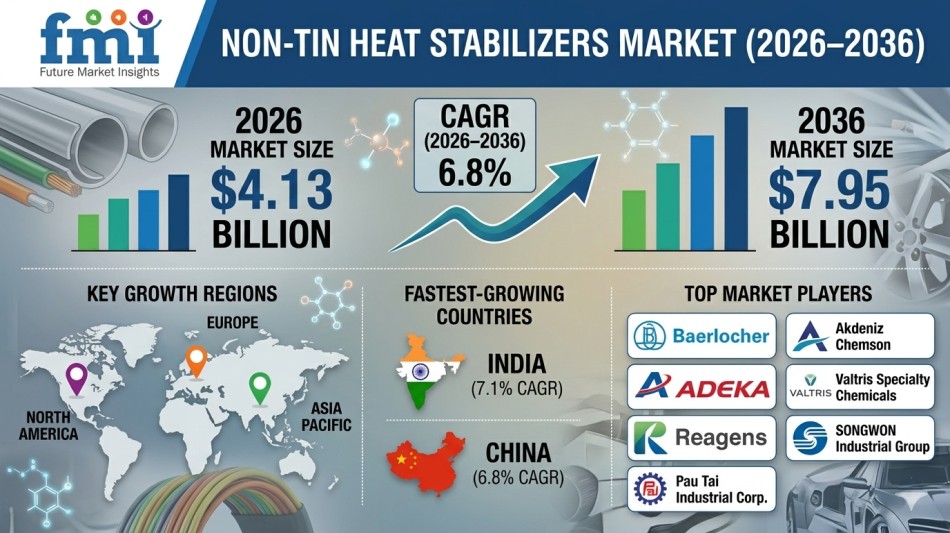
NEWARK, DE / ACCESS Newswire / March 17, 2026 / The global Non-Tin Heat Stabilizers Market is poised for steady growth over the next decade, expanding from USD 4.13 billion in 2026 to USD 7.95 billion by 2036, registering a CAGR of 6.8%. According to the latest analysis by Future Market Insights (FMI), demand is being driven by the irreversible phase-out of heavy metal-based stabilizers in polyvinyl chloride (PVC) processing, alongside increasing regulatory pressure and sustainability mandates across construction, infrastructure, and packaging sectors.
Non-Tin Heat Stabilizers Market Snapshot (2026-2036)
Market size in 2026: USD 4.13 billion
Market size in 2036: USD 7.95 billion
CAGR (2026-2036): 6.8%
Leading product type: Calcium-zinc stabilizers (~41% share)
Leading application: Pipes and fittings (~33% share)
Key growth regions: Asia Pacific, Europe, North America
Fastest-growing countries: India (7.1% CAGR), China (6.8% CAGR)
Get Access of Report Sample: https://www.futuremarketinsights.com/reports/sample/rep-gb-32333
Market Momentum
The Non-Tin Heat Stabilizers Market begins at approximately USD 4.13 billion in 2026, supported by regulatory-driven replacement of legacy tin and lead stabilizers in PVC processing. By 2030, the market experiences consistent expansion as infrastructure upgrades and potable water system projects accelerate the demand for compliant, heavy-metal-free materials.
Between 2030 and 2036, growth intensifies as advanced calcium-zinc systems and organic-based stabilizers achieve improved thermal stability, optical clarity, and processing efficiency. Increasing investments in recycling-compatible PVC formulations and green building materials further reinforce adoption. By 2036, the market reaches USD 7.95 billion, maintaining a steady CAGR of 6.8%.
Why the Market Is Growing
The market is expanding due to the critical need to replace heavy metal-based stabilizers in PVC formulations. Regulatory frameworks such as extended producer responsibility (EPR), REACH compliance, and environmental safety standards are compelling manufacturers to transition toward safer alternatives.
A key growth driver is the global push for non-toxic materials in potable water infrastructure, where pipes and fittings must meet stringent certification standards. Additionally, the expansion of recycling ecosystems requires stabilizers that do not contaminate closed-loop material streams.
Technological advancements in co-stabilizer systems, organic chemistry formulations, and process optimization are improving performance parity with legacy tin-based stabilizers. At the same time, sustainability initiatives are accelerating the development of bio-based and fully organic stabilizer solutions, opening new opportunities for innovation.
Segment Spotlight
Product Type: Calcium-Zinc Stabilizers Lead with ~41% Share
Calcium-zinc stabilizers dominate the market due to their cost-effectiveness and scalability in rigid PVC applications. Their compatibility with co-stabilizers allows manufacturers to maintain acceptable thermal stability while transitioning away from legacy systems.
Application: Pipes and Fittings Hold ~33% Share
Pipes and fittings represent the leading application segment, driven by strict regulatory requirements for potable water systems. Municipal infrastructure projects are mandating heavy-metal-free PVC formulations, accelerating adoption across global markets.
End-Use Industry: Building and Construction (~31% Share)
The building and construction sector continues to drive demand as regulatory bodies enforce restrictions on hazardous additives in long-life materials such as window profiles, pipes, and cladding systems.
Regional Growth: Asia Pacific, Europe, and North America Drive Expansion
Asia Pacific remains the dominant growth hub, led by India and China, where infrastructure development and regulatory alignment are accelerating the transition to non-tin stabilizers.
Europe's market is strongly policy-driven, with REACH regulations and sustainability frameworks mandating full compliance and phase-out of hazardous additives.
North America is witnessing steady adoption, supported by infrastructure modernization and tightening standards for potable water systems and building materials.
Drivers, Opportunities, Trends, Challenges
Drivers:
Regulatory phase-out of heavy metals in PVC processing
Rising demand for non-toxic materials in infrastructure and construction
Expansion of recycling-compatible polymer systems
Opportunities:
Bio-based and organic stabilizer innovation
Custom formulation and technical service offerings
High-clarity stabilizers for medical and packaging films
Trends:
Integration of co-stabilizer systems for enhanced performance
Shift toward closed-loop recycling compatibility
Increasing demand for high-purity, application-specific stabilizers
Challenges:
Narrower processing windows compared to legacy tin systems
Higher formulation and operational costs
Equipment upgrades required for optimal processing performance
Country Growth Outlook (CAGR 2026-2036)
Country |
CAGR |
India |
7.1% |
China |
6.8% |
United Kingdom |
6.5% |
United States |
5.9% |
Germany |
5.4% |
South Korea |
5.2% |
Japan |
4.7% |
Competitive Landscape
The Non-Tin Heat Stabilizers Market is moderately consolidated, with competition centered on formulation expertise, co-stabilizer innovation, and technical service capabilities. Leading players differentiate themselves through proprietary one-pack stabilizer systems, advanced R&D capabilities, and strong regulatory compliance frameworks.
Global manufacturers are focusing on delivering integrated solutions that combine chemical performance with on-site technical support, enabling customers to optimize extrusion processes and maintain production efficiency during the transition phase.
Key Players in the Non-Tin Heat Stabilizers Market
Baerlocher
Akdeniz Chemson
ADEKA
Valtris Specialty Chemicals
Reagens
SONGWON Industrial Group
Pau Tai Industrial Corp.
For an in-depth analysis of evolving formulation trends and to access the complete strategic outlook for the Non Tin Heat Stabilizers Market through 2036, visit the official report page at: https://www.futuremarketinsights.com/reports/non-tin-heat-stabilizers-market
Explore More Related Studies Published by FMI Research:
Polyethylene Furanoate (PEF) Technical Textile FIber Market: https://www.futuremarketinsights.com/reports/polyethylene-furanoate-pef-technical-textile-fiber-market
Elastic Core-Spun Yarn Market: https://www.futuremarketinsights.com/reports/elastic-core-spun-yarn-market
Cold Plates Market: https://www.futuremarketinsights.com/reports/cold-plates-market
Industrial Lubricant Market: https://www.futuremarketinsights.com/reports/industrial-lubricants-market
Organic Fertilizer Market: https://www.futuremarketinsights.com/reports/organic-fertilizer-market
About Future Market Insights (FMI)
Future Market Insights (FMI) is a leading provider of market intelligence and consulting services, serving clients in over 150 countries. Headquartered in Delaware, USA, with a global delivery center in India and offices in the UK and UAE, FMI delivers actionable insights to businesses across industries including automotive, technology, consumer products, manufacturing, energy, and chemicals.
An ESOMAR-certified research organization, FMI provides custom and syndicated market reports and consulting services, supporting both Fortune 1,000 companies and SMEs. Its team of 300+ experienced analysts ensures credible, data-driven insights to help clients navigate global markets and identify growth opportunities.
For Press & Corporate Inquiries
Rahul Singh
AVP - Marketing and Growth Strategy
Future Market Insights, Inc.
+91 8600020075
For Sales - sales@futuremarketinsights.com
For Media - Rahul.singh@futuremarketinsights.com
For web - https://www.futuremarketinsights.com/
SOURCE: Future Market Insights, Inc.
View the original press release on ACCESS Newswire