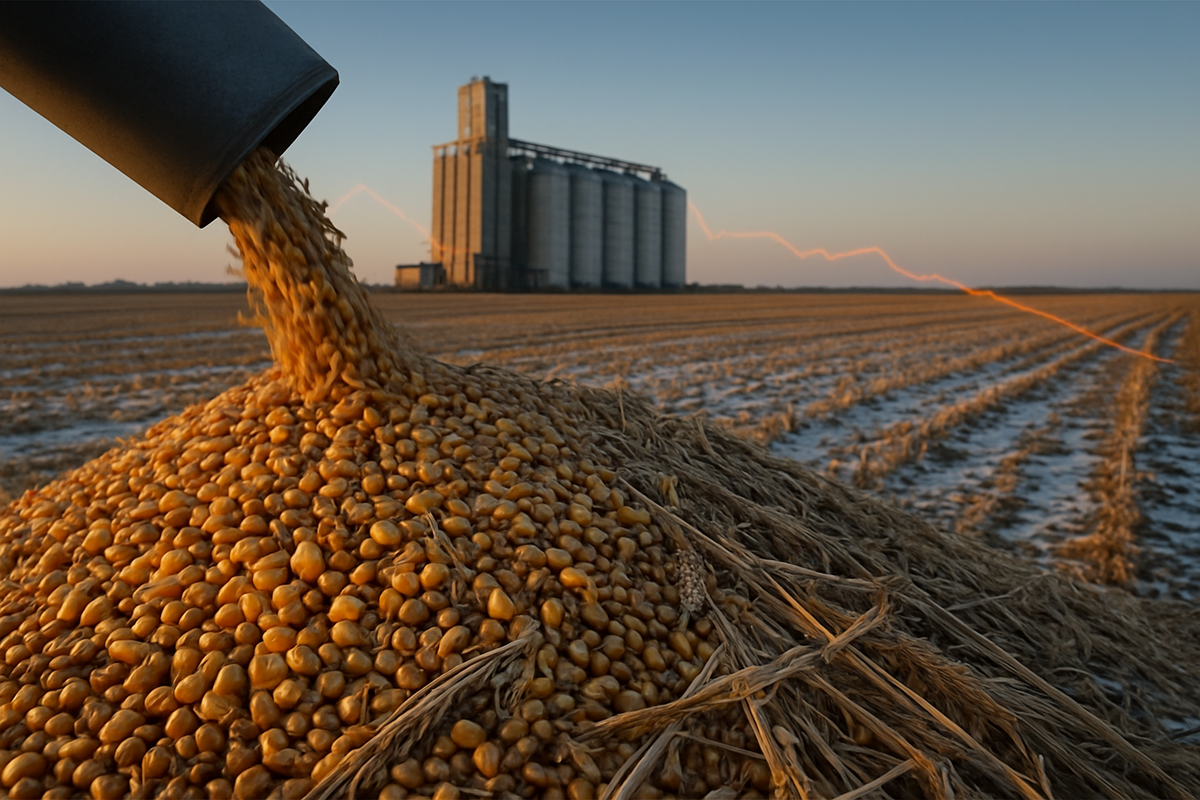
As the final bells ring across the Chicago Board of Trade this December 31, 2025, the narrative of the global grain market has shifted from one of geopolitical panic to one of overwhelming abundance. Corn, soybean, and wheat futures are closing the year at multi-year lows, capping a second half of 2025 defined by record-breaking harvests in the United States and aggressive expansion in South American production. The transition from "scarcity pricing" to "abundance management" has caught many producers off guard, leaving the agricultural sector to grapple with thin margins and a glut of inventory.
The immediate implications of this slide are profound. For the American farmer, the 2025 season has been a "yield-rich, cash-poor" year, where record-breaking productivity has ironically depressed the very prices needed to cover rising input costs. On the global stage, the United States is increasingly finding itself sidelined as China and other major importers pivot toward cheaper Brazilian and Argentinian origins, signaling a structural shift in global trade routes that may persist long into 2026.
A Wall of Supply: The Mechanics of the 2025 Slide
The primary catalyst for the year-end retreat was the realization of a historic U.S. harvest. By late November, the USDA’s World Agricultural Supply and Demand Estimates (WASDE) confirmed that the U.S. had achieved a record corn yield, projected between 181 and 183 bushels per acre. This resulted in a total production of approximately 16.75 billion bushels, a figure that effectively smothered any hope of a late-year price rally. Corn futures, which began the year with some optimism, have settled into a range of $4.42 to $4.48 per bushel as 2025 concludes.
Soybeans faced an even steeper uphill battle. While the U.S. harvest was robust, the real pressure came from the Southern Hemisphere. Brazil’s 2024/25 crop reached a staggering 166 million metric tons, and as 2025 draws to a close, planting for the 2025/26 season is progressing under near-perfect conditions. This "bumper-on-bumper" scenario has driven soybean futures toward the $10.50 level. Traders have spent the last quarter of the year liquidating long positions, as the prospect of another 177 million-ton Brazilian harvest in early 2026 removes any incentive for bullish speculation.
Wheat markets, meanwhile, have seen the "war premium" associated with the Black Sea region almost entirely evaporate. Although tensions remain, the global market has successfully diversified its supply chains. With global ending stocks remaining sufficient and Russia continuing to export at aggressive volumes to maintain market share, wheat futures have hovered between $5.17 and $5.50 per bushel. The year-end slide was further exacerbated by logistical bottlenecks; for the fourth consecutive year, low water levels on the Mississippi River forced a pivot to more expensive rail transport, widening the "basis" and further reducing the net price received by domestic growers.
Winners and Losers: Corporate Divergence in a Low-Price Era
The downturn has created a stark divide among the giants of the agribusiness world. Archer-Daniels-Midland (NYSE: ADM) has emerged as one of the most visible casualties of the 2025 surplus. The company’s crushing subsegment saw profits plunge by nearly 93% in the latter half of the year. The combination of a global soybean glut and the "crushed" margins resulting from it forced ADM to slash its full-year earnings guidance. The company’s struggles were compounded by regulatory uncertainty surrounding the U.S. 45Z Clean Fuel Production Credit, which left the renewable diesel sector—a key driver of soybean oil demand—in a state of paralysis.
Bunge Global (NYSE: BG) has managed to navigate the storm with slightly more agility, thanks to its broader global footprint and significant presence in the booming South American market. However, even Bunge has not been immune to the margin compression affecting the processing sector. Both firms are entering 2026 with a focus on cost-cutting and portfolio optimization as they wait for the biofuel policy landscape to clear.
In the equipment sector, Deere & Co (NYSE: DE) is facing a difficult cyclical downturn. With farm income at its lowest point in years, the appetite for high-tech, high-cost machinery has vanished. Deere has projected a 15–20% decline in North American large agriculture sales for the upcoming year, as farmers choose to repair existing fleets rather than invest in new ones. Conversely, Corteva (NYSE: CTVA) has shown remarkable resilience. By focusing on the "software" of farming—high-yield seeds and specialized crop protection—Corteva has managed to raise its EBITDA guidance. Farmers, it seems, are willing to pay a premium for efficiency even when prices are low. To further unlock value, Corteva recently announced a landmark plan to split into two separate entities (Seed and Crop Protection) by late 2026.
Policy, Trade, and the New Global Order
The 2025 grain slide is more than just a story of high yields; it is a reflection of a changing geopolitical landscape. China’s strategic pivot away from U.S. agricultural origins has reached a tipping point. Estimates for 2025 suggest that U.S. exports to China have dropped significantly, with Beijing increasingly favoring Brazilian soybeans and corn. This shift is not merely about price; it is a deliberate effort by China to diversify its food security risks, a move that has left U.S. exporters searching for new markets in Southeast Asia and North Africa.
Furthermore, the delay in implementing the 45Z Clean Fuel Production Credit has had a chilling effect on the domestic market. Intended to incentivize the production of low-carbon intensity fuels, the lack of clear guidance from Washington has left refiners hesitant to sign long-term contracts for soybean oil. This policy vacuum has effectively capped the potential for "green" demand to offset the losses in traditional export markets.
Historically, this period mirrors the "long tail" of the mid-2010s, where several years of record production led to a sustained period of low prices. However, the current environment is complicated by higher interest rates and elevated input costs for fertilizers and fuel. Unlike previous cycles, the "break-even" point for farmers has shifted higher, making the current sub-$4.50 corn and sub-$11.00 soybean prices far more painful than they were a decade ago.
The Road Ahead: 2026 and the Search for a Floor
Looking toward 2026, the market is searching for a catalyst to break the bearish trend. In the short term, all eyes will be on the final realization of the South American harvest. Any weather-related disruption in Brazil or Argentina during the first quarter of 2026 could provide a much-needed "weather rally," though the current forecasts suggest a smooth path for Southern Hemisphere growers.
Strategically, U.S. producers may be forced to pivot their planting intentions for the 2026 spring season. We may see a shift away from corn and toward alternative crops or a renewed focus on "regenerative" practices that qualify for higher-value niche markets. For the public companies, the focus will remain on "efficiency at scale." We should expect more consolidation in the processing sector and a continued push toward digital agriculture tools that promise to lower the cost per bushel produced.
The potential for a "Black Swan" event—such as a sudden escalation in trade tariffs or a major shift in U.S. energy policy—remains the wild card. However, based on current inventory levels, the most likely scenario for the first half of 2026 is one of "sideways-to-lower" price action as the market works through the massive carryover from the 2025 season.
Conclusion: A Market in Transition
The year 2025 will be remembered as the year the "scarcity mindset" finally broke. The combination of record U.S. yields, a dominant South American presence, and a shifting trade relationship with China has created a perfect storm for grain futures. While this is a boon for global food inflation and livestock producers who benefit from lower feed costs, it represents a significant challenge for the American farm belt and the major agribusinesses that support it.
Moving forward, investors should keep a close watch on the USDA’s January 2026 reports for final production revisions and the progress of the Brazilian harvest. The "45Z" policy decision in Washington will also be a critical pivot point for the soy complex. As we enter the new year, the market is no longer asking if there is enough food to feed the world; it is asking where on earth we are going to store it all.
This content is intended for informational purposes only and is not financial advice.