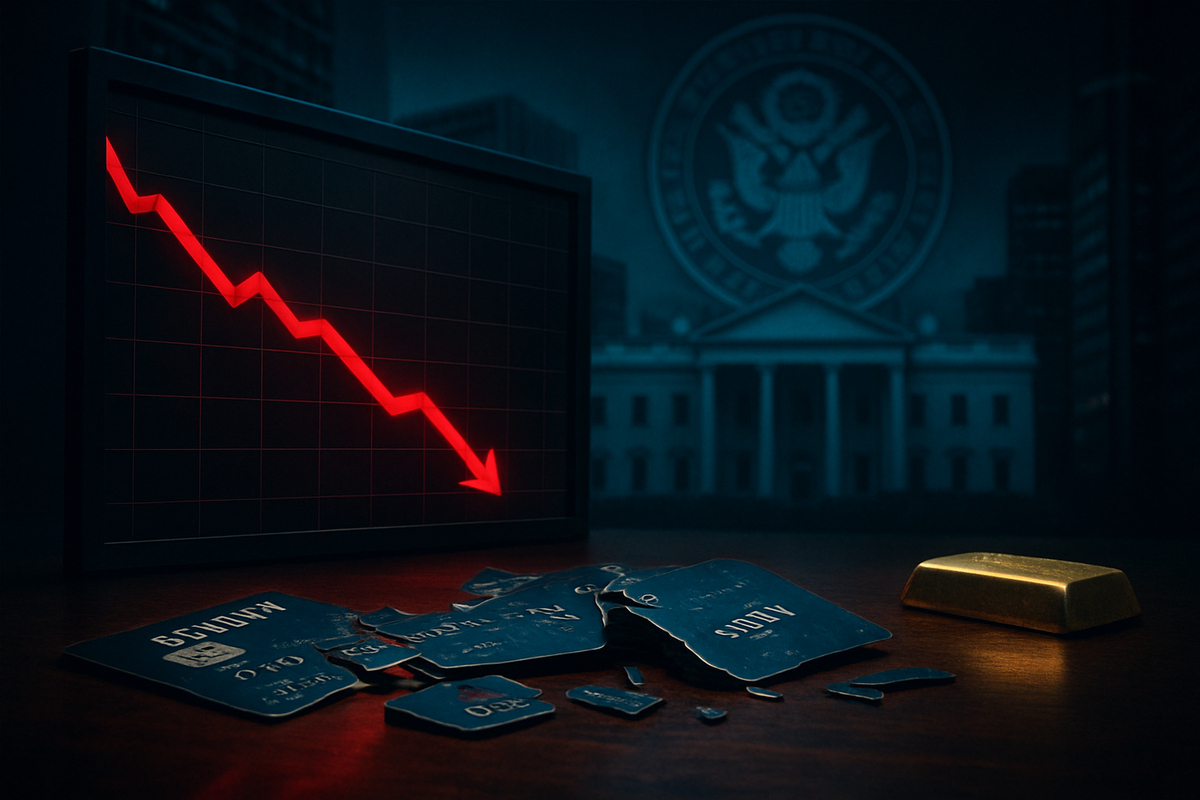
In a move that has sent shockwaves through the American financial system, the Trump administration has officially proposed a national 10% cap on credit card interest rates. The announcement, which was first teased via social media late Friday evening, January 9, 2026, has triggered a massive sell-off across the banking sector as markets opened this morning, Monday, January 12. Investors are grappling with the potential for a fundamental restructuring of the consumer lending business model, which has historically relied on high-interest margins to offset the risks of unsecured lending.
The immediate implications are stark: major bank indices have plunged, with some consumer-heavy lenders seeing double-digit percentage drops in pre-market and early morning trading. Beyond the stock price volatility, the proposal has ignited a fierce debate over credit accessibility and the limits of executive influence over the private financial sector. As the administration targets a January 20 implementation date—the one-year anniversary of the President’s second inauguration—the banking industry is bracing for a protracted legal and legislative battle.
The 'Interest Rate Shock' of 2026: A Timeline of the Proposal
The current crisis began in earnest on the evening of January 9, 2026, when President Trump characterized current credit card interest rates—which currently average near 21%—as a "predatory scam" on the American public. By Saturday morning, Senator Roger Marshall (R-Kan.) confirmed he was leading the legislative charge to codify a temporary one-year 10% cap, aiming to provide "immediate relief" to households struggling with persistent inflation. This move effectively co-opted a previous bipartisan effort led by Senators Bernie Sanders (I-Vt.) and Josh Hawley (R-Mo.), thrusting the proposal from the political fringes into the center of the administration's economic agenda.
The timing of the proposal has been particularly volatile due to a simultaneous escalation of tensions between the White House and the Federal Reserve. On Sunday, January 11, Fed Chair Jerome Powell revealed that the Department of Justice had served the central bank with subpoenas related to a probe into headquarters renovations—a move many analysts view as a "pretext" to undermine the Fed's independence. This dual-pronged pressure on the financial system—targeting both the profitability of private banks and the autonomy of the central bank—led to what traders are calling the "January 12th Jitters," characterized by a flight to safety that saw gold prices hit a record high of $4,600 per ounce.
The banking industry's response was swift and unified. A joint statement from the American Bankers Association (ABA) and the Bank Policy Institute (BPI) warned that a 10% cap would make it impossible to price for risk, effectively "de-banking" millions of Americans with lower credit scores. Despite these warnings, the administration has signaled it will move forward with or without industry cooperation, setting the stage for a dramatic showdown in Washington.
Winners and Losers: The Tally of the Sell-Off
The primary losers in this policy shift are the specialized consumer lenders and major credit card issuers. Capital One (NYSE: COF) saw its stock price crater by nearly 10% in early trading, as the firm is heavily exposed to the subprime and near-prime markets that would be most affected by a rate cap. Similarly, Synchrony Financial (NYSE: SYF), which manages private-label credit cards for numerous retailers, saw a decline of 11%, with analysts warning that their entire business model could be rendered unviable under a 10% ceiling.
Among the "Big Four" banks, Citigroup (NYSE: C) took the hardest hit, dropping over 4% due to its massive global credit card portfolio. JPMorgan Chase (NYSE: JPM) and Bank of America (NYSE: BAC) followed with declines of approximately 3%, as their diversified revenue streams—including investment banking and wealth management—offered only a partial cushion against the expected hit to their retail divisions. American Express (NYSE: AXP) also saw a 4.2% slide, as investors worry that the cap could jeopardize the high-margin interest income that funds its premium rewards programs.
On the winning side of the ledger, safe-haven assets are the clear beneficiaries. Aside from the surge in gold, "shadow banking" entities and unregulated private lenders may see a long-term boom if traditional banks are forced to retreat from the market. Furthermore, some fintech companies that operate on fee-based models rather than interest-spread models could potentially gain market share, though the broader sector remains under pressure due to the general uncertainty surrounding financial regulation.
A Fundamental Shift: Profitability and Historical Precedents
The proposed 10% cap represents a direct assault on the Net Interest Margin (NIM)—the lifeblood of bank profitability. For products like credit cards, where the spread between the cost of funds and the interest charged covers both operating costs and the high probability of default (Provision for Credit Losses), a 10% cap would represent a compression of over 1,000 basis points for many issuers. Historically, when such caps have been implemented, banks have not simply accepted lower profits; they have fundamentally changed how they operate.
Comparisons are being drawn to the 1970s usury laws, where state-level caps in a high-inflation environment made mortgage lending so unprofitable that banks effectively stopped issuing loans until they could relocate to states with more favorable regulations, such as South Dakota. More recently, the 2011 Durbin Amendment, which capped debit card interchange fees, led to a "balloon effect" where banks eliminated free checking accounts and raised monthly maintenance fees to recoup the lost $6.5 billion in annual revenue.
If the Trump administration’s proposal becomes law, industry experts anticipate a massive "credit rationing" event. Banks would likely stop lending to any borrower with a credit score below 660, as the 10% cap would not cover the historical default risk of those segments. This could lead to a paradoxical long-term decline in credit losses for banks, but at the cost of a significantly smaller market and the potential social fallout of millions of Americans losing access to traditional credit.
What Comes Next: Strategic Pivots and Legislative Hurdles
In the short term, all eyes are on the upcoming earnings calls, starting with JPMorgan Chase (NYSE: JPM) on Tuesday, January 13. Investors will be looking for executive guidance on how the industry plans to fight the proposal and what "Plan B" looks like. If the cap appears likely to pass, expect a rapid reintroduction of annual fees for even the most basic credit cards. These fees would serve as a proxy for interest income, allowing banks to maintain margins while technically complying with the 10% rate ceiling.
Furthermore, a significant strategic pivot toward non-interest income is expected. Banks may increase fees for late payments (within legal limits), ATM usage, and wire transfers. There is also the possibility of a shift toward "buy now, pay later" (BNPL) structures, which often operate under different regulatory frameworks than traditional revolving credit. However, the biggest challenge remains the legislative process; while the President has called for the cap, it will require a majority in Congress to override existing state-level preemption laws and the National Bank Act.
The Bottom Line for Investors
The Trump administration's 10% rate-cap proposal has introduced a level of regulatory risk not seen in the banking sector for decades. The "January 12th Jitters" reflect a market that is suddenly forced to price in the end of high-yield consumer lending. While the proposal faces significant legal and legislative hurdles, the mere threat of its implementation has already begun to reshape investor sentiment and bank strategy.
Moving forward, investors should closely monitor the progress of Senator Marshall’s bill and any further executive orders that may attempt to bypass Congress. The health of the banking sector in 2026 will likely depend on whether the industry can successfully argue that such a cap would do more harm than good by cutting off credit to the very consumers it intends to help. For now, the era of "easy" interest income for credit card issuers appears to be under direct and unprecedented threat.
This content is intended for informational purposes only and is not financial advice.