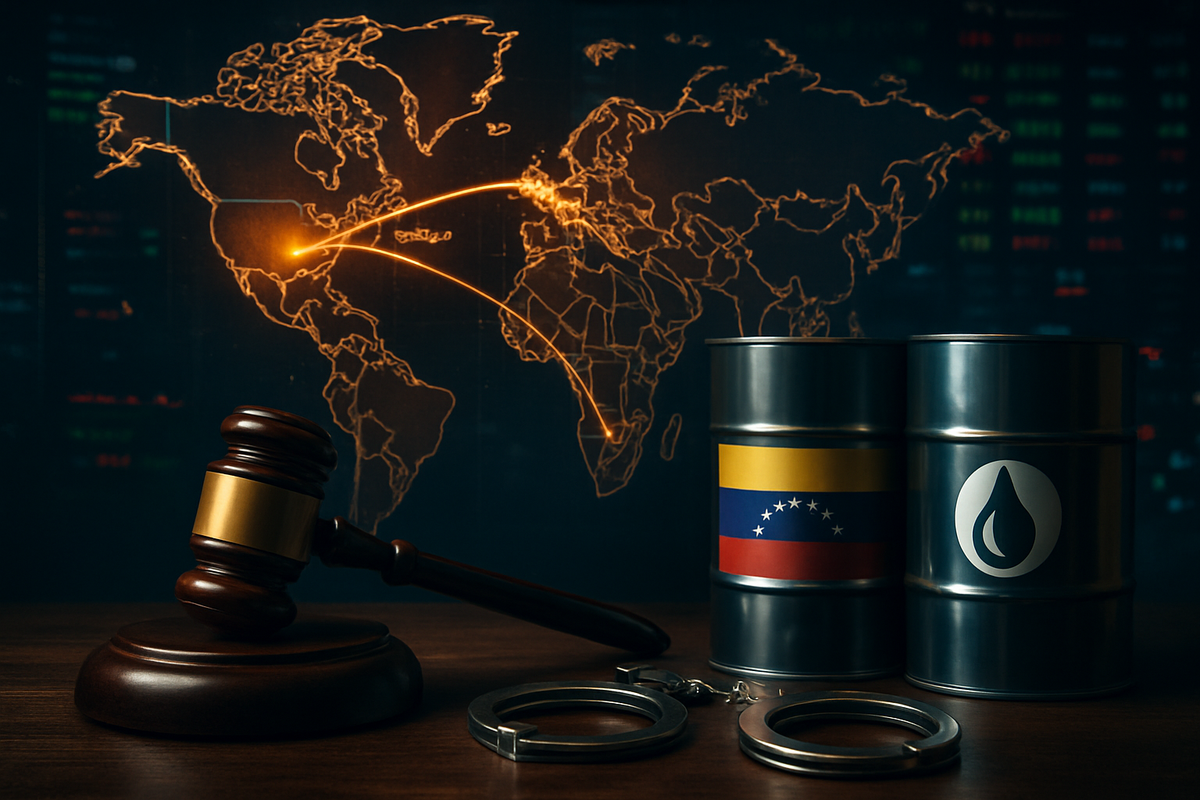
NEW YORK — In a seismic shift that has rewritten the geopolitical map of the Western Hemisphere, the era of Nicolás Maduro’s rule in Venezuela has come to a sudden and violent conclusion. On January 3, 2026, a high-stakes U.S. military operation titled "Operation Absolute Resolve" resulted in the apprehension of the embattled leader, who was subsequently extradited to the United States to face a litany of narco-terrorism charges. As of today, January 19, 2026, Maduro remains in a federal detention center in New York, while global financial markets and energy hubs scramble to price in the most significant disruption to the Latin American status quo in decades.
The immediate implications are staggering. Crude oil markets, which initially spiked on news of the capture, are now experiencing a complex "regime-change premium." Investors are weighing the short-term volatility of a potentially unstable transition in Caracas against the long-term prospect of Venezuela—home to the world’s largest proven oil reserves—re-entering the global economy as a transparent, U.S.-aligned energy powerhouse. While the streets of Caracas remain under a tense provisional military council, Wall Street is already identifying the corporate titans poised to lead the multi-billion dollar reconstruction of the Venezuelan energy sector.
From Miraflores to Manhattan: The Timeline of a Takedown
The path to Maduro’s current residence at the Metropolitan Detention Center in New York was paved by years of escalating legal and economic pressure. Following the disputed 2024 elections, the U.S. State Department aggressively increased the bounty for Maduro's capture, which reached a staggering $50 million by August 2025. This escalation coincided with the designation of his inner circle, the "Cartel of the Suns," as a Specially Designated Global Terrorist (SDGT) organization. The unsealing of a superseding indictment by the Southern District of New York (SDNY) provided the legal framework for "Operation Absolute Resolve," a precision strike that bypassed the traditional diplomatic channels that had failed for over a decade.
On January 5, 2026, just two days after his capture, Maduro appeared before U.S. District Judge Alvin Hellerstein. Clad in a standard-issue jumpsuit rather than his typical presidential sash, Maduro pleaded not guilty to charges of narco-terrorism conspiracy and cocaine importation. His defense team has already signaled a strategy focused on "sovereign immunity" and "prisoner of war" status, arguing the capture was an extrajudicial kidnapping. However, the U.S. Department of Justice (DOJ) appears undeterred, presenting evidence that alleges Maduro’s administration functioned more as a criminal enterprise than a legitimate government, facilitating the flow of hundreds of tons of narcotics into the United States.
Market reactions were instantaneous. Brent crude surged past $95 a barrel in the hours following the news before settling back into the mid-$80s as the U.S. Treasury hinted at a rapid expansion of production licenses for Western firms. The "Maduro Discount"—the low price at which Venezuelan crude was sold to illicit buyers in the "shadow fleet"—is effectively dead. Analysts now expect a standardized, transparent pricing model for Venezuelan heavy crude to emerge by the second quarter of 2026, a move that could fundamentally alter the balance of power within the OPEC+ alliance.
The Corporate Vanguard: Winners and Losers in a Post-Maduro Era
The primary corporate beneficiary of this geopolitical earthquake is undoubtedly Chevron Corporation (NYSE: CVX). As the only U.S. major to maintain a physical presence in Venezuela through the leanest years of the Maduro regime, Chevron is uniquely positioned to capitalize on the transition. Late in 2025, Chevron’s operations were severely restricted under "maximum pressure" tactics, with exports falling to 100,000 barrels per day. However, since the capture, internal sources at the Treasury Department suggest that General License 41 will be expanded to a full-scale operational permit. With infrastructure already in place, Chevron could potentially double its production in the Orinoco Belt within six months, turning a survival strategy into a multi-billion dollar windfall.
On the refining front, U.S. Gulf Coast operators are breathing a sigh of relief. Refiners like Phillips 66 (NYSE: PSX), Valero Energy Corporation (NYSE: VLO), and PBF Energy Inc. (NYSE: PBF) possess complex "coking" facilities specifically designed to process the "heavy, sour" crude that Venezuela produces in abundance. For years, these refiners have had to rely on more expensive or logistically challenging alternatives like Western Canadian Select (WCS) or Mexican Maya crude. The return of Venezuelan heavy barrels at competitive prices is expected to boost refining margins by $8 to $12 per barrel, according to early estimates from energy analysts.
Conversely, the "losers" in this scenario include the service providers and middlemen who operated in the shadows of the sanctions regime. Russian and Chinese state-backed firms, which had traded debt-for-oil with the Maduro government, now face the prospect of their contracts being declared null and void by a new Venezuelan administration. Furthermore, the "shadow fleet"—the clandestine network of aging tankers used to bypass U.S. sanctions—faces an existential crisis as Venezuelan oil returns to the formal, regulated market, likely depressing the demand for illicit shipping services globally.
A Tectonic Shift in Energy Security and Industry Trends
The capture of Maduro is more than just a headline; it represents a pivot point in the broader industry trend of "near-shoring" energy security. For the past decade, the U.S. has relied increasingly on domestic shale and Canadian imports. However, the rehabilitation of the Venezuelan energy sector offers a massive, geographically proximate source of crude that reduces dependence on the volatile Middle East. This event fits into a wider trend of the U.S. using judicial and military reach to secure energy corridors, a precedent that will likely make other resource-rich but politically unstable nations rethink their adversarial stances toward Washington.
From a regulatory standpoint, the U.S. Treasury’s Office of Foreign Assets Control (OFAC) is expected to undergo a massive pivot. Rather than focusing on enforcement and "maximum pressure," the agency will likely shift toward a "Marshall Plan" style of reconstruction, issuing licenses that encourage capital expenditure rather than mere maintenance. The historical precedent often cited is the post-2003 reconstruction of the Iraqi oil sector, though analysts hope Venezuela’s existing, albeit dilapidated, infrastructure will allow for a faster recovery.
Furthermore, the impact on service companies cannot be overstated. Giants like SLB (NYSE: SLB) and Halliburton Company (NYSE: HAL), which have had billions in assets written off or impaired in Venezuela over the last decade, are looking at a gold rush. The task of refurbishing thousands of wells and modernizing the state-owned PDVSA’s infrastructure represents the largest oilfield services opportunity in the world today. Investors are already watching these tickers closely for any announcements regarding new service contracts as the provisional government in Caracas begins to stabilize.
The Road Ahead: Transition, Trials, and Taps
In the short term, the market must navigate the "fog of transition." While Maduro is in custody, the remnants of his military and the "Cartel of the Suns" still hold significant influence in the Venezuelan interior. Potential scenarios include a brief period of civil unrest or a more orderly transition led by U.S.-backed opposition figures. Investors should expect high volatility in the energy markets throughout the spring of 2026 as these political dynamics play out. The key milestone to watch will be the announcement of a formal transition government and the subsequent "Day 1" energy reform package that will likely privatize key assets of PDVSA.
Long-term, the legal proceedings in New York will serve as a continuous background noise to the economic recovery. The discovery phase of Maduro’s trial could unearth embarrassing details for global financial institutions that may have facilitated the regime’s illicit activities, potentially leading to a new wave of banking sector fines and regulatory scrutiny. Strategically, Venezuela will likely seek a rapid return to its previous production levels of 2-3 million barrels per day, a move that will require at least $50 billion in foreign direct investment over the next five years.
Summary: A New Chapter for the Global Oil Patch
The capture of Nicolás Maduro marks the end of a turbulent chapter in Latin American history and the beginning of what could be a historic economic resurgence for Venezuela. The key takeaways for investors are clear: the U.S. Gulf Coast refining sector stands to gain a significant competitive advantage as heavy crude flows resume, and established players like Chevron Corporation (NYSE: CVX) are the primary vehicles for playing this geopolitical reset.
As we look toward the coming months, the market will be hyper-focused on three things: the stability of the provisional government in Caracas, the speed at which OFAC lifts the remaining sanctions, and the initial production reports from the Orinoco Belt. While the road to full recovery is long and fraught with legal and political obstacles, the "unlocked" potential of Venezuela’s oil fields is the single most important development in the global energy market for 2026. For the first time in a generation, the "black gold" of Venezuela is being priced on its quality and volume, rather than its political risk.
This content is intended for informational purposes only and is not financial advice.