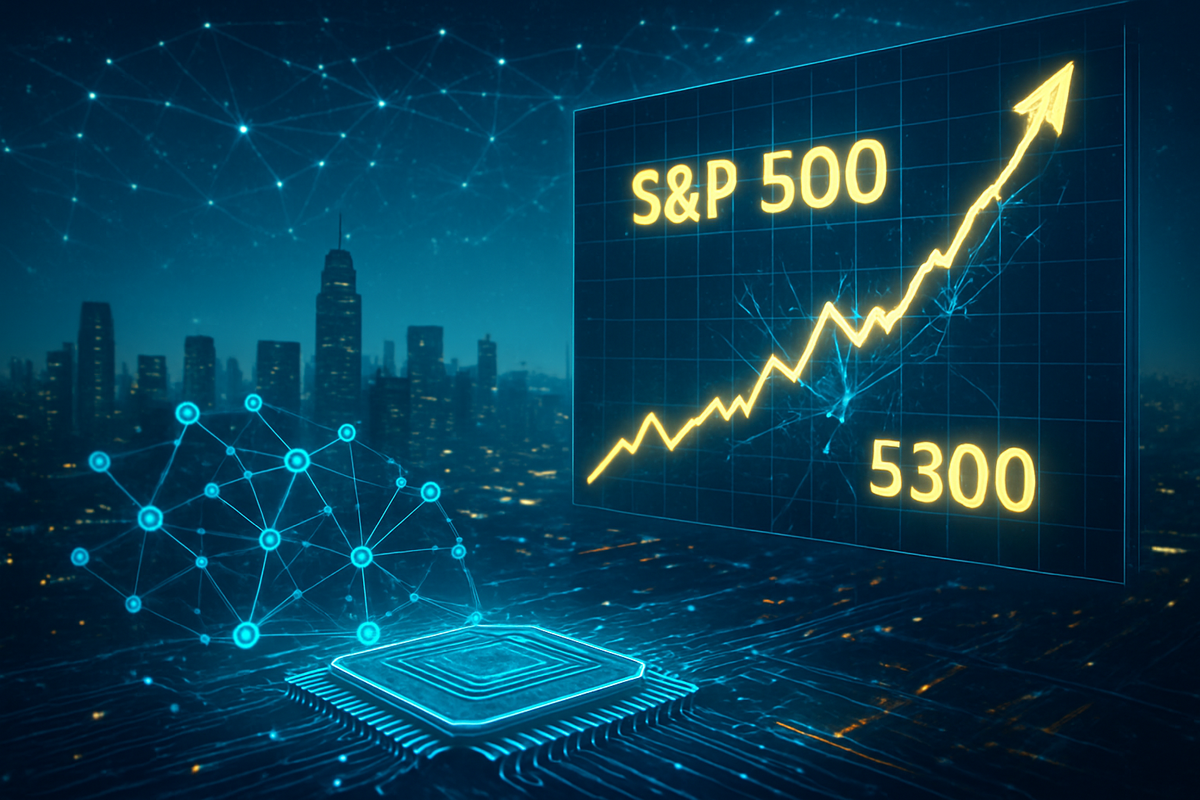
In a definitive display of market resilience, the S&P 500 (CME:GSPC) achieved a landmark milestone in May 2024, crossing the 5,300 threshold for the first time in history. This surge, culminating in a record close of 5,308.18 on May 15, 2024, represented a fundamental shift in investor sentiment—a transition from the "inflation anxiety" that dominated the early 2020s to an era of "technological optimism" anchored by artificial intelligence.
The achievement was more than just a numerical record; it signaled the market's ability to compartmentalize significant geopolitical friction and high interest rates in favor of a transformative growth narrative. By shattering this ceiling, the index proved that the "AI trade" had matured into a structural pillar of the global economy, providing a stabilizing force even as traditional macroeconomic indicators flashed signs of uncertainty.
The Perfect Storm: Inflation Cooling and the AI Surge
The march to 5,300 was catalyzed by a "perfect storm" of favorable data and corporate excellence. On the morning of May 15, 2024, the Department of Labor released the April Consumer Price Index (CPI) report, which showed inflation cooling to 3.4% year-over-year. This slight but significant deceleration—the first in several months—ignited a rally as investors breathed a collective sigh of relief, betting that the Federal Reserve would finally have the "confidence" needed to initiate rate cuts later in the year.
However, the rally’s fuel was not purely macroeconomic. The timeline of May 2024 was punctuated by the anticipation and eventual release of blockbuster earnings from NVIDIA (NASDAQ: NVDA). When the chipmaker reported a staggering 262% revenue increase on May 22, it essentially validated the trillions of dollars being poured into AI infrastructure. Stakeholders, from institutional hedge funds to retail investors, viewed this as a "Green Light" moment. The market's reaction was swift; the technology sector didn't just lead the index higher—it dragged the broader market along with it, effectively ignoring the "higher-for-longer" interest rate rhetoric from central bankers.
Winners and Losers: The AI Divide
The ascent to 5,300 created a stark divergence between the "AI-enabled" and the "legacy-bound." The clearest winner was NVIDIA (NASDAQ: NVDA), which saw its stock price surge nearly 27% in May alone, briefly touching a $1,000 per-share valuation before its subsequent 10-for-1 stock split. But the winner's circle was not limited to silicon. The rally expanded into the energy sector, with companies like Vistra Corp (NYSE: VST) and First Solar (NASDAQ: FSLR) seeing explosive gains. Investors realized that the massive data centers required for AI would need unprecedented amounts of electricity, turning boring utility stocks into high-growth "AI infrastructure" plays.
On the losing end of this historic month were companies struggling to adapt to the high-rate environment or those whose business models were perceived as vulnerable to AI disruption. EPAM Systems (NYSE: EPAM) plummeted over 24% after lowering its outlook, citing a slowdown in traditional IT spending as clients diverted budgets toward generative AI projects. Similarly, companies like Paycom Software (NYSE: PAYC) and Illumina (NASDAQ: ILMN) faced stiff headwinds, struggling with slowing growth and regulatory hurdles that left them in the shadows of the tech-heavy rally.
A New Anchor: AI vs. Geopolitical Noise
The wider significance of the May 2024 rally lies in its defiance of geopolitical volatility. During this period, the world was grappling with an escalation of the Israel-Hamas conflict and the sudden death of Iranian President Ebrahim Raisi. Historically, such events might have triggered a massive "flight to safety," spiking oil prices and depressing equity valuations. Instead, the S&P 500 remained remarkably steady. This suggested a shift in the market's "DNA," where the perceived productivity gains from AI began to act as a hedge against traditional geopolitical risk.
This trend mirrors the historical precedents of the late 1990s internet boom, but with a critical difference: the companies leading the 2024 charge were already generating massive cash flows. Regulators and policymakers also took note, as the rally forced a re-evaluation of how AI might impact labor markets and energy policy. The 5,300 milestone wasn't just a win for Wall Street; it was the moment the market decided that technology-driven productivity was more important than the immediate noise of global conflict.
Looking Ahead: From 5,300 to the 2026 Landscape
As we look back from the perspective of January 2026, the May 2024 milestone was clearly the foundation for the current market environment. In the short term following that rally, many analysts feared a "blow-off top," but the 5,300 level eventually became a strong floor of support. The strategic pivots made by legacy companies in mid-2024—aggressively integrating AI or restructuring for efficiency—have defined the corporate winners of today.
The primary challenge that emerged was the concentration of the index. With the "Magnificent Seven" and utilities accounting for so much of the S&P 500's gains, the market became highly sensitive to any fluctuation in tech earnings. However, the scenarios that have played out since then show that as long as AI continues to deliver measurable ROI (Return on Investment), the market’s appetite for growth remains insatiable. The 2024 rally taught investors that in a world of geopolitical uncertainty, software and silicon are the new safe havens.
Summary and Final Thoughts
The S&P 500 crossing 5,300 in May 2024 remains a watershed moment in financial history. It marked the definitive end of the post-pandemic "inflation fear" era and the dawn of the "AI infrastructure" age. The key takeaway for investors was the importance of looking beyond the headlines; while geopolitical tensions dominated the news, the fundamental transformation of the economy via artificial intelligence was the true driver of value.
Moving forward, the market has matured, but the lessons of May 2024 remain relevant. Investors should continue to watch the intersection of energy demand and technological growth, as this "AI-Energy Nexus" continues to provide stability. The 5,300 mark was the point at which the market stopped asking if AI would change the world and started pricing in exactly how much that change was worth.
This content is intended for informational purposes only and is not financial advice.