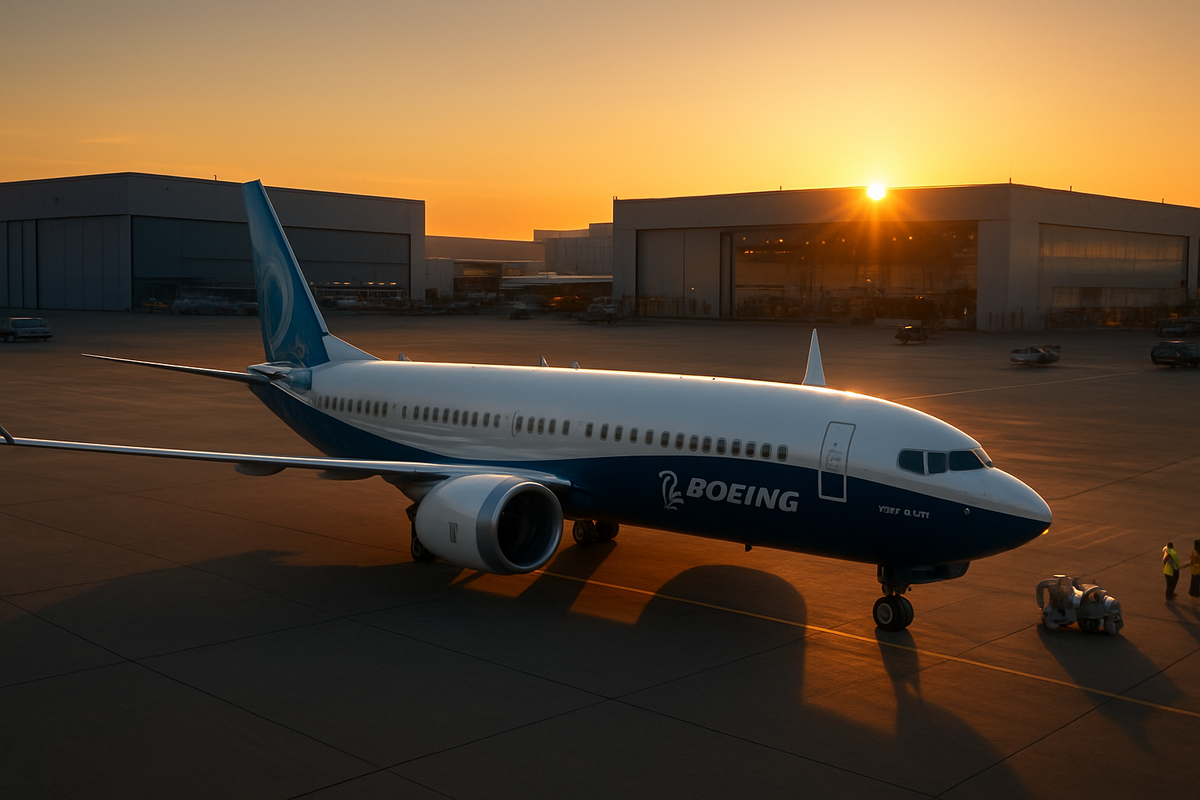
On January 27, 2026, The Boeing Company (NYSE: BA) released its fourth-quarter and full-year 2025 financial results, marking a historic, albeit complex, milestone for the aerospace giant. After years of financial bleeding, safety crises, and labor unrest, Boeing reported its first annual net profit in seven years. The results signal a "cautious stabilization" under the leadership of CEO Kelly Ortberg, who has spent the last year attempting to steer the company through a fundamental overhaul of its manufacturing culture and supply chain.
The immediate market reaction was one of relief, though tempered by the nuances of the balance sheet. While the headline profit figure—a staggering $8.2 billion for the fourth quarter—was heavily inflated by the $9.6 billion divestment of its Digital Aviation Solutions unit, the underlying operational metrics showed significant improvement. With production of the 737 MAX finally stabilizing at 42 aircraft per month and the successful integration of a key supplier, Boeing appears to have finally moved past the "free-fall" era that began with the MAX groundings and was exacerbated by the COVID-19 pandemic and recent manufacturing lapses.
Stabilization at a Premium: The Road to 2026
The path to these results was defined by a series of high-stakes maneuvers throughout 2025. Following a crippling 53-day IAM labor strike in late 2024, Boeing spent the first half of 2025 rebuilding its workforce morale and clearing a massive delivery backlog. A pivotal moment occurred in October 2025, when the Federal Aviation Administration (FAA) finally lifted production caps, allowing Boeing to move from 38 to 42 737 MAX units per month. This increase was contingent on Boeing’s "safety first" protocol, which CEO Kelly Ortberg emphasized has slowed delivery timelines in exchange for higher "build quality per unit."
Financially, the year ended with Boeing generating $89.46 billion in revenue, a 34% increase year-over-year. The fourth quarter’s positive free cash flow of $0.4 billion was a "psychological win" for the company, as it had burned through billions in the previous four quarters. However, the commercial airplanes unit still faced an operating loss of $632 million in Q4, highlighting that while the company is profitable on a net basis due to asset sales, its core manufacturing engine is not yet firing on all cylinders. The acquisition of Spirit AeroSystems, finalized on December 8, 2025, for $8.3 billion, remains the most significant structural change, aimed at eliminating "quality escapes" by bringing fuselage production back in-house.
The timeline leading to this report was marred by setbacks in Boeing's defense and space sectors. The Boeing Defense, Space & Security (BDS) division recorded a $565 million charge on the KC-46A tanker program in the final quarter, driven by strike-related disruptions and supply chain costs. Furthermore, the company confirmed that the first delivery of the 777X has been pushed to 2027, as certification hurdles continue to plague the widebody program. Key stakeholders, including major airline CEOs and federal regulators, have expressed a "trust but verify" stance, acknowledging the progress while remaining wary of any future "out-of-sequence" work.
Winners and Losers in the Aerospace Duopoly
The stabilization of Boeing has had immediate ripple effects across the industry. Airbus SE (OTC: EADSY) remains the clear winner in terms of delivery volume, ending 2025 with 793 aircraft delivered compared to Boeing’s 600. In a symbolic shift, the Airbus A320 family officially surpassed the Boeing 737 in total cumulative deliveries in late 2025. However, Boeing’s return to a predictable production rate has actually benefited Airbus by stabilizing the global supply chain, which had been suffering from the "whiplash effect" of Boeing's erratic order and delivery schedules.
Major airline customers have had to play a defensive game. Southwest Airlines Co. (NYSE: LUV) was forced to reduce its 2025 delivery expectations and postpone cabin retrofits on older jets to maintain capacity. Similarly, United Airlines Holdings, Inc. (NASDAQ: UAL) has shifted its strategy to rely more heavily on the 787-10 for long-haul growth as a hedge against the 777X delays. Conversely, Ryanair Holdings plc (NASDAQ: RYAAY) had to trim its passenger forecast for the year due to delivery shortfalls, demonstrating that even a "stabilized" Boeing is still operating well below the capacity required by its largest budget-carrier clients.
In the supply chain, the narrative is split. Key partners like GE Aerospace (NYSE: GE) have thrived, reporting a 21% increase in engine deliveries. Meanwhile, component manufacturers like Howmet Aerospace Inc. (NYSE: HWM) and TransDigm Group Incorporated (NYSE: TDG) saw record revenues in 2025 as airlines were forced to fly older aircraft longer, driving up demand for high-margin spare parts. However, the spinoff of the aerospace unit from Honeywell International Inc. (NASDAQ: HON), expected in late 2026, suggests that Tier-1 suppliers are preparing for a future where Boeing and Airbus are no longer in crisis mode, but are instead focused on steady, long-term production.
Industry Trends and the Regulatory Shadow
Boeing’s 2025 performance fits into a broader industry trend of "industrial reconstruction." After years of prioritizing financial engineering and rapid delivery, the aerospace sector is shifting back to a manufacturing-first philosophy. The FAA’s "unprecedented on-site presence" in Boeing’s factories has set a new global standard for regulatory oversight, likely impacting how other international bodies monitor aviation manufacturing. This "shadow of the regulator" has fundamentally changed the speed at which new aircraft variants, like the 737-7 and 737-10, can reach the market.
Historically, the Boeing recovery of 2025-2026 will likely be compared to the company’s turnaround after the 707 and 747 developmental crises. However, the current landscape is far more competitive. The duopoly is no longer a balanced pair; Airbus holds a significant lead in the narrowbody market, and Boeing’s primary challenge is not just technical but cultural. The decision to simplify over 5,100 work instruction documents for mechanics is a direct response to the complexity issues that led to the mid-air door plug blowout in early 2024, signaling a return to basics that the industry hasn't seen in decades.
The Road Ahead: 2026 and Beyond
Looking forward, the next 12 to 24 months will be a "test of credibility" for Boeing. The company has set a target to increase 737 production to 50 aircraft per month by the end of 2026, but CEO Ortberg has been clear that this goal is secondary to "factory health." The successful integration of Spirit AeroSystems will be the most critical operational metric for 2026. If Boeing can prove that bringing manufacturing back in-house reduces defects, it may regain the trust of both the FAA and the flying public.
The potential for strategic pivots remains. With the 777X delayed until 2027, Boeing may need to focus more heavily on its 787 Dreamliner production, aiming to reach 10 units per month by late 2026. Market opportunities in the widebody segment are ripe, as international travel has fully rebounded to pre-pandemic levels. However, if Boeing fails to hit its certification milestones for the MAX 7 and MAX 10 variants this year, it risks losing even more ground to the Airbus A321neo, which currently dominates the mid-market segment.
Conclusion: A Fragile New Normal
In summary, Boeing’s 2025 earnings report is a milestone of survival rather than a declaration of victory. The company has successfully stanched the flow of cash and returned to profitability, but the $2.2 billion annual profit is modest compared to the mountain of debt and the $682 billion backlog it must now execute. The "Reconstruction Era" of Boeing is well underway, but the company remains a "show-me" story for investors and regulators alike.
Moving forward, the market will be closely watching for two things: the seamless absorption of Spirit AeroSystems and the FAA’s eventual certification of the 737 MAX 10. For investors, the takeaway is clear: Boeing has established a floor, but the ceiling remains lowered by the weight of its previous mistakes. The aerospace giant is no longer in a tailspin, but it still has a long, steep climb ahead before it reaches its previous heights.
This content is intended for informational purposes only and is not financial advice.