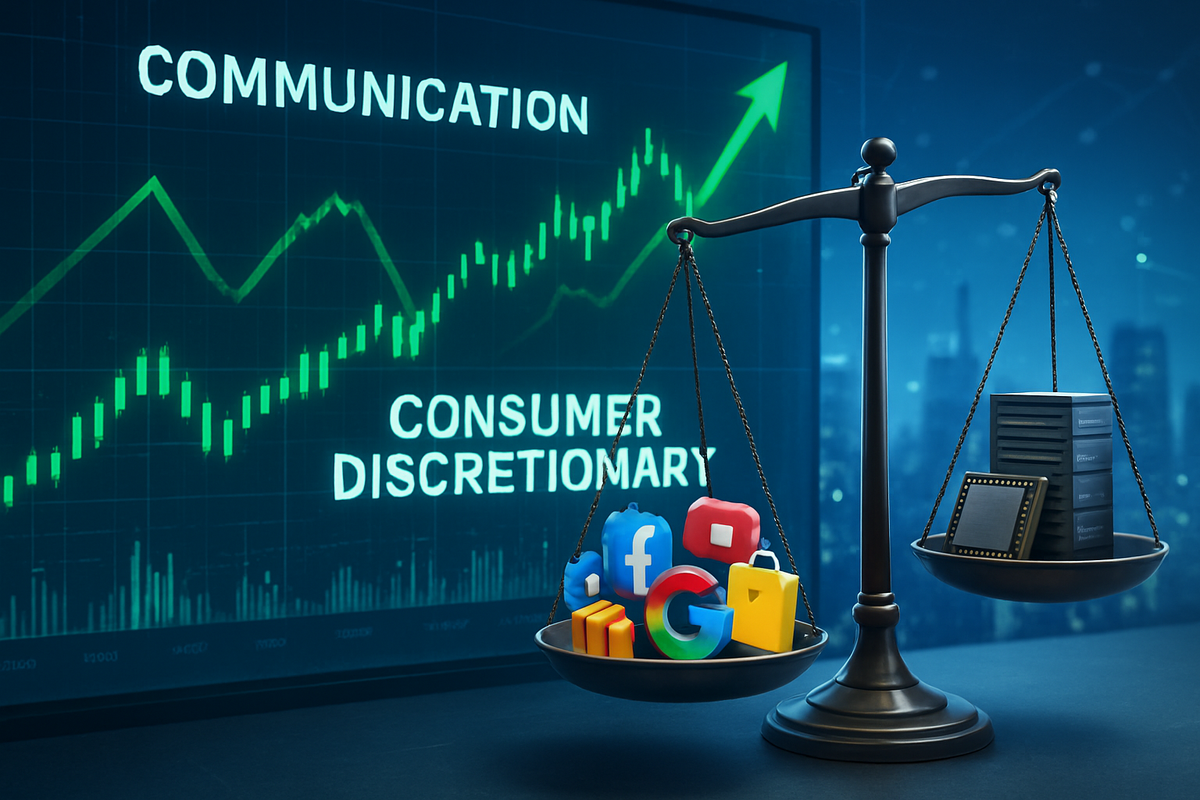
As of January 29, 2026, the equity markets are witnessing a significant transformation in leadership. For years, the Information Technology sector acted as the undisputed engine of market growth, fueled by a relentless pursuit of artificial intelligence (AI) dominance. However, today’s market action reveals a stark divergence. While major tech indices are stumbling under the weight of valuation fatigue and a maturing AI infrastructure cycle, the Communication Services and Consumer Discretionary sectors have surged to the forefront, driven by a robust recovery in global advertising and a windfall of consumer tax credits.
This shift marks a critical "sector rotation" that analysts have anticipated since late 2025. As investors pivot from speculative "AI discovery" toward tangible "AI monetization," the premium valuations previously afforded to hardware and semiconductor giants are being redistributed. Today’s gains in media, advertising, and retail suggest that the broader market is finally catching up to the tech titans, creating a more diversified—and perhaps more sustainable—rally for the 2026 fiscal year.
The Great Rotation: From Hardware Hype to Fundamental Value
The divergence observed today is the culmination of a trend that began in the final quarter of 2025. Throughout much of 2024 and 2025, the Technology sector enjoyed a massive run, delivering a 23.7% return last year alone. However, entering 2026, the sector’s trailing Price-to-Earnings (P/E) ratio hit a staggering 39.91, the highest across all market segments. By mid-January 2026, the market began to push back. Hardware providers like Intel Corp. (NASDAQ: INTC) and HP Inc. (NYSE: HPQ) issued cautious guidance, citing a slower-than-expected replacement cycle for "AI-PCs" and cooling demand for server infrastructure.
In contrast, the Communication Services sector has emerged as the clear winner in early 2026. This sector, which includes social media, search, and entertainment, has successfully pivoted from building AI to using it to drive revenue. Global advertising spend is forecast to reach a record $1.27 trillion this year, and companies that have integrated AI-optimized ad ranking systems are reaping the rewards. On today’s trading floor, the sentiment is clear: investors are no longer satisfied with the promise of AI; they are hunting for the profits of AI.
The initial reaction from Wall Street has been one of cautious optimism for a "soft landing." Major analysts, including those at Charles Schwab, have recently upgraded Communication Services to an "Outperform" rating. Meanwhile, the Consumer Discretionary sector is benefiting from a unique fiscal tailwind: new tax legislation that went into effect at the start of 2026. This legislation is projected to inject $160 billion in consumer credits and deductions into the economy, with the average tax refund expected to jump by 44% year-over-year.
Winners and Losers in the New Market Regime
The primary beneficiaries of this shift are the mega-cap "monetizers." Meta Platforms Inc. (NASDAQ: META) and Alphabet Inc. (NASDAQ: GOOGL) have led the Communication Services charge. Meta's recent quarterly performance showed a 21.5% year-over-year growth in advertising revenue, largely attributed to AI-driven engagement tools that have kept users on their platforms longer and more profitably. Alphabet has similarly benefited from an increase in commercial search queries as AI-integrated search results improve conversion rates for advertisers.
In the Consumer Discretionary space, the "lipstick effect" is in full swing, as consumers prioritize small luxuries and home improvements. Lowe’s Companies Inc. (NYSE: LOW) saw its stock price climb 13.67% in January alone, as homeowners anticipate utilizing their increased tax refunds for renovation projects. Starbucks Corp. (NASDAQ: SBUX) and McDonald’s Corp. (NYSE: MCD) have also shown resilience, with gains of 13.22% and 7.8% respectively, as steady wage growth supports daily discretionary spending. Even Expedia Group Inc. (NASDAQ: EXPE) has seen a 51.5% one-year return as the travel boom shows no signs of slowing down in 2026.
On the losing end, pure-play technology hardware and semiconductor firms are feeling the squeeze. As the "build-out" phase of AI matures, the massive capital expenditures from "hyperscalers" are shifting away from buying more chips toward developing proprietary software solutions. Tesla Inc. (NASDAQ: TSLA), often caught between the tech and discretionary labels, has managed to stay afloat by leaning into its identity as a consumer robotics and energy firm rather than just an EV manufacturer, though it faces stiff competition from a broadening field of cyclical leaders.
AI Monetization and the "Refund Windfall"
The wider significance of today’s market movement lies in the maturation of the AI trade. We have moved past the era where simply mentioning "AI" in an earnings call would send a stock up 10%. The market is now rewarding companies that use AI to cut production costs—particularly in the gaming and media industries—or to increase the efficiency of digital storefronts. This transition from "infrastructure" to "application" is a classic historical precedent, reminiscent of the late 1990s when the focus shifted from building the internet’s backbone to the companies that actually sold goods and services over it.
Simultaneously, the 2026 tax refund windfall is a powerful macroeconomic stimulus that is uniquely aiding the Consumer Discretionary sector. With an estimated $160 billion entering households through credits and deductions, the "earnings gap" between the high-flying tech stocks and the rest of the market is rapidly closing. This suggests a healthier, more balanced economy where growth is not solely dependent on a handful of Silicon Valley giants.
However, this transition is not without risks. High interest rates, though stabilized by recent Federal Reserve cuts in late 2025, continue to weigh on "long-duration" stocks that rely on future earnings. The regulatory environment also remains a wild card, as governments worldwide increase scrutiny on the very AI-driven advertising models that are currently fueling the Communication Services surge.
The Path Forward: What to Watch for in 2026
In the short term, the market will likely continue to be driven by the "refund effect" through the first half of 2026. Investors should keep a close eye on retail sales data and Q1 earnings reports from discretionary giants to see if the projected spending materialized. If consumer confidence remains high, we may see a sustained rally in mid-cap retail and hospitality stocks that have been overlooked during the AI frenzy.
Long-term, the challenge for the Technology sector will be to prove its value proposition once again. Tech firms will need to undergo strategic pivots, moving away from high-burn R&D toward bottom-line profitability. We may see an increase in mergers and acquisitions as larger tech firms look to acquire the "application-layer" startups that are currently winning market share in Communication Services.
The emergence of "Agentic AI"—AI systems that can perform complex tasks autonomously—will be the next frontier for Communication Services. If firms like Meta and Alphabet can successfully deploy these agents to handle customer service, sales, and content creation at scale, the sector's current "Outperform" rating may be just the beginning of a multi-year growth cycle.
Closing Thoughts on a Broadening Market
The market gains led by Communication Services and Consumer Discretionary on this January day represent more than just a daily fluctuation; they represent a fundamental realignment of investor expectations. The "Magnificent Seven" trade has fragmented, and in its place, a more nuanced market has emerged—one that values "Growth at a Reasonable Price" (GARP) and tangible consumer demand over speculative potential.
As we move further into 2026, the key takeaway for investors is the importance of diversification beyond the tech sector. While technology will always be a cornerstone of the modern economy, the current strength in advertising, retail, and media highlights that there are multiple paths to growth. Investors should watch for the continued cooling of tech valuations and the potential for a sustained "cyclical" rally as the effects of 2026's fiscal stimulus continue to ripple through the economy.
This content is intended for informational purposes only and is not financial advice.