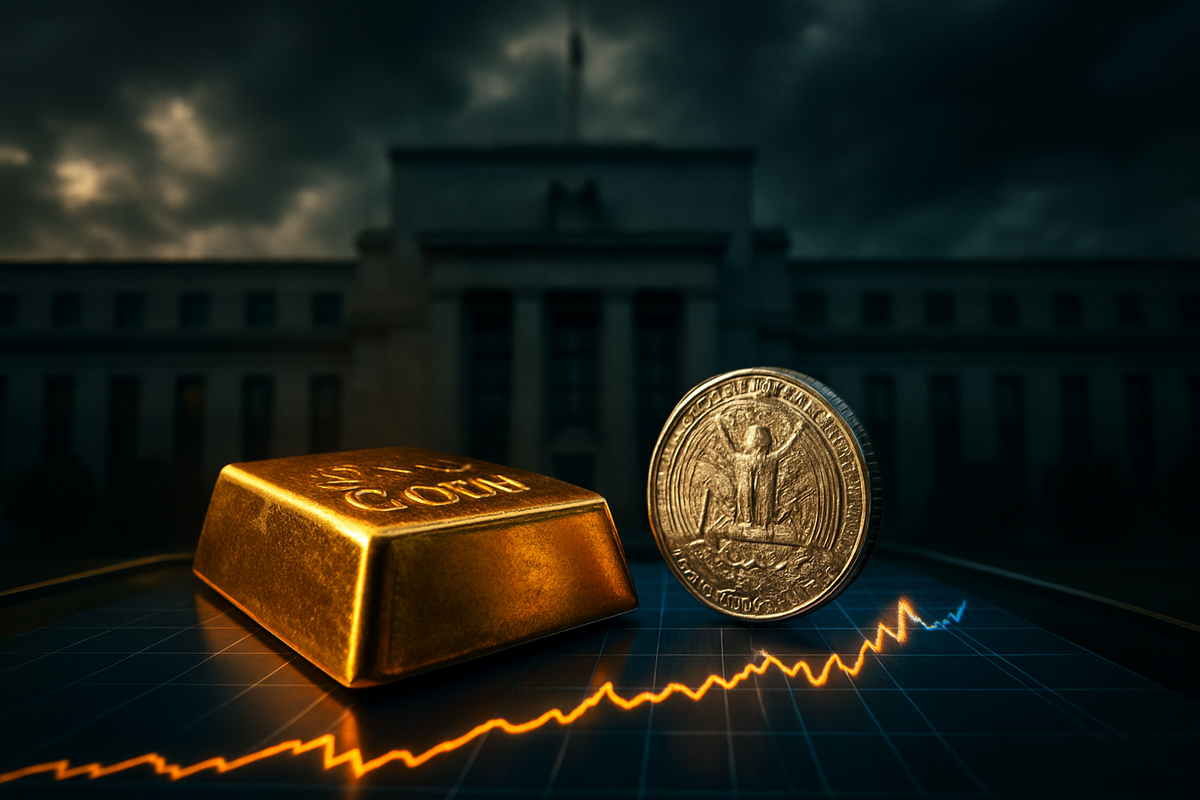
On January 29, 2026, the global financial landscape reached a fever pitch as spot gold surged to an unprecedented all-time high of $5,595 per ounce, while silver staged a "parabolic" ascent to touch $120.45 per ounce. This monumental rally, which analysts are calling the "Great Revaluation," marks a fundamental shift in how markets perceive value amidst deepening institutional instability and persistent inflation. The surge has placed the Federal Reserve in an increasingly tight corner, caught between a vertical commodity market and intense pressure from the executive branch to loosen the reins on monetary policy.
The immediate implications of this price explosion are profound. While the record highs have minted fortunes for precious metals investors, they signal a growing lack of confidence in the U.S. dollar as a stable store of value. As of today, the gold-to-silver ratio has collapsed to a decade-low of 45:1, suggesting a speculative mania in industrial and monetary metals that the Federal Reserve has yet to tame. For the public, these prices translate to a surge in the cost of everything from high-end electronics and solar panels to jewelry and investment coins, further complicating the inflation narrative that Chair Jerome Powell has struggled to control.
The Path to the Peak
The road to these record highs began in late 2025, driven by a "perfect storm" of a weakening dollar, heightening geopolitical tensions in the Middle East and Southeast Asia, and a unique domestic crisis involving the independence of the Federal Reserve. The timeline reached a critical junction on January 28, 2026, when the Federal Open Market Committee (FOMC) concluded its first meeting of the year. Despite the dramatic rise in metals, the FOMC chose to hold the federal funds rate steady at 3.50%–3.75%, maintaining what Powell described as a "hawkish but steady" stance.
Key players in this unfolding drama include Federal Reserve Chair Jerome Powell, who is currently navigating a criminal investigation by the Justice Department into cost overruns at the Fed’s headquarters—a probe Powell has dismissed as a "coercion attempt" to force rate cuts. Simultaneously, the Supreme Court has been deliberating Trump v. Cook, a case involving the President's attempt to fire Fed Governor Lisa Cook. These political battles have acted as a catalyst for the precious metals rally, as investors flee toward "politically neutral" assets that cannot be manipulated by government decree.
Market reaction to the Fed's decision to hold rates has been one of skeptical resilience. While the Fed signaled only one potential rate cut for the entirety of 2026, the gold market ignored the hawkish rhetoric entirely, breaking the $5,500 barrier just hours after the announcement. Traders are effectively calling the Fed’s bluff, betting that the central bank will eventually be forced to monetize the growing national debt or cave to political pressure as the 2026 election cycle approaches.
Winners and Losers in a High-Metal Economy
The primary winners in this environment are the major mining conglomerates, which have seen their profit margins expand to historic levels. Newmont Corporation (NYSE: NEM) and Barrick Gold Corporation (NYSE: GOLD) have reported record free cash flows, with operating margins in some cases exceeding 70%. Because the all-in sustaining costs (AISC) for these giants have remained relatively stable between $1,400 and $1,600 per ounce, the $4,000 premium over production costs has turned these once-laggard stocks into the darlings of Wall Street.
The VanEck Gold Miners ETF (NYSEARCA: GDX) has delivered a staggering 189% return over the last twelve months, significantly outperforming the broader S&P 500. In the silver sector, companies like Pan American Silver Corp. (NYSE: PAAS) and Wheaton Precious Metals Corp. (NYSE: WPM) have seen even more explosive growth, as the industrial demand for silver in the green energy sector combines with its revived status as a monetary hedge. These companies are now sitting on massive war chests, leading to a wave of consolidation as they seek to acquire junior miners to replenish their reserves.
Conversely, the losers in this scenario are the traditional regional banks and companies heavily reliant on low-cost credit. As the Fed maintains higher rates to combat the "commodity inflation" driven by gold and silver, the cost of borrowing remains high for small businesses and consumers. Furthermore, companies in the technology and renewable energy sectors that utilize silver for industrial components—such as solar panel manufacturers—are facing a sudden spike in input costs that could squeeze their 2026 earnings.
A Paradigm Shift in Global Finance
The current surge in precious metals is not merely a localized event but a significant shift in the broader financial paradigm. Historically, gold rallies were often short-lived responses to specific crises. However, the 2026 rally fits into a trend of "de-dollarization" and a move toward hard assets that has been brewing since the early 2020s. Unlike the 2011 peak, which was largely driven by a post-recession "fear trade," the current environment is defined by the erosion of the "Fed Put"—the belief that the central bank can always stabilize markets without consequences.
The regulatory implications are also coming to the fore. As gold and silver prices soar, there is renewed talk in Washington about "windfall profit taxes" on mining companies, similar to those proposed for oil majors in previous decades. Furthermore, the Trump v. Cook Supreme Court case could redefine the very nature of central bank independence. If the court rules that the executive branch has more direct control over the Fed, gold may continue its climb as the perceived "inflation protection" becomes even more necessary for institutional portfolios.
Comparisons to the 1970s "stagflation" era are increasingly common among economists. Just as gold served as an escape hatch during the Nixon and Carter administrations, the 2026 surge reflects a market that no longer believes the official inflation statistics. While the Fed focuses on "core" metrics that exclude food and energy, the "Great Revaluation" of metals suggests that the market is pricing in a long-term devaluation of fiat currency that transcends traditional economic cycles.
The Road Ahead: 2026 and Beyond
Looking ahead, the short-term outlook remains highly volatile. Analysts expect a period of consolidation as some investors take profits at the $5,500 level, yet the underlying drivers—debt, political discord, and dollar weakness—remain unresolved. In the long term, if the Federal Reserve does manage to maintain its independence and eventually bring core inflation down to 2%, gold and silver may see a significant correction. However, any pivot toward aggressive rate cuts in the second half of 2026 could send gold toward the $6,000 mark.
Mining companies will likely undergo a strategic pivot, moving away from aggressive exploration and toward maximizing shareholder returns through dividends and buybacks. This shift is already visible in the guidance provided by Barrick Gold, which has prioritized its copper-gold "dual-commodity" strategy to capture both the monetary and industrial upside. Investors should also watch for the emergence of "silver mania," as the smaller silver market is more prone to rapid, speculative spikes that can decouple from fundamental value.
The ultimate scenario for 2026 may be a "higher-for-longer" commodity price environment that forces the Fed to rethink its 2% inflation target entirely. If the central bank is forced to raise its target to 3% or 4% to accommodate the reality of rising resource costs, it would effectively cement the gains in gold and silver as the new baseline for the global economy.
Summary of a Market in Transition
The Federal Reserve's stance in January 2026 remains one of defiance against both market momentum and political pressure. By holding interest rates steady, the Fed is attempting to signal that it will not be bullied by the "gold bugs" or the White House. However, the record highs in precious metals suggest that the market’s verdict on the future of the dollar is already coming in. The "Great Revaluation" is a clear sign that the era of easy money and unquestioned central bank authority may be drawing to a close.
Moving forward, the market is likely to remain in a state of heightened tension. Investors should keep a close eye on the Supreme Court's ruling on Fed independence and the Fed's next "dot plot" scheduled for March. These will be the primary indicators of whether the current rally is a speculative bubble or a permanent adjustment to a new economic reality.
In conclusion, while the Fed may not be ready to acknowledge gold and silver as official barometers of its success, the $5,500 and $120 price tags are hard to ignore. For the first time in generations, the precious metals market is not just reacting to the news—it is making it.
This content is intended for informational purposes only and is not financial advice.