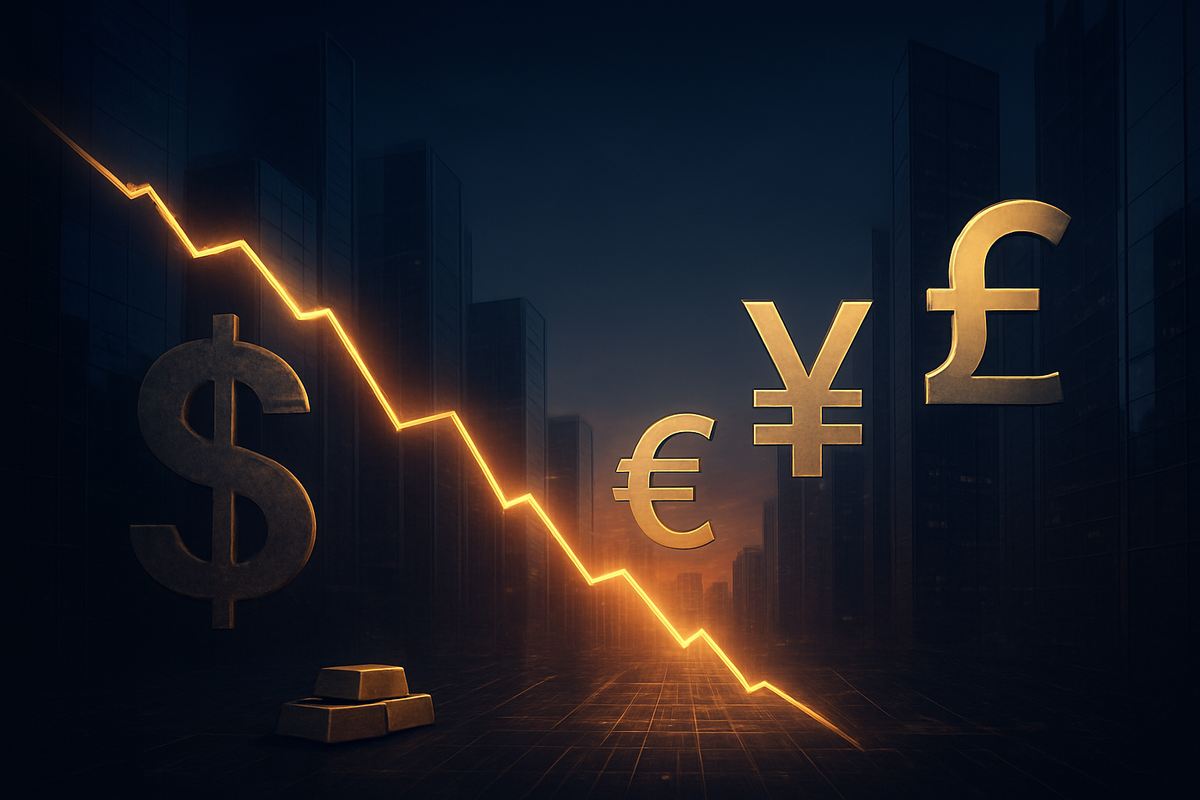
In a dramatic shift for global finance, the U.S. Dollar Index (DXY) has plummeted to its lowest level since early 2022, signaling an end to the "dollar exceptionalism" that defined the early 2020s. As of late January 2026, the greenback is trading in the 95.00–96.00 range, a staggering retreat from the highs of 109 seen just a year ago. This decline has sent ripples through international boardrooms, as the "Sell America" trade takes hold among investors wary of cooling U.S. growth and a ballooning federal deficit.
The immediate implications are profound: while American tourists are finding their purchasing power diminished in London and Tokyo, U.S. multinational corporations are reporting a massive "translation tailwind" that is artificially inflating their quarterly earnings. However, the celebration on Wall Street is tempered by rising import costs and a historical shift in global reserves, where gold has—for the first time in modern history—surpassed U.S. Treasuries in the portfolios of several major central banks.
The Roots of the Slide: A Convergence of Easing and Excess
The dollar’s descent began in earnest during the second half of 2025, driven by a decisive pivot from the Federal Reserve. After a long battle with inflation, the Fed implemented three consecutive 25-basis-point rate cuts in late 2025, bringing the federal funds rate down to a neutral range of 3.50%–3.75%. This narrowed the interest rate differential that had long made the dollar a magnet for global capital. While the Fed held rates steady in January 2026, the market is already pricing in further cuts for March, viewing the current pause as a temporary reprieve rather than a change in direction.
Adding fuel to the fire is the deteriorating U.S. fiscal position. The federal deficit is now projected to exceed $2 trillion for fiscal year 2026, exacerbated by the "One Big Beautiful Bill Act" (OBBBA) of 2025, which significantly increased federal borrowing and tax refunds. Investors have grown increasingly uneasy over "fiscal profligacy," with governance risks further heightened by public disputes between the White House and the Federal Reserve. This political friction has prompted European and Asian funds to seek alternatives to dollar-denominated debt, leading to a notable 1.3% single-day drop in the DXY on January 27, 2026—the worst performance since the "tariff tantrum" of early 2025.
Multinationals Win, Importers Lose: The FX Dividend
For U.S. tech and consumer giants, the weakening dollar is providing a much-needed financial cushion. Microsoft (NASDAQ: MSFT) reported a 17% revenue increase in its latest quarterly results, but management noted that nearly 2% of that growth—approximately $1.6 billion—was purely due to the translation effect of a weaker dollar. Similarly, Apple (NASDAQ: AAPL) has been able to use the currency tailwind to buffer the impact of new 2025 tariffs, keeping the iPhone 17 competitively priced in recovering markets like China.
Consumer staples giant Procter & Gamble (NYSE: PG) projected a $300 million after-tax tailwind for fiscal 2026, explicitly stating that foreign exchange benefits are now offsetting higher logistical costs. Other major beneficiaries include IBM (NYSE: IBM), which saw a 3% boost from currency translation, and Tesla (NASDAQ: TSLA), whose U.S.-made vehicles have suddenly become 10–12% cheaper for European and Asian buyers compared to two years ago.
However, the news is not universally positive. Retail behemoths like Walmart (NYSE: WMT) and Target (NYSE: TGT) are facing a "double whammy." As the dollar weakens, the cost of importing goods from Asia has spiked, and these companies are finding it difficult to pass those costs onto consumers already wary of 2025’s price hikes. Across the Atlantic, European firms like the Swiss pharmaceutical giant Roche (SIX: ROG) are seeing their profits "blunted," as their significant U.S. sales lose value when converted back into the surging Swiss Franc.
A New World Order: De-Dollarization Moves from Theory to Practice
The decline of the greenback is more than just a cyclical downturn; it reflects a structural shift in the global financial architecture. In a historic blow to the "petrodollar," Saudi Arabia completed a $14.7 billion oil transaction with China settled entirely in yuan in early January 2026. This move was echoed by the broader BRICS+ bloc, which has accelerated the development of "BRICS Pay," a blockchain-based digital ledger that bypasses the New York-based SWIFT system.
Central banks in China and India have been the most aggressive in this diversification. China’s U.S. Treasury holdings have dropped to a decade-low of $682 billion, while the Reserve Bank of India has slashed its Treasury exposure by 20% in the last year alone. The pivot toward gold has driven the precious metal to record highs above $5,500 per ounce, reinforcing the narrative that the dollar’s status as the world’s ultimate safe-haven asset is being challenged for the first time in eighty years.
The Horizon: Inflationary Risks and Strategic Pivots
As we look toward the remainder of 2026, the primary concern for the U.S. economy is the potential for "imported inflation." A weaker dollar makes imported components and raw materials more expensive, which could force the Federal Reserve to pause its easing cycle or even consider hikes if consumer prices begin to re-accelerate. This "no landing" scenario could lead to a period of stagflation if U.S. GDP growth continues to lag behind that of the UK and Japan, both of which reported surprising economic resilience in January 2026.
Companies are already beginning to pivot their strategies. We are seeing a resurgence in "near-shoring" and "on-shoring" as firms try to reduce their reliance on foreign-denominated supply chains. Additionally, U.S. exporters are ramping up their marketing efforts in Europe and Asia, capitalizing on their newfound price advantage. Investors should expect a volatile 2026, with the currency market increasingly driven by fiscal policy debates in Washington rather than just monetary policy in Frankfurt or Tokyo.
Summary: A Market in Transition
The current decline of the U.S. dollar is a complex phenomenon driven by a cooling domestic economy, high-stakes fiscal expansion, and an organized global effort to diversify away from the greenback. While the "FX dividend" is currently padding the bottom lines of S&P 500 multinationals, the long-term implications of a weaker dollar—higher borrowing costs and reduced global influence—cannot be ignored.
Moving forward, investors should keep a close eye on the U.S. Treasury’s upcoming auction schedules and the rhetoric surrounding the Federal Reserve’s independence. The transition to a more "multi-polar" currency world is no longer a distant possibility; it is the current reality of the 2026 market. Those who can navigate the pitfalls of import-driven inflation while capturing the benefits of export competitiveness will be the winners in this new economic era.
This content is intended for informational purposes only and is not financial advice.