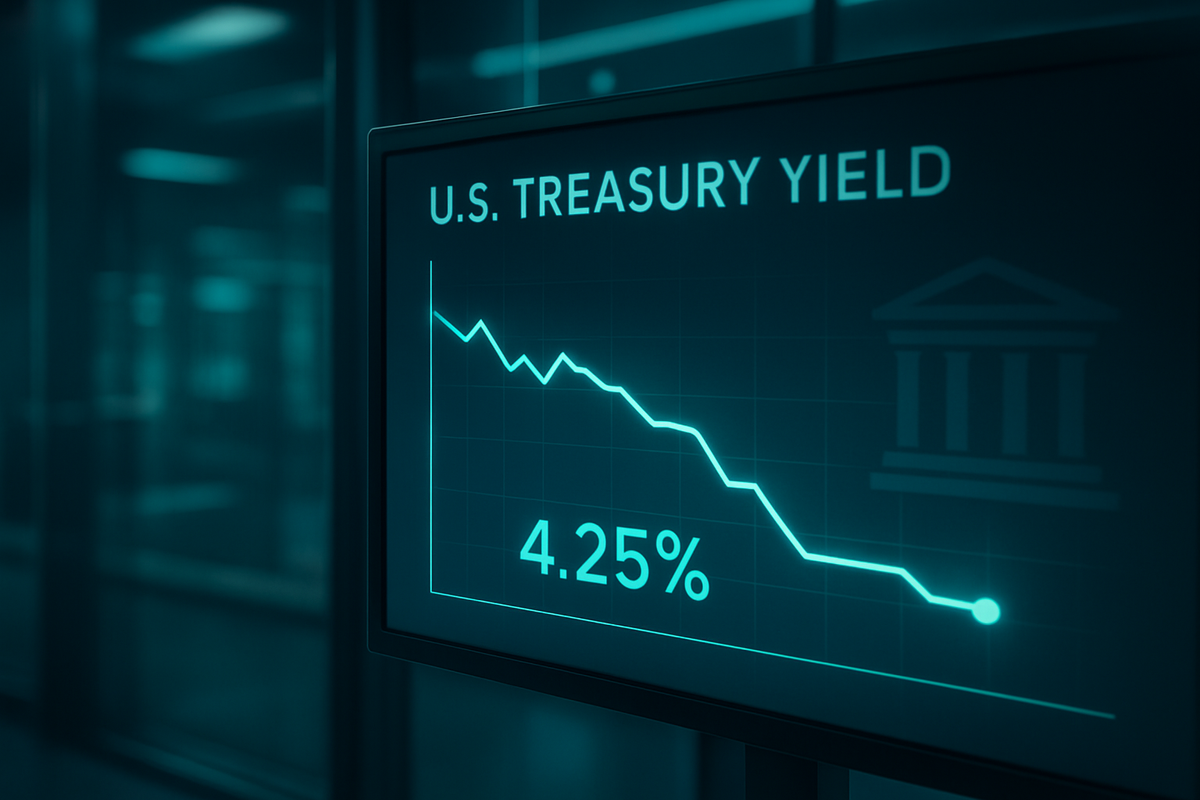
The benchmark 10-year Treasury yield has retreated to 4.25% as of January 29, 2026, offering a slight reprieve to a market that had been gripped by a sudden surge in borrowing costs earlier this month. The move marks a cooling from a five-month high of 4.31% reached on January 20, as investors recalibrate their expectations following the Federal Reserve’s first policy meeting of the year and a series of disruptive geopolitical headlines.
This retreat to 4.25% is being viewed by analysts as a stabilizing force for both fixed-income portfolios and equity valuations. While the yield remains significantly higher than the 3.95% levels seen in late 2025, the stabilization suggests that the "valuation shock" of early January may be subsiding, allowing market participants to pivot their focus from interest rate volatility toward corporate earnings and domestic economic resilience.
A Volatile Path to Stability
The journey to the 4.25% level has been a volatile one for the Treasury market. Throughout the first three weeks of January 2026, the 10-year yield climbed aggressively as the market reacted to the "One Big Beautiful Bill Act," a major fiscal stimulus package that raised concerns about expanding federal deficits and increased bond supply. Simultaneously, geopolitical tensions flared when the U.S. administration threatened a 10% tariff on several European nations following disagreements over international acquisitions, sparking fears of renewed inflationary pressure.
The peak of the sell-off occurred on January 20, when the yield touched 4.31%, fueled by rumors that international sovereign funds might reduce their U.S. debt holdings in retaliation for trade restrictions. However, the tone shifted following the Federal Open Market Committee (FOMC) meeting on January 28, 2026. The Fed chose to keep the benchmark federal funds rate unchanged at 3.5%–3.75%, pausing the easing cycle it had begun in late 2025.
While the Fed’s official stance remained cautious, with Chair Jerome Powell noting that policy did not yet seem "significantly restrictive," the absence of a hawkish surprise provided the "stabilization trade" the market was seeking. The subsequent auction of 10-year notes saw surprisingly robust demand from domestic institutional buyers, effectively capping the yield at the 4.25% mark. This move has successfully flattened the volatility curve, providing a much-needed "anchor" for global asset pricing after a chaotic start to the year.
Winners and Losers in the Yield Shift
The descent toward 4.25% has created a clear divide between market winners and those facing renewed scrutiny. Technology giants, whose valuations are highly sensitive to the discount rates used in financial modeling, have been the primary beneficiaries. NVIDIA (NASDAQ: NVDA) saw its shares climb 1.62% in late-January trading, buoyed not just by the yield relief but also by news of a massive $60 billion AI investment initiative. Similarly, Apple (NASDAQ: AAPL) traded up over 2% as the 4.25% yield provided a more comfortable "valuation floor" for its premium price-to-earnings multiple.
Conversely, the banking sector has struggled to find its footing despite the yields remaining at levels that typically support net interest margins. JPMorgan Chase & Co. (NYSE: JPM) and Bank of America Corp. (NYSE: BAC) both reported negative year-to-date returns, down 6.15% and 5.42% respectively. While both institutions provided resilient guidance for 2026 income, they have been hampered by political headwinds and legal challenges, proving that for the nation’s largest lenders, the "rate tailwind" is currently being offset by regulatory and idiosyncratic risks.
In the real estate and utility sectors, the reaction has been more nuanced. Prologis (NYSE: PLD), the logistics real estate powerhouse, saw its valuation "neutralized" by the move to 4.25%, as the market began to focus more on its 30% cash rent spreads rather than the cost of its debt. NextEra Energy (NYSE: NEE) emerged as a standout winner, posting a 6.6% return over the last 30 days. As a utility with significant exposure to AI data center power demand, NextEra has successfully transitioned in the eyes of investors from a mere "bond proxy" to a "growth beneficiary" of the ongoing infrastructure boom.
Wider Market Implications and Historical Context
The broader significance of the 10-year yield stabilizing at 4.25% lies in what it signals about the U.S. economy’s "soft landing" in 2026. Historically, a yield of 4.25% alongside GDP growth tracking at roughly 2.3% to 2.5% suggests an economy that is "hot" but not "overheating." This environment has allowed the Russell 2000 index to outperform the S&P 500 for 14 straight sessions in January, as the stabilization at 4.25% eased fears of rate-driven defaults among smaller, more leveraged companies.
This event also highlights a shift in industry trends where the "risk-free rate" is no longer the sole driver of equity prices. In 2024 and 2025, every basis point move in the 10-year yield dictated the direction of the Nasdaq. In 2026, we are seeing a "decoupling," where companies like Microsoft (NASDAQ: MSFT) can see their shares decline despite stable yields if their capital expenditures for AI are perceived as too aggressive. The 4.25% yield is becoming a "background variable" rather than the lead protagonist.
Furthermore, the international ripple effects are profound. With Japanese Government Bonds (JGBs) also seeing a sell-off due to fiscal concerns in Japan, the U.S. 10-year Treasury at 4.25% remains an attractive destination for global capital. This capital inflow helps support the U.S. dollar, which in turn influences the trade dynamics and tariff discussions currently dominating the headlines in Washington.
Future Outlook: Navigating the New Equilibrium
Looking ahead, the market’s attention will shift toward the "terminal rate" of this current economic cycle. Short-term, the 4.25% level will be tested by the upcoming February inflation data. If the Consumer Price Index (CPI) remains "sticky" at the current 2.7% year-over-year rate, the 10-year yield could easily re-test the 4.31% highs. However, if the labor market—which currently shows an unemployment rate of 4.4%—starts to soften further, we could see a move toward 4.00% by the end of the second quarter.
A major strategic pivot for investors in the coming months will be the transition of Federal Reserve leadership. With Chair Powell’s term nearing its end and speculation mounting over his successor in May 2026, the 10-year yield will likely act as a barometer for "policy continuity" risk. Market participants will need to adapt to a scenario where the Fed may be more tolerant of slightly higher inflation in exchange for maintaining robust GDP growth.
The primary challenge for corporations will be managing the "higher-for-longer" reality of a 4% plus yield environment. While the immediate panic of a move toward 5% has subsided, the era of "free money" is firmly in the rearview mirror. Companies with strong balance sheets and high free cash flow will continue to separate themselves from "zombie" firms that require frequent debt refinancing.
Summary and Investor Takeaways
The retreat of the 10-year Treasury yield to 4.25% serves as a critical junction for the 2026 market. It reflects a precarious balance between a resilient domestic economy, lingering inflationary pressures, and a Federal Reserve that is willing to wait for clearer data before committing to further rate cuts. For investors, the key takeaway is that the "valuation floor" has been established, but the ceiling for growth will be determined by corporate execution rather than central bank intervention.
Moving forward, the market appears to be entering a period of "tempered optimism." The stabilization of yields has allowed for a broadening of the rally into small-cap and value sectors, reducing the market's over-reliance on a handful of tech giants. However, the path remains fraught with geopolitical and fiscal risks that could easily push yields back toward recent highs.
In the coming months, investors should keep a close watch on Treasury auction demand and the internal divisions within the FOMC. Any sign of a consensus shift toward more aggressive rate cuts—or, conversely, a resurgence in inflation—will immediately challenge the current 4.25% equilibrium. For now, the bond market has provided a moment of calm, but in the volatile landscape of early 2026, that calm may prove to be fleeting.
This content is intended for informational purposes only and is not financial advice.