As of February 2, 2026, the technology sector is still reeling from what market analysts are calling the "Great AI Reset." Microsoft (NASDAQ: MSFT), long the standard-bearer for the generative AI revolution, recently reported second-quarter fiscal 2026 results that, while superficially strong, triggered a massive sell-off. The immediate implication for the market is clear: the era of rewarding "AI potential" has ended, and a new, more demanding era of "AI proof" has begun.
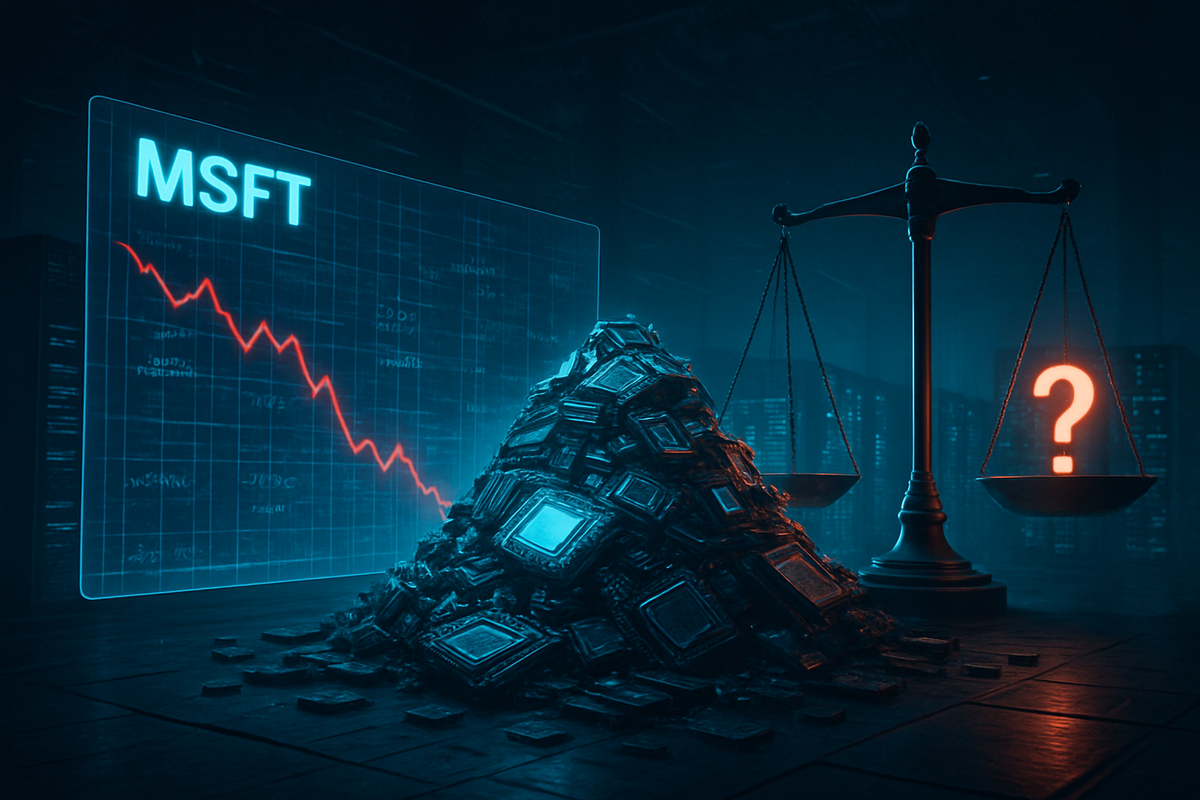
Despite beating analyst estimates on both revenue and earnings, Microsoft’s stock price suffered a historic 10.5% plunge on January 29, 2026, following its earnings call the previous evening. This single-day rout erased approximately $375 billion in market capitalization, marking one of the largest destructions of shareholder value in corporate history. The disconnect between robust growth and a crashing stock price has left investors questioning the long-term profitability of the massive infrastructure investments required to stay ahead in the AI race.
The Post-Earnings Reality Check
Microsoft’s second-quarter fiscal 2026 results, released on January 28, 2026, initially appeared to be a triumph. The company reported revenue of $81.3 billion, a 17% increase year-over-year, which outpaced the consensus estimate of $80.3 billion. Adjusted earnings per share (EPS) came in at $4.14, beating the expected $3.91. Most notably, the "Microsoft Cloud" segment surpassed the $50 billion quarterly milestone for the first time, reaching $51.5 billion. However, the optimism was short-lived as investors dissected the underlying costs and growth trajectories.
The primary catalyst for the sell-off was the disclosure of $37.5 billion in quarterly capital expenditures (CapEx), a staggering figure mostly dedicated to building out AI-integrated data centers and purchasing high-end hardware. While Azure, Microsoft’s cloud computing platform, grew 39% year-over-year, it represented a slight deceleration from the 40% growth seen in the previous quarter. CFO Amy Hood warned that growth was currently "supply-constrained," suggesting that even with tens of billions in spending, Microsoft cannot build infrastructure fast enough to meet current demand.
The initial market reaction was a "beat-and-drop" scenario. While Microsoft outperformed expectations, the sheer scale of the spending led to a "rerating" of the stock. Investors, led by major institutional stakeholders, expressed concern that the company is entering a "circular financing" loop—spending massive amounts on hardware that takes years to translate into sustainable, high-margin software profits. By the close of trading on February 2, the stock was hovering near a critical support level of $433.50, significantly down from its pre-earnings high of $481.63.
Ripple Effects Across the "Magnificent Seven"
The Microsoft sell-off sent shockwaves through its peers, creating a "sympathy pressure" effect on Alphabet Inc. (NASDAQ: GOOGL). Alphabet, which is scheduled to report earnings on February 4, saw its shares trade lower as investors anticipated a similarly bloated CapEx budget for Google Cloud. The fear is that the competitive pressure to keep pace with Microsoft is forcing all major tech firms into a low-ROI spending spree that could compress margins for years to come.
Amazon.com Inc. (NASDAQ: AMZN) also faced headwinds, with its stock price dipping in late January. Investors are particularly focused on the upcoming AWS growth figures and whether Amazon can maintain its cloud dominance without mirroring Microsoft’s $150 billion annual CapEx trajectory. However, there was one notable outlier in the sector: Meta Platforms Inc. (NASDAQ: META). Meta’s stock surged nearly 10% during the same week as Microsoft's crash, as the company successfully demonstrated that its AI spending was already driving immediate returns in advertising efficiency and user engagement, offering a blueprint for what "AI execution" should look like.
For the hardware providers, the outlook is mixed. NVIDIA Corporation (NASDAQ: NVDA) remains the primary beneficiary of Microsoft’s aggressive spending, yet its stock has also faced volatility. Investors are now concerned that if software giants like Microsoft begin to tap the brakes on their infrastructure build-out due to shareholder pressure, NVIDIA’s "endless demand" narrative could finally face a test. The hardware-software divide has become the central tension of the 2026 market, with the winners being those who can turn silicon into sustainable cash flow.
A Wider Significance: The AI Infrastructure Trap
This event fits into a broader industry trend where the market is no longer satisfied with "cloud-plus-AI" growth. In 2024 and 2025, any mention of AI integration was enough to drive a stock price higher. By early 2026, the market has pivoted to a fundamentalist view. The historical precedent often cited by analysts is the fiber-optic build-out of the late 1990s. While that infrastructure eventually enabled the modern internet, many of the companies that built it faced years of stagnation or bankruptcy before the investments paid off.
The regulatory environment also looms large over Microsoft’s current predicament. Global regulators have been scrutinizing the partnership between Microsoft and OpenAI, and the GAAP-basis $7.6 billion accounting gain from the recapitalization of that investment raised eyebrows in late January. Policymakers are increasingly concerned about the concentration of AI power within a few "hyperscalers," which could lead to tighter antitrust oversight. This potential for regulatory "drag" is adding another layer of risk to Microsoft’s capital-intensive strategy.
Furthermore, the "supply-constrained" nature of Azure growth highlights a potential ceiling for the industry. If Microsoft cannot build data centers fast enough despite spending $37 billion a quarter, the rapid AI growth rates that the market has priced in may be physically impossible to maintain. This physical limitation on growth is a relatively new phenomenon in the software world, which historically benefited from near-infinite scalability with minimal marginal costs.
What Comes Next: Strategic Pivots and Scenarios
In the short term, Microsoft must convince the market that its $37.5 billion quarterly spend is not just defensive but offensive. The company is expected to pivot its messaging toward "AI Efficiency"—focusing on how it can lower the cost of serving AI models to improve margins. Analysts will be watching for any signs of a slowdown in CapEx in the second half of 2026. If Microsoft continues to spend at this rate without an acceleration in Azure growth, the stock could test deeper support levels in the $380 to $400 range.
Longer-term, the strategic challenge for Microsoft is to maintain its leadership in the "Copilot" ecosystem across its Productivity and Business Processes segment. While that segment grew a healthy 16% to $34.1 billion, it has yet to show the "hyper-growth" that would justify the company's valuation premium. A potential strategic pivot could involve more aggressive vertical integration, such as developing more of its own custom AI silicon to reduce its dependence on expensive third-party hardware, thereby easing the CapEx burden.
The Wrap-Up: A New Paradigm for Tech Investors
The late January 2026 performance of Microsoft serves as a definitive turning point for the technology sector. The "Great AI Reset" has taught investors that revenue beats are meaningless if they are bought with unsustainable levels of capital investment. Microsoft remains a powerhouse with record-setting cloud revenues, but the market has shifted its gaze from the top line to the bottom line—and specifically to the return on invested capital (ROIC).
Moving forward, the tech market is likely to be characterized by high volatility as each of the "Magnificent Seven" reports their progress in monetizing AI. Investors should watch the $430 support level for MSFT closely; a break below this could signal a broader "bearish death cross" for the stock. In the coming months, the focus will remain on whether Microsoft can resolve its supply constraints and if its massive infrastructure bets will finally begin to yield the high-margin profits that shareholders were promised at the start of the decade.
This content is intended for informational purposes only and is not financial advice.