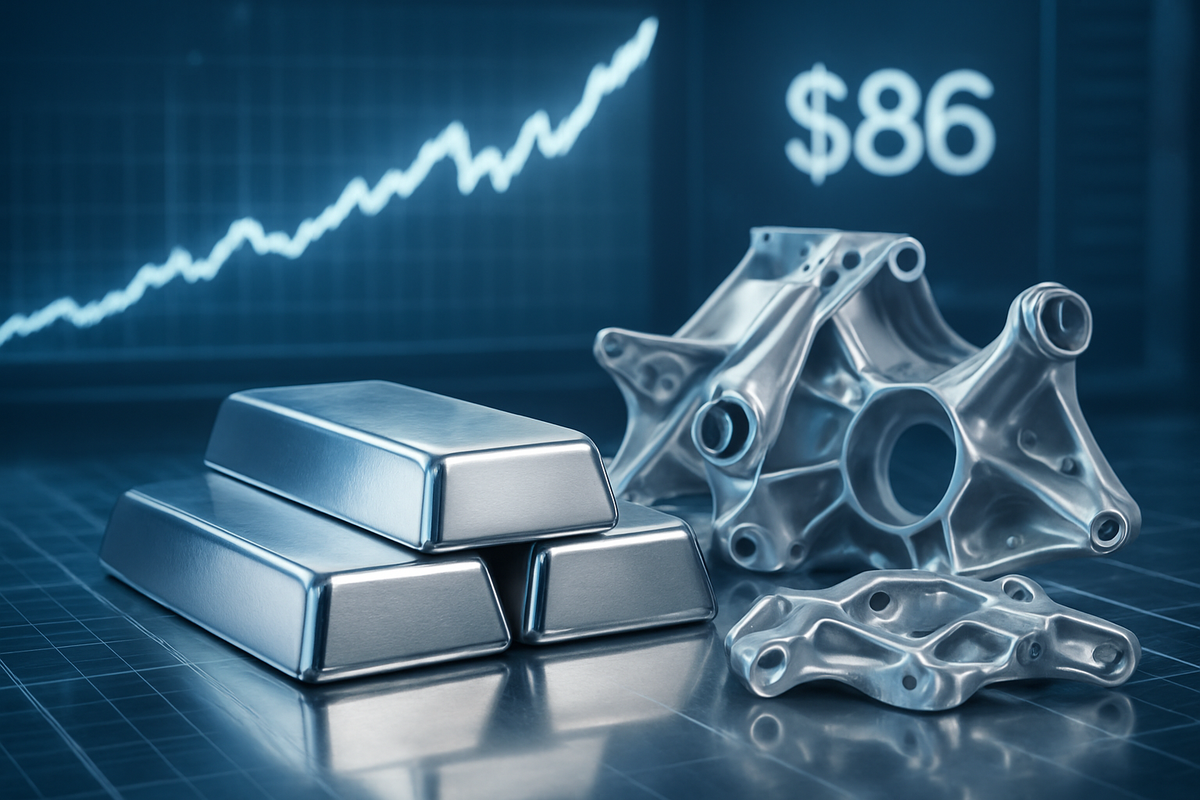
LONDON — February 23, 2026 — Silver prices have staged a dramatic recovery to $86 per ounce this week, marking a pivotal moment in the precious metals market as the traditional "gold-silver ratio" continues its aggressive contraction. After a volatile start to the year, silver is once again outperforming its yellow counterpart on a percentage basis, driven by a potent combination of persistent safe-haven interest and a resurgence in industrial demand following the Lunar New Year holidays in Asia.
The narrowing of the gold-silver ratio to 64:1—down from a staggering 104:1 at its cyclical peak—signals what analysts are calling a "historic catch-up" for the white metal. As institutional investors pivot toward assets with both monetary and industrial utility, silver’s unique position at the heart of the global energy transition and aerospace manufacturing has propelled it into a new price regime, leaving gold’s steady but slower gains in the rearview mirror.
The Road to $86: Volatility and the Post-Holiday Rebound
The climb to $86 per ounce follows a period of unprecedented turbulence. After silver prices reached an all-time high of over $120 in late January 2026, the market experienced a sharp "flash correction" that saw prices briefly dip into the low $70s earlier this month. However, the conclusion of the Lunar New Year celebrations on February 17, 2026, acted as a catalyst for the current rally. As markets in Shanghai and Hong Kong reopened, a "liquidity vacuum" was filled by a wave of physical buying from Chinese industrial giants and retail investors, who traditionally favor silver during the "Year of the Horse."
This recovery is underpinned by a structural supply deficit that has now entered its sixth consecutive year. While gold has benefited from central bank purchasing, silver's rally is more complex, fueled by a 150% gain throughout 2025 that shifted the market's internal dynamics. The move from a 104:1 ratio to 64:1 represents a massive re-rating of silver's value relative to gold, reflecting a realization among traders that the world’s silver stockpiles are being depleted faster than they can be replenished by primary mining operations.
Industry Winners and the Cost of Conductivity
The primary beneficiaries of this price surge are the major silver producers, led by Fresnillo plc (LSE: FRES), the world’s largest primary silver miner. With prices holding firmly above the $80 mark, profit margins for high-output miners have expanded to record levels. Pan American Silver (NYSE: PAAS) has also seen its valuation climb, particularly as its integrated Juanipio mine continues to deliver high-grade silver at a time when global reserves are thinning. For pure-play exposure, investors have flocked to First Majestic Silver (NYSE: AG), which has leveraged its own minting facilities to capture the high premiums currently found in the retail bullion market.
Conversely, the high cost of silver is creating significant headwinds for industrial consumers. In the solar sector, companies like First Solar (NASDAQ: FSLR) are facing a "thrifting" crisis; silver now accounts for nearly 20% of the total cost of a photovoltaic module. While demand for renewable energy remains inelastic, the high price point is forcing a rapid shift toward silver-coated copper and other conductive substitutes. Similarly, in the aluminum and aerospace sectors, companies like Alcoa (NYSE: AA) and Boeing (NYSE: BA) are navigating the rising costs of specialized silver-aluminum alloys (Al-Cu-Li-Ag). These alloys are essential for the next generation of fuel-efficient aircraft, and the strategic stockpiling of silver by aerospace firms has contributed to the current supply squeeze.
A Fundamental Shift in Global Industry Trends
This "silver breakout" is more than just a speculative bubble; it is a reflection of the metal's evolving role in a decarbonizing economy. Historically, silver was viewed primarily as a monetary asset that followed gold's lead. In 2026, however, its industrial profile has taken center stage. The energy transition has transformed silver into a critical strategic mineral, similar to lithium or cobalt, but with the added benefit of a 5,000-year history as a store of value.
The shift in the gold-silver ratio from 104:1 to 64:1 mirrors past historical precedents, such as the silver bull markets of 1980 and 2011, but with a key difference: the current move is driven by a physical shortage rather than purely speculative futures trading. Analysts point to the fact that nearly 70% of silver is produced as a by-product of lead, zinc, and copper mining, meaning that even at $86/oz, supply cannot be easily ramped up. This "inelastic supply" against "exploding demand" from the solar and aerospace sectors has created a fundamental floor that many believe will prevent a return to the double-digit ratios of the early 2020s.
The Path Forward: Can Silver Reach Triple Digits?
As we look toward the second half of 2026, the market is bracing for a potential run toward the $100 per ounce milestone. The immediate focus will be on the sustainability of industrial demand. If silver remains above $85, the "thrifting" trend in the solar industry could accelerate, potentially leading to demand destruction. However, the aerospace sector’s reliance on silver for high-performance aluminum alloys appears less flexible, providing a consistent source of "must-have" buying pressure.
In the short term, the market will be watching the COMEX inventory levels and the Shanghai Gold Exchange for signs of further physical tightening. Strategic pivots are already underway; streaming companies like Wheaton Precious Metals (NYSE: WPM) are increasingly seeking out new contracts that prioritize silver by-product rights, anticipating that the metal will continue to outperform gold on a percentage basis for the foreseeable future. The challenge for the market will be managing the volatility that has become a hallmark of the 2026 "silver era."
Summary of the Silver Super-Cycle
The surge to $86/oz on February 23, 2026, confirms that silver is no longer just "gold’s restless cousin." The narrowing of the gold-silver ratio to 64:1 represents a fundamental revaluation of the metal based on its scarcity and its essential role in modern technology. While the journey from 104:1 has been volatile, the combination of a post-Lunar New Year liquidity boost and a multi-year supply deficit has created a robust environment for continued outperformance.
For investors, the key takeaways are clear: watch for the impact of silver prices on solar manufacturing margins and keep an eye on the burgeoning aerospace demand for silver-aluminum alloys. As silver continues its historic catch-up, the market is entering a new phase where the "white metal" may finally step out from the shadow of the yellow one.
This content is intended for informational purposes only and is not financial advice.