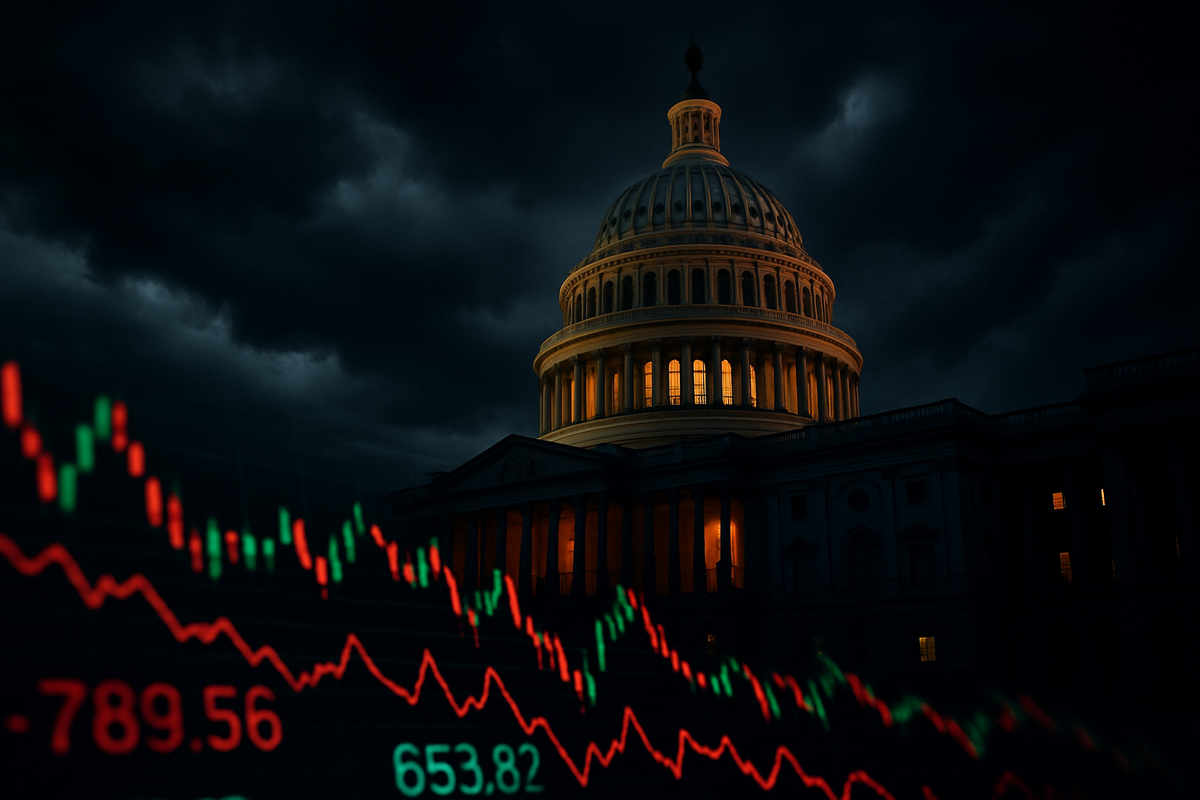
In a week defined by high-stakes political theater and a brief but disruptive lapse in federal operations, Washington has managed to pull back from the edge of a total collapse—though only partially. On February 3, 2026, a $1.2 trillion appropriations package was signed into law, ending a four-day partial government shutdown and securing the operations of 11 out of 12 federal agencies through the remainder of the fiscal year. While the deal provides a temporary sigh of relief for the broader economy, it leaves a glaring "poison pill" on the horizon: the Department of Homeland Security (DHS) remains funded only through February 13, 2026, setting the stage for a second, potentially more volatile, confrontation in less than a week.
The immediate implications for the market are marked by a profound sense of uncertainty, primarily driven by a "data blackout." With the brief shutdown shuttering the Bureau of Labor Statistics (BLS) and other reporting bodies during the crucial transition, the highly anticipated February Jobs Report—originally scheduled for today, February 6—has been indefinitely delayed. This lack of transparency has sent shockwaves through the financial sector, as the Federal Reserve is now forced to fly blind without the "gold-standard" metrics required to calibrate interest rate decisions for its upcoming March meeting.
The passage of the Consolidated Appropriations Act, 2026 (H.R. 7148) was anything but certain. Following weeks of gridlock, the House of Representatives cleared the bill with a razor-thin 217-214 margin. The timeline of this crisis can be traced back to the late January expiration of previous stopgap measures, which coincided with a catastrophic breakdown in negotiations over border policy. This impasse was exacerbated by the "Alex Pretti incident" in Minneapolis, a fatal encounter involving federal immigration officers that ignited a firestorm of demands for oversight from Senate Minority Leader Chuck Schumer (D-NY) and his caucus.
Key players in the negotiation included Speaker Mike Johnson (R-LA), who faced immense pressure from the House Freedom Caucus to maintain hardline stances, and Senate Majority Leader John Thune (R-SD), who navigated his first major fiscal hurdle since taking the leadership mantle. President Donald Trump, while ultimately signing the $1.2 trillion package, has used the podium to signal a shift in defense spending priorities, emphasizing production over executive payouts. The initial market reaction was a sharp "risk-off" move; following the signing of the partial deal, the Dow Jones Industrial Average (DJIA) fell 600 points on February 5 as investors realized the "data blackout" would hinder the Federal Reserve's ability to combat sticky inflation.
The defense sector presents a complex picture in this new fiscal reality. Lockheed Martin (NYSE: LMT), Northrop Grumman (NYSE: NOC), and RTX Corporation (NYSE: RTX) have seen their backlogs swell to record levels—nearly $194 billion for Lockheed alone—due to a $901 billion defense budget. However, these gains are tempered by the administration’s aggressive rhetoric against executive compensation and share buybacks. The looming threat is that future funding will be contingent on companies redirecting capital from shareholders toward the rapid expansion of munitions production lines, a move that could compress margins in the short term.
The healthcare and pharmaceutical sectors have emerged as the clear losers of this funding cycle. UnitedHealth Group (NYSE: UNH) and Humana Inc. (NYSE: HUM) saw their stock prices plummet in late January and early February after the administration proposed "near-flat" Medicare Advantage rate increases for 2027. This regulatory squeeze, combined with the new Pharmacy Benefit Manager (PBM) reforms tucked into H.R. 7148, has also pressured CVS Health (NYSE: CVS). The reforms aim to "delink" PBM fees from drug prices, a move intended to increase transparency but one that threatens the traditional profit models of these massive healthcare intermediaries. Meanwhile, Pfizer (NYSE: PFE) and Merck & Co. (NYSE: MRK) are closely watching how these PBM shifts will affect their net pricing and formulary placements.
This event fits into a broader trend of "governance by crisis" that has plagued the U.S. fiscal landscape for over a decade, but with a new, more dangerous twist: the weaponization of economic data reporting. The delay of the CPI (Consumer Price Index) and employment data prevents the market from accurately pricing in inflation risks. Historically, shutdowns have been short-lived enough to avoid major data gaps, but the timing of this 2026 lapse directly hit the BLS collection window. This creates a ripple effect where commercial banks and institutions like Cisco Systems (NASDAQ: CSCO) and Amazon.com (NASDAQ: AMZN) must delay major capital allocation decisions because the macro-economic baseline is missing.
Furthermore, the PBM reforms included in the funding bill represent a significant policy pivot. For years, "delinking" was a fringe proposal, but its inclusion in a must-pass spending bill signals a bipartisan appetite for structural changes in the healthcare supply chain. This could serve as a historical precedent for future regulatory actions against other sectors perceived as high-margin intermediaries. The ripple effects will likely be felt by cybersecurity firms like Palo Alto Networks (NASDAQ: PANW), which are seeing federal contract awards slowed not by a lack of budget, but by the administrative backlog caused by the four-day lapse and the ongoing DHS uncertainty.
The short-term outlook is dominated by the February 13 deadline for the Department of Homeland Security. If no deal is reached, the nation faces a lapse in funding for the TSA and FEMA. For the travel industry and companies like Amazon.com (NASDAQ: AMZN), which rely on seamless logistics and transportation infrastructure, a TSA walkout or slowdown could be catastrophic. Markets are currently pricing in a 40% chance of a DHS shutdown, leading to increased volatility in Treasury yields as traders hedge against the possibility of a deeper fiscal crisis.
Looking long-term, defense contractors may need to pivot their strategies. If the Trump administration follows through on its threat to curb buybacks, we may see a strategic shift toward massive domestic infrastructure investment within the defense industrial base. This "production-first" mandate could force a re-evaluation of how large-cap industrial companies are valued, moving the needle from "return on capital" metrics toward "total output capacity."
The recent funding deal is a bittersweet victory for market stability. While the broader government is funded, the specific exclusion of DHS and the resulting "data blackout" have introduced a level of opacity that the markets have not seen in years. The key takeaway for investors is that the "risk-off" environment is likely to persist until the February 13 deadline is cleared and the BLS releases its delayed reports.
Moving forward, the market will likely be characterized by sector-specific volatility rather than broad index swings. Investors should keep a close eye on the DHS negotiations and any further rhetoric regarding PBM transparency and defense capital allocation. The lasting impact of this period may not be the four-day shutdown itself, but the realization that economic data—the very lifeblood of market efficiency—can become a casualty of the ongoing partisan warfare in Washington.
This content is intended for informational purposes only and is not financial advice