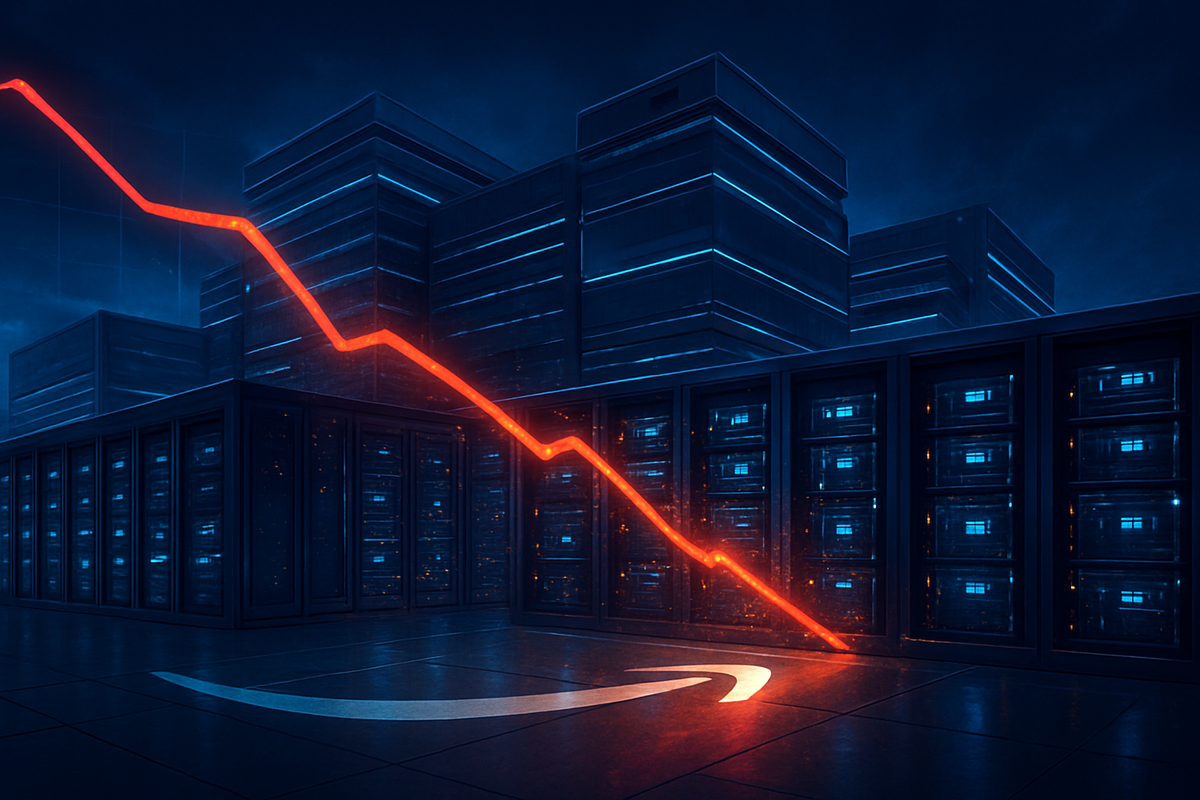
Amazon.com Inc. (NASDAQ: AMZN) shares suffered their steepest one-day decline in nearly two years on Friday, February 6, 2026, after the e-commerce and cloud titan unveiled a capital expenditure (capex) forecast that stunned even the most aggressive Wall Street analysts. Despite reporting record-breaking revenue of $213.4 billion for the fourth quarter of 2025, the company’s stock tumbled 10% as investors pivoted their focus from short-term profitability to a staggering $200 billion spending plan earmarked for 2026.
The market reaction highlights a growing "sticker shock" among shareholders who had anticipated a more moderate $150 billion capex figure. This massive escalation in spending—aimed primarily at securing dominance in the artificial intelligence (AI) infrastructure race—has ignited a debate over whether the "efficiency era" touted by Big Tech just two years ago has been permanently replaced by a capital-intensive arms race with no clear finish line.
The Trillion-Dollar Tumble: A Timeline of the Capex Shock
The sell-off began in after-hours trading on Thursday, February 5, following the release of Amazon’s Q4 2025 results. While the headline numbers initially looked strong—AWS revenue grew 24% year-over-year to $35.6 billion, its fastest growth rate in 13 quarters—the mood soured during the conference call. CEO Andy Jassy and CFO Brian Olsavsky confirmed that the company would transition from its 2025 spending level of approximately $125 billion to a monumental $200 billion in 2026.
This guidance shattered the consensus expectation of $150 billion, a figure that had already been viewed as a high-water mark for the industry. The $50 billion "surprise gap" triggered an immediate revaluation of the company's free cash flow (FCF) outlook. TTM (trailing twelve-month) free cash flow, which investors use to gauge the health of Amazon’s core retail and cloud operations, fell to $11.2 billion—a sharp contraction from the record levels seen in 2024. The market's immediate reaction was a swift 10% haircut, wiping out billions in market capitalization in a matter of hours.
The timeline leading to this moment has been defined by a relentless surge in demand for generative AI. Throughout 2025, Amazon faced capacity constraints for its AWS cloud division, which prevented it from fully capturing the exploding AI workload market. By early 2026, the executive team decided that "capacity equals monetization," choosing to double down on infrastructure to avoid losing ground to competitors. The $200 billion figure also includes significant allocations for Project Kuiper, Amazon's satellite internet venture, and the development of the next-generation Trainium3 and Inferentia AI chips.
Winners and Losers in the Infrastructure Inversion
The immediate "loser" of this earnings report is undoubtedly Amazon (NASDAQ: AMZN) shareholders, who saw their positions diluted by the prospect of heavy capital outflows and compressed margins through at least the next fiscal year. Retail investors, who had cheered the company’s 2023–2024 focus on "operational efficiency" and logistics optimization, now find themselves holding a company that looks more like a high-stakes infrastructure play than a high-margin services business.
Conversely, the clear "winners" are the suppliers feeding the AI beast. NVIDIA Corp (NASDAQ: NVDA) and Advanced Micro Devices Inc (NASDAQ: AMD) are expected to remain prime beneficiaries, as Amazon will still require massive quantities of external GPUs while its internal chip programs scale. Power management and data center cooling specialists like Vertiv Holdings Co (NYSE: VRT) also saw their stock prices buoyed, as the sheer scale of Amazon’s $200 billion spend guarantees a massive backlog for infrastructure components. Taiwan Semiconductor Manufacturing Co (NYSE: TSM), which manufactures Amazon’s custom silicon on its 3nm nodes, stands to gain as AWS shifts more workloads to its proprietary Trainium and Inferentia hardware to recapture long-term margins.
The AI Arms Race: A Shift in Industrial Strategy
This event signals a profound shift in the broader technology landscape. For decades, the "Big Four"—Amazon, Microsoft Corp (NASDAQ: MSFT), Alphabet Inc (NASDAQ: GOOGL), and Meta Platforms Inc (NASDAQ: META)—were prized for their asset-light scalability. In 2026, that narrative has been inverted. We are now entering an era of "Industrial Tech," where the ability to build massive physical data centers and secure rare energy resources is the primary competitive moat.
Amazon’s $200 billion commitment has effectively raised the "table stakes" for the entire industry. Historical precedents, such as the telecommunications build-out of the late 1990s, suggest that while such massive spending can lead to temporary overcapacity and market volatility, it also lays the groundwork for the next generation of economic growth. However, unlike the 90s, the current spending is backed by real, accelerating revenue in the cloud sector. The AWS backlog reaching $244 billion suggests that the demand is tangible, even if the cost to meet it is higher than investors initially bargained for.
Looking Ahead: Strategic Pivots and Margin Pressure
In the short term, Amazon must prove to the market that it can manage this capital deployment without completely eroding its operating income. Investors will be watching closely for signs that the $200 billion spend is translating into even faster AWS growth and improved efficiency in its logistics network. There is also the possibility of a strategic pivot in Amazon’s retail division; to fund the AI expansion, the company may be forced to implement further cost-cutting measures, such as the 16,000 job cuts announced alongside the Q4 report, or increase fulfillment fees for third-party sellers.
Long-term, the success of this strategy hinges on Amazon’s "Project Rainier"—the massive deployment of nearly 1 million custom Trainium chips. If Amazon can successfully transition its customers away from expensive third-party GPUs toward its own, more cost-effective silicon, it could eventually see a dramatic expansion in cloud margins. The "bull case" is that today’s 10% drop is a classic overreaction to necessary investment, while the "bear case" warns that the AI market may not mature fast enough to justify a $200 billion annual spend.
Conclusion: A High-Stakes Transformation
The 10% plunge in Amazon’s stock price is a sobering reminder that the AI revolution is not free. While the company is growing at a healthy clip and its cloud division is reaccelerating, the sheer scale of the required capital is testing investor patience. The shift from a projected $150 billion to a confirmed $200 billion capex for 2026 marks a definitive moment in the "AI Arms Race," signaling that the tech giants are now in a phase of "all-in" competition.
Moving forward, the market will likely remain volatile as it digests the quarterly progress of these massive investments. Investors should keep a close eye on AWS’s operating margins and the commercial rollout of Project Kuiper in late 2026. The central question remains: Is Amazon building the essential infrastructure of the 21st century, or is it caught in a spending spiral that will take years to pay off? For now, the "Efficiency Year" is a distant memory, replaced by the year of the "Trillion Dollar Bet."
This content is intended for informational purposes only and is not financial advice.