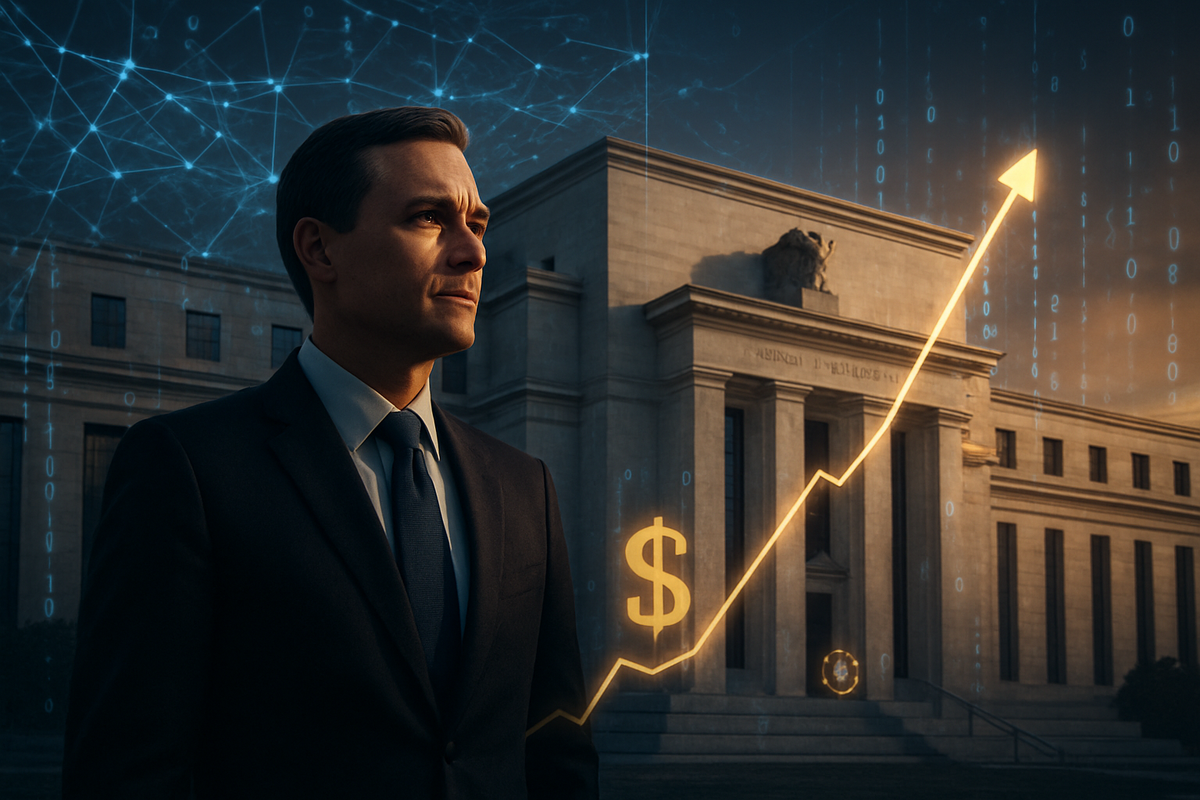
In a move that has sent shockwaves through global financial markets, the nomination of Kevin Warsh to succeed Jerome Powell as the Chair of the Federal Reserve has signaled a dramatic regime shift in American monetary policy. Announced on January 30, 2026, the decision marks the end of the "Powell Era" and the beginning of a controversial experiment that combines aggressive balance sheet reduction with a surprising pivot toward lower interest rates. The "Warsh Shock," as it has been dubbed on Wall Street, has already triggered a historic collapse in precious metals prices while simultaneously igniting a speculative rally in high-growth technology and financial sectors.
As of February 6, 2026, the market is still recalibrating to the reality of a Fed leader who intends to replace traditional "data-dependency" with a forward-looking "AI-productivity" thesis. While Warsh historically carried the reputation of an inflation hawk, his current platform suggests a belief that the Artificial Intelligence revolution is a structural disinflationary force, granting the central bank the latitude to cut rates even as the economy maintains robust growth. This "hawkish dove" approach aims to shrink the Fed's footprint on the economy while providing a cheap-money tailwind for the private sector’s technological race.
A Calculated Succession Amid Institutional Friction
The nomination of Kevin Warsh was not merely an economic decision but a deeply political one, arriving after months of escalating tension between the White House and the incumbent Fed leadership. Jerome Powell’s term is set to expire in mid-May 2026, but the transition has been marred by an unprecedented Department of Justice investigation into alleged cost overruns at the Fed’s headquarters—a move widely seen by critics as a strategy to erode the central bank’s independence. Against this backdrop, Warsh emerged as the "central casting" choice, a former Fed Governor (2006–2011) with deep ties to Morgan Stanley and the academic prestige of Stanford University, capable of satisfying both populist demands for growth and institutional demands for stability.
The timeline leading up to the January 30 announcement was a whirlwind of speculation. Following a Supreme Court battle regarding the President's authority to fire Fed governors for "cause," the administration moved quickly to name a successor who could navigate the legal and economic minefield. Warsh reportedly edged out other finalists, including White House economic advisor Kevin Hassett and BlackRock executive Rick Rieder, by proposing a "New Economy" framework reminiscent of Alan Greenspan’s tenure in the late 1990s.
Initial market reactions were swift and violent. On the day of the announcement, the U.S. Dollar surged as the "debasement trade"—the bet that the Fed would be forced to inflate its way out of national debt—evaporated. Conversely, the "Warsh Effect" crushed the commodities sector, leading to a single-day washout in gold and silver markets that analysts at JPMorgan Chase & Co. (NYSE: JPM) described as a "healthy flush of speculative excess."
Winners and Losers: A Dividied Market Landscape
The prospect of a Warsh-led Federal Reserve has created a stark divide between industries that rely on cheap liquidity and those that benefit from a steeper yield curve and deregulation. Large financial institutions are currently the primary beneficiaries of the "Warsh Era." Firms like Goldman Sachs Group, Inc. (NYSE: GS) and Wells Fargo & Company (NYSE: WFC) are expected to see significant Net Interest Margin (NIM) expansion. Warsh’s plan to cut short-term rates while aggressively shrinking the Fed’s balance sheet creates a "bear steepener," allowing banks to borrow at lower rates and lend at higher long-term yields. Furthermore, his vocal opposition to the "Basel III Endgame" capital requirements suggests a period of significant deregulation ahead for the banking sector.
In the technology sector, the reaction has been more nuanced but ultimately bullish for AI leaders. NVIDIA Corp. (NASDAQ: NVDA) and Microsoft Corp. (NASDAQ: MSFT) have seen their valuations supported by Warsh’s thesis that AI is a massive productivity multiplier. By arguing that these technological gains act as a natural brake on inflation, Warsh has provided a macro-economic justification for keeping interest rates lower than traditional models would dictate, specifically to support the capital-intensive infrastructure these companies provide.
However, the "Warsh Shock" has been catastrophic for the precious metals and real estate sectors. Gold mining giants such as Newmont Corporation (NYSE: NEM) and Barrick Gold Corp (NYSE: GOLD) saw their stock prices tumble as the U.S. Dollar was re-anchored as a credible store of value. Meanwhile, the real estate market faces a daunting paradox. While the benchmark funds rate may fall, Warsh’s desire to actively sell the Fed’s $2 trillion in Mortgage-Backed Securities (MBS) threatens to keep mortgage rates elevated. This prospect has pressured residential homebuilders like Lennar Corp. (NYSE: LEN) and logistics-focused REITs like Prologis, Inc. (NYSE: PLD), which are now forced to discount future cash flows against higher long-term borrowing costs.
The Significance of the 'AI-Productivity' Pivot
Warsh’s nomination is more than a change in leadership; it represents a fundamental shift in how the Fed interprets the modern economy. For the past decade, the central bank has been criticized for being "backward-looking," reacting to inflation data that is often months old. Warsh proposes a return to a "discretionary, forward-looking" model, similar to the one used by Alan Greenspan during the 1990s internet boom. This approach assumes that official government data often fails to capture the real-time efficiency gains provided by new technology, such as generative AI and robotics.
This policy shift fits into a broader industry trend toward "supply-side" monetary policy. Instead of simply managing demand through interest rate hikes, the Warsh-led Fed appears poised to support the expansion of the economy's productive capacity. By focusing on a "smaller Fed" with a significantly reduced balance sheet, Warsh aims to move the primary engine of credit creation back from the central bank to the private commercial banking system.
The regulatory implications are equally significant. If Warsh successfully rolls back the stringent capital requirements of the post-2008 era, it could trigger a massive wave of consolidation in the regional banking sector. However, the historical precedent is a double-edged sword; critics point to the "Greenspan Put" of the 1990s as a contributing factor to the eventual dot-com bubble and the 2008 financial crisis, warning that ignoring traditional inflation metrics in favor of "productivity miracles" carries immense long-term risk.
The Road to May: What Comes Next?
In the short term, the financial world will be laser-focused on the Senate confirmation hearings. While Republicans hold the majority needed to confirm Warsh, the proceedings are expected to be contentious, as Democrats are likely to challenge his commitment to the Fed's dual mandate of maximum employment and price stability. Investors should expect a "volatility tax" on all market transactions until Warsh officially takes the gavel in May 2026.
A major strategic pivot for corporations will be the transition from a "growth-at-any-cost" mindset to one of "operating leverage." Under Warsh, companies that can prove they are using AI to reduce costs and increase output will likely outperform. Conversely, "zombie companies" that relied on the Fed’s massive balance sheet to keep credit spreads narrow may find themselves facing a liquidity crunch as Quantitative Tightening (QT) accelerates.
In the long term, the most critical scenario to watch is the decoupling of the Fed funds rate from the 10-year Treasury yield. If Warsh cuts rates but long-term yields stay high due to balance sheet sales, the "higher-for-longer" environment for mortgages and corporate debt will persist, potentially causing a prolonged stagnation in the housing market even as the S&P 500 reaches new highs driven by tech.
Conclusion: A High-Stakes Gamble on the Future
The nomination of Kevin Warsh represents a high-stakes gamble that the American economy has entered a new "Golden Age" of productivity. By pivoting toward a more dovish interest rate policy while simultaneously stripping back the Fed's emergency-era balance sheet, Warsh is attempting a delicate re-balancing act that has never been successfully performed on this scale. The "Warsh Shock" has already redefined the winners and losers of 2026, favoring the architects of the AI revolution and the titans of Wall Street while punishing those who bet on the continued decline of the dollar.
As we move forward, the market’s primary focus will be on whether the "AI-productivity" thesis holds true. If inflation remains low despite rate cuts, Warsh will be hailed as a visionary who modernized central banking for the 21st century. If, however, inflation proves stickier than his models predict, the Fed may find itself with fewer tools to combat a traditional price spiral. Investors should remain vigilant, watching for signs of liquidity stress in the small-cap and crypto markets, which will serve as the "canaries in the coal mine" for Warsh’s aggressive balance sheet reduction.
This content is intended for informational purposes only and is not financial advice.