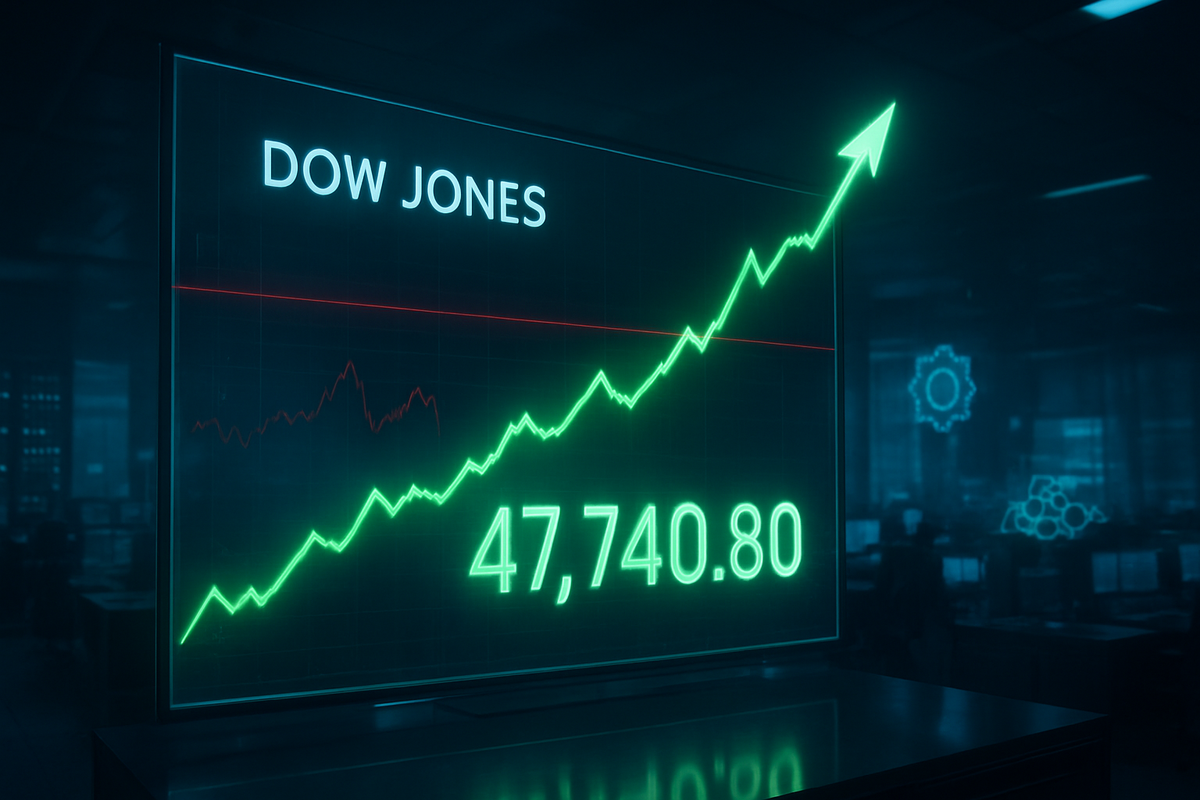
In a trading session defined by whiplash-inducing volatility, the Dow Jones Industrial Average (DJIA) successfully navigated a massive 1,125-point intraday swing on March 10, 2026, to close at 47,740.80. The 0.5% gain may appear modest on paper, but the technical implications are profound, as the blue-chip index managed to reclaim critical support levels and signal a potential end to the geopolitical-induced correction that has dogged markets throughout the late winter.
The recovery marks a significant psychological victory for bulls, effectively turning a potential "black swan" event in the energy markets into a relief rally of historic proportions. By crossing back above the 47,600 technical floor, the Dow has invalidated a bearish breakdown, restoring momentum to a market that had recently retreated from all-time highs near the 50,000 mark.
The Great Reversal: A Day of Binary Outcomes
The trading day began under a cloud of systemic fear. Early session selling was fueled by reports of escalated skirmishes in the Persian Gulf and a partial shutdown of the Strait of Hormuz. These developments sent Brent Crude prices soaring and triggered a flight to safety, with the Dow plummeting more than 800 points in the opening hours. At its intraday trough, the index threatened to breach the 46,000 level, a move that would have placed the market in a precarious technical "no man’s land."
The timeline shifted dramatically in the afternoon following unexpected diplomatic signals. Comments from President Donald Trump suggesting a "near-complete" diplomatic breakthrough with Iran served as the catalyst for the reversal. Within two hours, the index erased its 800-point deficit and climbed into positive territory. This 1,125-point round trip is one of the largest intraday swings in the index's history, highlighting the high-stakes environment of 2026’s global macro landscape. Market participants described the shift as a transition from "crisis management" to "opportunistic accumulation" in a matter of minutes.
Winners and Losers: Tech Gains as Energy Slumps
The intraday rotation created a stark divide between sectors. As the prospect of a regional conflict faded, the "war trade" collapsed. ExxonMobil (NYSE: XOM) and Chevron (NYSE: CVX) faced significant headwinds as Brent Crude plummeted 12.5% to roughly $86 per barrel. ExxonMobil, which had previously evacuated non-essential personnel from Middle Eastern operations, saw its stock price struggle as the risk premium vanished from the oil complex.
Conversely, technology and industrial giants spearheaded the recovery. Cisco Systems (NASDAQ: CSCO) led the gainers with a 2.81% jump, buoyed by improving sentiment across the networking and cloud infrastructure space. Caterpillar (NYSE: CAT) also outperformed, rising 1.56% as investors bet on a "re-industrialization" theme that benefits from lower energy input costs. Financial heavyweights like Goldman Sachs (NYSE: GS) and Visa (NYSE: V) saw a late-day lift as the "soft landing" narrative was revived. However, not all components joined the party; Salesforce (NYSE: CRM) remained a notable laggard, dropping 3.61% despite the broader market's buoyancy, while UnitedHealth Group (NYSE: UNH) finished lower by 1.68%, failing to catch the afternoon bid.
A Turning Point for Market Breadth and Technicals
The significance of the 0.5% gain lies primarily in the expansion of market breadth. At the midday lows, the rally was dangerously narrow, with only 8 of the 30 Dow components trading in the green. Such a concentration of strength often precedes further market weakness. However, by the closing bell, the picture had shifted. Advancing issues led decliners by a ratio of roughly 60% to 37% across the broader U.S. exchanges, suggesting that the "relief" was felt well beyond the index's largest constituents.
Technically, the Dow’s ability to close at 47,740 places it back above the 50-day moving average and the critical 47,600 support zone. Analysts are now looking toward the 48,800–48,900 range as the next major hurdle. This event mirrors historical "shakeouts" where extreme intraday volatility flushes out weak-handed investors before a sustained move higher. The 2026 breakout bears a striking resemblance to the market's behavior during the late 2023 pivot, where technical resilience in the face of geopolitical uncertainty laid the groundwork for the next leg of the bull market.
The Path to 50,000: What Comes Next
In the short term, market participants will be hyper-focused on the follow-through. For the breakout to hold, the Dow must consolidate above 47,700 without retesting the intraday lows of March 10. A sustained move above 48,000 would likely trigger a wave of algorithmic buying, potentially setting the stage for a run at the elusive 50,000 milestone by early summer. Strategic pivots are already underway, with hedge funds shifting away from defensive energy hedges and back into cyclical "growth at a reasonable price" (GARP) stocks.
However, challenges remain. The reliance on diplomatic breakthroughs means that any reversal in geopolitical rhetoric could re-introduce the same volatility that triggered the 1,125-point swing. Investors should monitor the $85–$90 per barrel range for oil; if prices stabilize here, it provides a "Goldilocks" environment for Dow industrials—low enough to curb inflation but high enough to reflect steady global demand.
Resilience in the Face of Geopolitical Flux
The events of March 10, 2026, serve as a masterclass in market psychology. The Dow's 47,740 close is more than just a number; it is a testament to the underlying resilience of the U.S. economy and its ability to absorb external shocks. By reclaiming the 47,600 level, the market has signaled that it is not yet ready to surrender the gains of the past year to geopolitical uncertainty.
Moving forward, investors should keep a close watch on market breadth and the performance of laggards like Salesforce and UnitedHealth. A truly healthy bull market will require these components to stabilize and join the broader industrial and tech names in the ascent. While the road to 50,000 remains paved with volatility, the March 10 breakout has provided the technical foundation necessary for the next major leg of the market's journey.
This content is intended for informational purposes only and is not financial advice