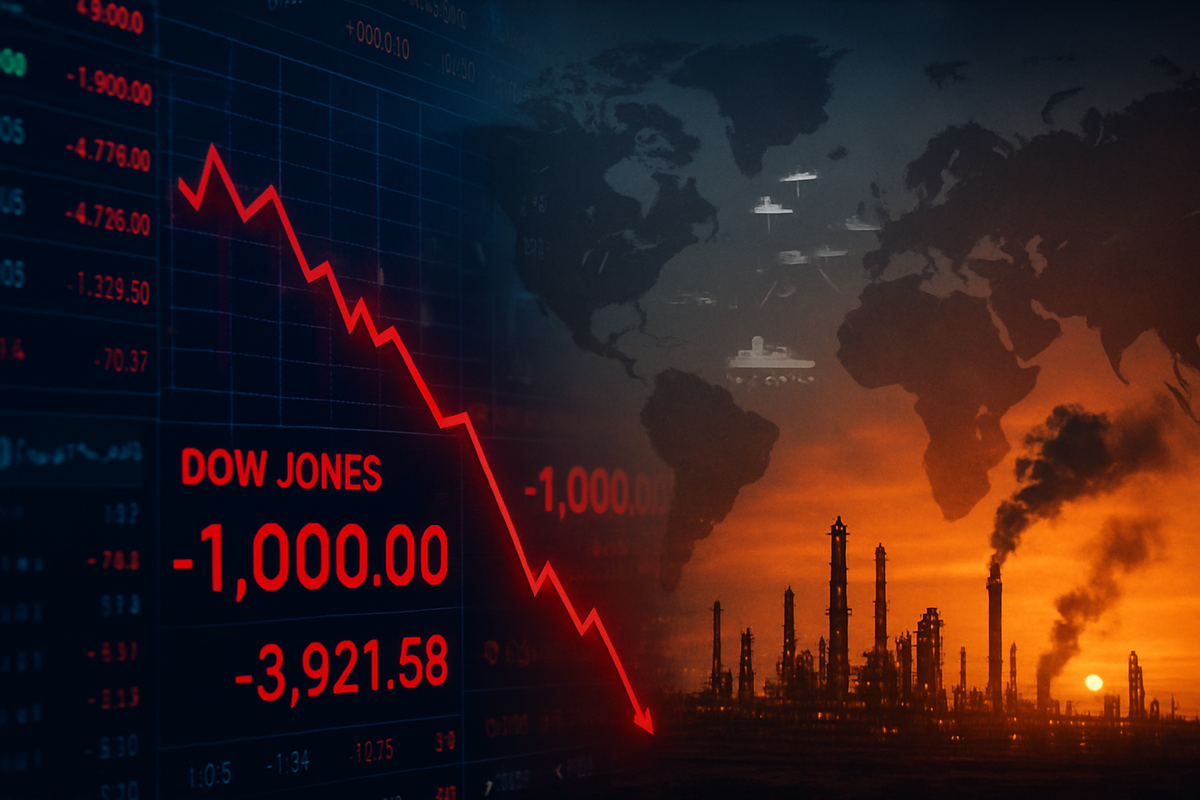
The U.S. stock market endured one of its most harrowing sessions in years on Friday, March 13, 2026, as a toxic combination of escalating Middle Eastern warfare and deteriorating domestic economic indicators triggered a mass exodus from risk assets. By the closing bell, the total market capitalization of U.S. equities had plummeted by an estimated $1 trillion, leaving investors grappling with a "Friday the 13th" that lived up to its ominous reputation. The sell-off was broad-based, cutting through every sector and leaving no major index unscathed as the specter of a multi-front war and a "hard landing" for the American economy became the dominant market narrative.
The blue-chip Dow Jones Industrial Average plummeted 453 points, but the real damage was felt in the broader indices. The S&P 500 and the tech-heavy Nasdaq Composite bore the brunt of the $1 trillion wipeout, falling 1.8% and 2.4%, respectively. Analysts pointed to a "perfect storm" of catalysts: a geopolitical flashpoint in the Strait of Hormuz that sent oil prices soaring, and a morning "data dump" of economic reports that suggested the U.S. economy is stalling under the weight of persistent inflation and high interest rates.
A Session of Fear: The Anatomy of the March 13 Meltdown
The day began with a sense of trepidation that quickly morphed into panic. The primary driver was the sudden escalation of "Operation Epic Fury," the joint U.S.-Israeli military campaign against Iran that commenced in late February. Early Friday morning, reports surfaced that the Iranian Revolutionary Guard had successfully deployed drone swarms against several major energy infrastructure sites in the Gulf, effectively shutting down transit through the Strait of Hormuz. This news sent Brent crude prices surging toward $120 a barrel, sparking immediate fears of a global energy shock that would reignite the inflationary fires the Federal Reserve has been struggling to extinguish for years.
The geopolitical crisis was compounded by a dismal 8:30 AM ET release of the February Gross Domestic Product (GDP) revision and the latest JOLTS job openings report. The GDP data came in at a meager 1.4%, significantly lower than the 2.1% analysts had expected, while job openings fell to their lowest levels since 2017. These figures confirmed what many had feared: the U.S. economy is entering a period of "stagflation"—slowing growth paired with rising costs. By midday, a wave of institutional selling hit the tape, with high-frequency trading algorithms accelerating the decline as key technical support levels for the S&P 500 were breached.
The session was characterized by extreme volatility and a "flight to quality," though even traditional safe havens were under pressure. While the U.S. Treasury yields fluctuated wildly as investors weighed the possibility of a "war-time" inflation spike against a recessionary slowdown, the equity markets faced relentless pressure. By the final hour of trading, the "bloodbath" was complete, with the Nasdaq leading the descent as investors dumped high-valuation growth stocks in favor of cash and defensive commodities.
The Winners and Losers of the Conflict Economy
In a day where $1 trillion in value vanished, the divide between winners and losers was stark. The tech giants, which had driven much of the market’s gains over the past year, were the primary targets of the sell-off. Apple (NASDAQ: AAPL) and Microsoft (NASDAQ: MSFT) each fell by more than 2.5%, as investors worried that a prolonged conflict in the Middle East would disrupt global supply chains and dampen consumer spending. Nvidia (NASDAQ: NVDA), the darling of the AI era, saw its shares tumble 4.1% on fears that trade restrictions and increased energy costs for data centers would erode its lucrative margins. Similarly, Tesla (NASDAQ: TSLA) dropped 3.8% as the prospect of higher electricity costs and a global economic slowdown threatened the transition to electric vehicles.
Conversely, the "War and Energy" sectors provided the only pockets of green on traders' screens. Defense contractors surged as the scale of the conflict with Iran became clearer. Lockheed Martin (NYSE: LMT) and Northrop Grumman (NYSE: NOC) rose 4.2% and 3.9%, respectively, on expectations of a massive uptick in Department of Defense orders for munitions and missile defense systems. Palantir Technologies (NASDAQ: PLTR) also bucked the downward trend, gaining 5.3% as its AI-driven battlefield analytics tools were reportedly being deployed at scale in the theater of operations.
Energy majors were also notable outperformers, though their gains were tempered by fears of broader economic destruction. ExxonMobil (NYSE: XOM) and Chevron (NYSE: CVX) saw modest gains of roughly 1.5% as oil prices spiked. However, the rise in energy costs acted as a double-edged sword; while it boosted the top line for producers, it signaled higher operating costs for almost every other company in the market, particularly airlines and logistics firms, which saw massive double-digit declines during the session.
Stagflation and the Shadow of History
The events of March 13, 2026, represent more than just a bad day on the trading floor; they signal a potential paradigm shift in the global financial landscape. Market historians are already drawing parallels to the 1973 oil crisis and the market volatility of 1979, periods where geopolitical strife combined with economic weakness to create long-lasting bear markets. The $1 trillion loss is a stark reminder of how interconnected global security and financial stability have become, especially in an era of "high-for-longer" interest rates and massive sovereign debt.
The wider significance of this crash lies in the Federal Reserve’s now-impossible mandate. Before this session, there was hope that the Fed could begin a series of rate cuts to support a cooling economy. However, with oil prices surging due to the Iran conflict, any move to lower rates risks sending inflation back into the double digits. This "policy trap" has left investors feeling rudderless, contributing to the "sell first, ask questions later" mentality that dominated Friday's trading. Furthermore, the closure of the Strait of Hormuz threatens to dismantle the fragile "near-shoring" supply chain improvements made post-pandemic, potentially leading to a new wave of global trade protectionism.
Regulators are also facing renewed scrutiny. The speed of the $1 trillion wipeout has prompted calls for a review of automated trading "circuit breakers," which many retail investors feel are insufficient to prevent algorithmic cascades in times of geopolitical crisis. As the dust settles, the debate over how to manage a modern economy during a high-tech, high-stakes military conflict will likely dominate the halls of Congress and the halls of the SEC for months to come.
What Comes Next: A Treacherous Road for Investors
In the short term, the market is likely to remain in a state of high-alert. Investors will be laser-focused on the weekend’s developments in the Persian Gulf; any further escalation or news of successful Iranian counter-strikes could lead to a "gap down" opening on Monday morning. Strategists at major firms are already advising clients to pivot toward "fortress balance sheets"—companies with low debt and high cash reserves—while avoiding high-beta growth stocks that are sensitive to both interest rate spikes and supply chain shocks.
Longer-term, the market may be entering a "war economy" phase. This would see a significant reallocation of capital toward defense, cybersecurity, and domestic energy production (including nuclear and renewables) as the U.S. looks to decouple its economic fate from Middle Eastern volatility. There is also the potential for a "strategic pivot" in the tech sector; if the conflict drags on, companies like Alphabet (NASDAQ: GOOGL) and Amazon (NASDAQ: AMZN) may shift their focus toward government contracts and infrastructure resilience, mirroring the wartime pivots of industrial giants in the mid-20th century.
However, the most critical factor to watch will be consumer sentiment. If the "oil shock" of March 2026 translates to $6 or $7 per gallon at the pump by April, the U.S. consumer—the traditional engine of global growth—may finally buckle. This would almost certainly tip the economy from "soft landing" hopes into a deep and painful recession. The coming months will be a test of resilience for both the market and the geopolitical order.
Closing Thoughts: Navigating the New Volatility
The $1 trillion loss on March 13, 2026, will be remembered as a day when reality finally caught up with the markets. For years, investors had operated under the assumption that geopolitical tensions could be "contained" and that the Federal Reserve would always be there to provide a safety net. Both of those assumptions were shattered in a single session. The "bloodbath" fueled by Iran war jitters and weak economic data has exposed the fragility of the post-2020 bull market, leaving a trail of red ink across global portfolios.
Moving forward, the primary takeaway for investors is that the era of "easy money" and predictable geopolitical stability is over. Diversification, once a standard piece of advice, has now become a survival strategy. Markets are no longer just reacting to earnings calls and interest rate decisions; they are reacting to drone strikes, naval blockades, and the visceral reality of a world in conflict.
In the coming months, the key metrics to watch will not just be the CPI or the unemployment rate, but the daily transit volume in the Strait of Hormuz and the tone of diplomatic communiqués between Washington, Tel Aviv, and Tehran. The "Friday the 13th" crash of 2026 may be a one-day event, but its ripples will be felt for years as the global economy navigates a dangerous and uncertain new chapter.
This content is intended for informational purposes only and is not financial advice.