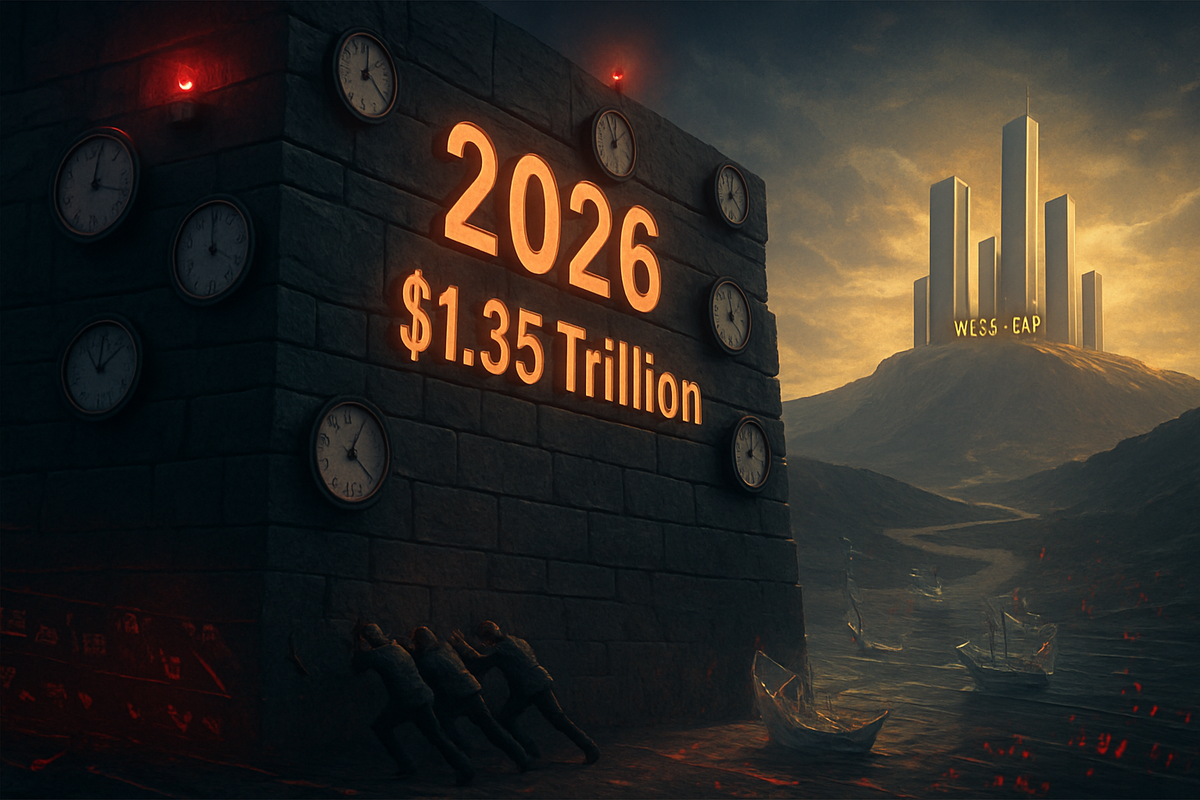
As of March 9, 2026, the long-predicted "reckoning" for American small-cap stocks has officially arrived. While the broader market remains buoyed by the resilient "Magnificent Seven" and a robust AI infrastructure supercycle, the Russell 2000 (IWM) has hit a formidable roadblock: a $1.35 trillion "debt maturity wall." After a brief January rally fueled by hopes of aggressive Federal Reserve easing, the small-cap index has decoupled from its larger peers, falling more than 4% behind the S&P 500 (SPY) in just the first nine weeks of the year.
This divergence marks a critical inflection point for the 2026 market. For years, smaller companies survived on "ultra-cheap" pandemic-era capital, but as those low-interest notes come due this month, the cost of staying in business has surged. With roughly 40% of the Russell 2000 currently classified as "unprofitable," the sudden spike in refinancing costs is no longer a theoretical risk—it is a liquidity crisis that is beginning to reshape the bottom half of the equity market.
The 2021 Hangover: A Timeline of the Refinancing Shock
The seeds of the current crisis were sown in 2021, a year of record-breaking debt issuance. Encouraged by near-zero interest rates, thousands of small and mid-sized firms took on massive amounts of high-yield bonds and leveraged loans. Fast forward five years to March 2026, and that debt is coming due all at once. The $1.35 trillion figure represents the single largest cluster of corporate maturities in a generation. Unlike the titans of the S&P 500, which utilized the low-rate era to lock in 30-year fixed debt, small-caps were forced into shorter durations or floating-rate structures.
The timeline of the current slump began in late February 2026, when hotter-than-expected CPI data effectively "evaporated" expectations for a March rate cut by the Federal Reserve. With the Fed funds rate holding steady at 3.50%–3.75%, companies attempting to roll over their 2021-era debt are finding that new coupons are coming in 150 to 200 basis points higher than their previous rates. This "coupon shock" is siphoning off free cash flow that would otherwise go toward growth or dividends, leading to a sharp "risk-off" sentiment among institutional investors who had hoped for a small-cap resurgence this spring.
Survival of the Fittest: Corporate Winners and Losers
The maturity wall is creating a stark divide between "zombie" firms and "fortress" balance sheets. Companies like Xerox Holdings Corp (NASDAQ: XRX) and Carter’s, Inc. (NYSE: CRI) are finding themselves under intense scrutiny; Xerox, in particular, is grappling with a net-debt-to-EBITDA ratio near 8x as its margins continue to shrink. Similarly, the biotech sector within the Russell 2000 has become a primary source of volatility. Firms like Viking Therapeutics (NASDAQ: VKTX) and Atara Biotherapeutics (NASDAQ: ATRA) have seen significant drawdowns as investors flee pre-revenue healthcare companies that lack the capital access to survive another year of "higher-for-longer" rates.
Conversely, the S&P 500’s leaders, such as Microsoft Corp (NASDAQ: MSFT) and Nvidia Corp (NASDAQ: NVDA), are effectively insulated from this crisis. These cash-rich giants are operating as net lenders, earning interest on their massive cash piles rather than paying it. Within the small-cap space, only a handful of "quality" names are thriving. UFP Technologies, Inc. (NASDAQ: UFPT) and Kulicke & Soffa Industries, Inc. (NASDAQ: KLIC) have been highlighted by analysts for their "fortress" balance sheets and net-cash positions, allowing them to potentially acquire distressed competitors as the debt wall forces liquidations elsewhere.
Structural Fragility and the "Floating Rate" Trap
The wider significance of this event lies in the structural difference between small and large-cap financing. Approximately 32% of Russell 2000 debt is tied to floating rates, compared to just 6% for the S&P 500. This means that even as the Fed paused its hiking cycle, small-cap interest expenses remained pegged to the 4% floor of the 10-year Treasury yield. This structural fragility has historical precedents in the post-2008 era, but the sheer volume of the 2026 wall is unprecedented.
The ripple effects are extending into the banking sector as well. Regional lenders, often the primary source of credit for small businesses, are facing a parallel $936 billion maturity wall in Commercial Real Estate (CRE). As small-cap firms struggle to service their corporate debt, the risk of defaults rising in regional bank portfolios, such as those held by JPMorgan Chase & Co. (NYSE: JPM)—though JPM remains resilient due to its diversified revenue—could tighten credit conditions even further, creating a self-reinforcing downward spiral for the Russell 2000 index.
The Path Ahead: M&A Waves and Potential Pivots
Looking toward the latter half of 2026, the market is bracing for two possible scenarios. In the short term, we expect a massive wave of "forced M&A." Strategic buyers and private equity firms, sitting on record levels of "dry powder," are likely to swoop in and acquire distressed small-cap players at steep discounts. For many Russell 2000 companies, being acquired may be the only alternative to a restructuring or a dilutive secondary offering that would wipe out existing shareholders.
In the long term, small-cap management teams will be forced to undergo a strategic pivot toward "capital efficiency." The era of "growth at any cost," fueled by zero-percent interest rates, is officially over. Surviving companies will need to prove they can generate positive free cash flow within their existing capital structures. This transition may result in a leaner, more resilient Russell 2000 by 2027, but the journey through the remainder of 2026 will likely be characterized by high volatility and a continued preference for large-cap stability.
Market Outlook: What to Watch Through 2026
The $1.35 trillion debt maturity wall of 2026 is a "slow-motion" event that will dominate financial headlines for months. The key takeaway for investors is that the "K-shaped" recovery has evolved into a "K-shaped" survival struggle. While the S&P 500 remains a bastion of quality and AI-driven growth, the Russell 2000 is fighting a battle against time and interest rates.
Moving forward, the market will be hyper-focused on every Fed communication and inflation print. Any sign that the Fed is willing to break its "3.5% floor" could provide a lifeline to small caps. However, if inflation remains sticky, the "zombie" culling within the small-cap sector will only accelerate. Investors should watch for credit spread widening in the high-yield market and keep a close eye on the earnings calls of mid-tier industrials and retailers for signs of refinancing distress. In this environment, balance sheet strength is no longer a secondary metric—it is the primary determinant of survival.
This content is intended for informational purposes only and is not financial advice