
As the Q3 earnings season wraps, let’s dig into this quarter’s best and worst performers in the hardware & infrastructure industry, including NetApp (NASDAQ: NTAP) and its peers.
The Hardware & Infrastructure sector will be buoyed by demand related to AI adoption, cloud computing expansion, and the need for more efficient data storage and processing solutions. Companies with tech offerings such as servers, switches, and storage solutions are well-positioned in our new hybrid working and IT world. On the other hand, headwinds include ongoing supply chain disruptions, rising component costs, and intensifying competition from cloud-native and hyperscale providers reducing reliance on traditional hardware. Additionally, regulatory scrutiny over data sovereignty, cybersecurity standards, and environmental sustainability in hardware manufacturing could increase compliance costs.
The 9 hardware & infrastructure stocks we track reported a strong Q3. As a group, revenues beat analysts’ consensus estimates by 3.6% while next quarter’s revenue guidance was in line.
While some hardware & infrastructure stocks have fared somewhat better than others, they have collectively declined. On average, share prices are down 3.8% since the latest earnings results.
NetApp (NASDAQ: NTAP)
Founded in 1992 as a pioneer in networked storage technology, NetApp (NASDAQ: NTAP) provides data storage and management solutions that help organizations store, protect, and optimize their data across on-premises data centers and public clouds.
NetApp reported revenues of $1.71 billion, up 2.8% year on year. This print exceeded analysts’ expectations by 1.1%. Overall, it was a satisfactory quarter for the company with a beat of analysts’ EPS estimates but revenue guidance for next quarter slightly missing analysts’ expectations.
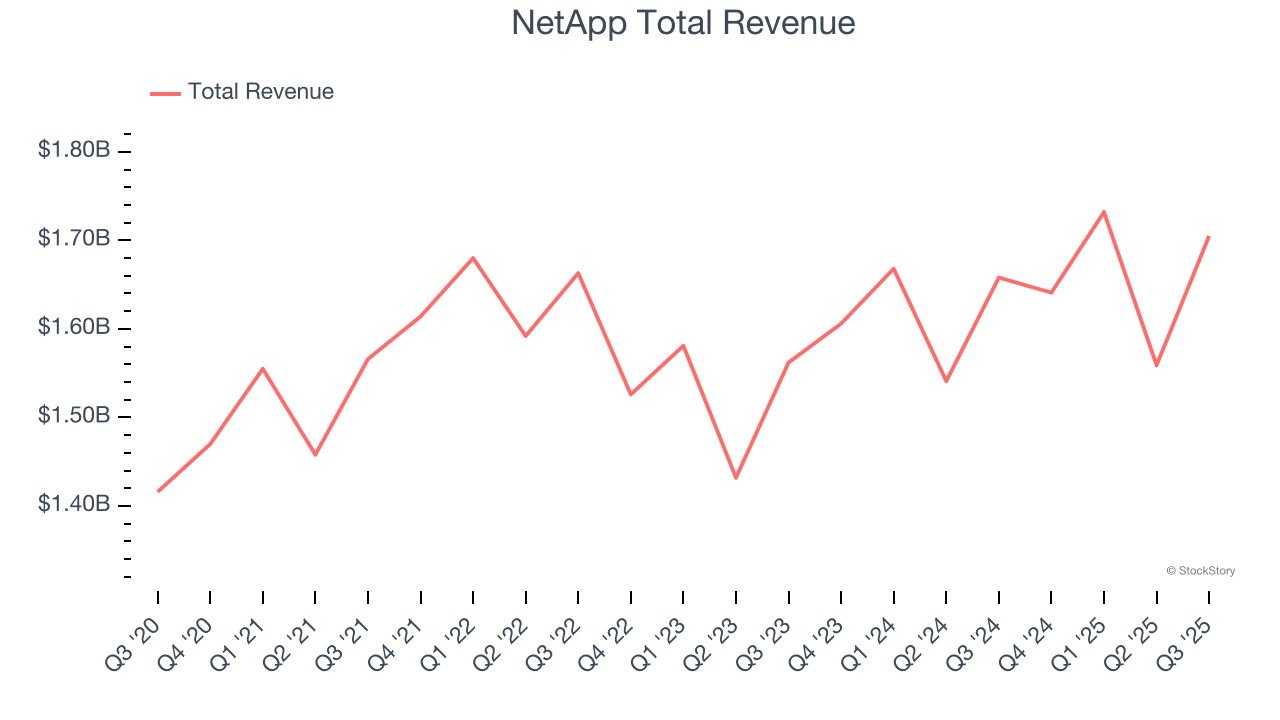
Interestingly, the stock is up 5.7% since reporting and currently trades at $117.82.
Is now the time to buy NetApp? Access our full analysis of the earnings results here, it’s free for active Edge members.
Best Q3: IonQ (NYSE: IONQ)
Founded by quantum physics pioneers from the University of Maryland and Duke University in 2015, IonQ (NYSE: IONQ) develops quantum computers that process information using trapped ions to solve complex computational problems beyond the capabilities of traditional computers.
IonQ reported revenues of $39.87 million, up 222% year on year, outperforming analysts’ expectations by 47.8%. The business had an incredible quarter with a beat of analysts’ EPS estimates and an impressive beat of analysts’ revenue estimates.
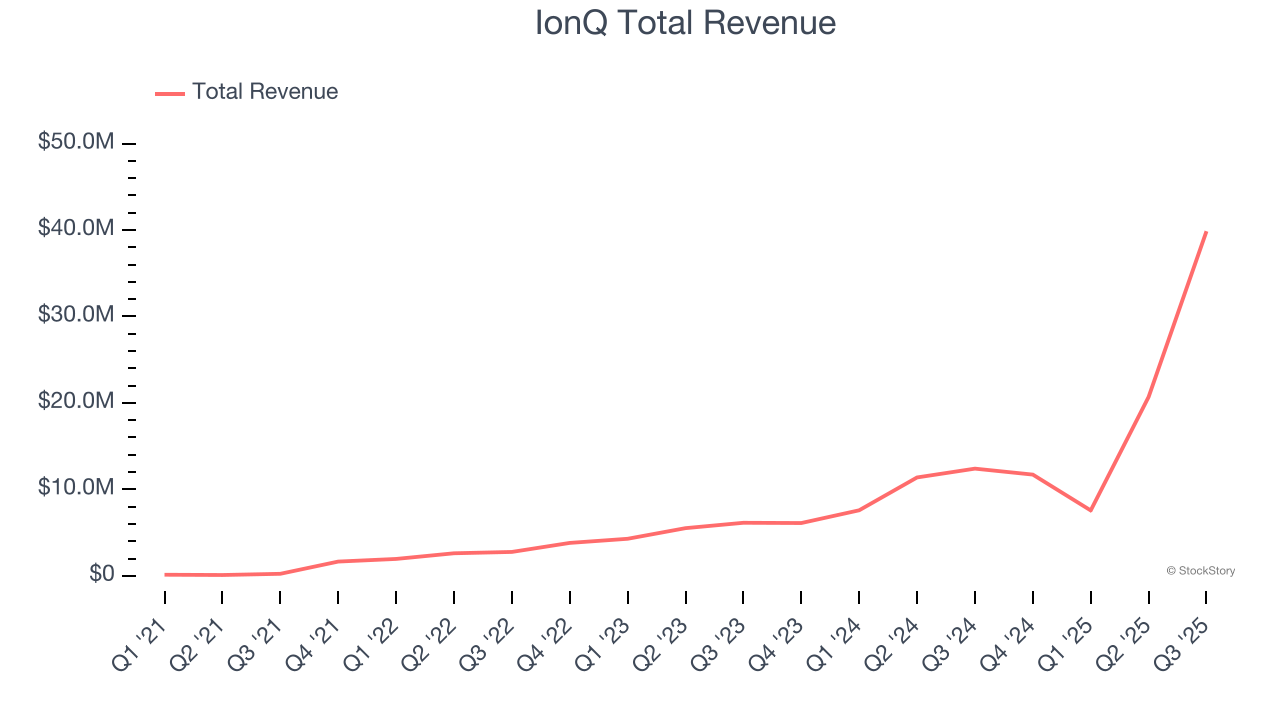
IonQ scored the biggest analyst estimates beat and fastest revenue growth among its peers. Although it had a fine quarter compared its peers, the market seems unhappy with the results as the stock is down 1.9% since reporting. It currently trades at $54.34.
Is now the time to buy IonQ? Access our full analysis of the earnings results here, it’s free for active Edge members.
Weakest Q3: HP (NYSE: HPQ)
Born from the legendary Silicon Valley garage startup founded by Bill Hewlett and Dave Packard in 1939, HP (NYSE: HPQ) designs and sells personal computers, printers, and related technology products and services to consumers, businesses, and enterprises worldwide.
HP reported revenues of $14.64 billion, up 4.2% year on year, exceeding analysts’ expectations by 0.7%. Still, it was a slower quarter as it posted a significant miss of analysts’ full-year EPS guidance estimates and a slight miss of analysts’ EPS guidance for next quarter estimates.
Interestingly, the stock is up 3.3% since the results and currently trades at $25.08.
Read our full analysis of HP’s results here.
Xerox (NASDAQ: XRX)
Pioneering the modern office copier and inventing technologies like Ethernet and the laser printer, Xerox (NASDAQ: XRX) provides document management systems, printing technology, and workplace solutions to businesses of all sizes across the globe.
Xerox reported revenues of $1.96 billion, up 28.3% year on year. This result missed analysts’ expectations by 3.2%. Aside from that, it was a satisfactory quarter as it also logged a beat of analysts’ EPS estimates but a significant miss of analysts’ revenue estimates.
The stock is down 21.7% since reporting and currently trades at $2.69.
Read our full, actionable report on Xerox here, it’s free for active Edge members.
Pure Storage (NYSE: PSTG)
Founded in 2009 as a pioneer in enterprise all-flash storage technology, Pure Storage (NYSE: PSTG) provides all-flash data storage hardware and software that helps organizations manage their data more efficiently across on-premises and cloud environments.
Pure Storage reported revenues of $964.5 million, up 16% year on year. This print topped analysts’ expectations by 0.9%. More broadly, it was a satisfactory quarter as it also recorded a solid beat of analysts’ billings estimates but EPS in line with analysts’ estimates.
The stock is down 25% since reporting and currently trades at $71.11.
Read our full, actionable report on Pure Storage here, it’s free for active Edge members.
Market Update
As a result of the Fed’s rate hikes in 2022 and 2023, inflation has come down from frothy levels post-pandemic. The general rise in the price of goods and services is trending towards the Fed’s 2% goal as of late, which is good news. The higher rates that fought inflation also didn't slow economic activity enough to catalyze a recession. So far, soft landing. This, combined with recent rate cuts (half a percent in September 2024 and a quarter percent in November 2024) have led to strong stock market performance in 2024. The icing on the cake for 2024 returns was Donald Trump’s victory in the U.S. Presidential Election in early November, sending major indices to all-time highs in the week following the election. Still, debates around the health of the economy and the impact of potential tariffs and corporate tax cuts remain, leaving much uncertainty around 2025.
Want to invest in winners with rock-solid fundamentals? Check out our Top 5 Quality Compounder Stocks and add them to your watchlist. These companies are poised for growth regardless of the political or macroeconomic climate.
StockStory’s analyst team — all seasoned professional investors — uses quantitative analysis and automation to deliver market-beating insights faster and with higher quality.