As we close out 2025, the landscape of artificial intelligence has shifted from the era of static chatbots to the age of the "Universal Agent." At the forefront of this revolution is Project Astra, a massive multi-year initiative from Google, a subsidiary of Alphabet Inc. (NASDAQ: GOOGL), designed to create an ambient, proactive AI that doesn't just respond to prompts but perceives and interacts with the physical world in real-time.
Originally unveiled as a research prototype at Google I/O in 2024, Project Astra has evolved into the operational backbone of the Gemini ecosystem. By integrating vision, sound, and persistent memory into a single low-latency framework, Google has moved closer to the "JARVIS-like" vision of AI—an assistant that lives in your glasses, controls your smartphone, and understands your environment as intuitively as a human companion.
The Technical Foundation of Ambient Intelligence
The technical foundation of Project Astra represents a departure from the "token-in, token-out" architecture of early large language models. To achieve the fluid, human-like responsiveness seen in late 2025, Google DeepMind engineers focused on three core pillars: multimodal synchronicity, sub-300ms latency, and persistent temporal memory. Unlike previous iterations of Gemini, which processed video as a series of discrete frames, Astra-powered models like Gemini 2.5 and the newly released Gemini 3.0 treat video and audio as a continuous, unified stream. This allows the agent to identify objects, read code, and interpret emotional nuances in a user’s voice simultaneously without the "thinking" delays that plagued earlier AI.
One of the most significant breakthroughs of 2025 was the rollout of "Agentic Intuition." This capability allows Astra to navigate the Android operating system autonomously. In a landmark demonstration earlier this year, Google showed the agent taking a single voice command—"Help me fix my sink"—and proceeding to open the camera to identify the leak, search for a digital repair manual, find the necessary part on a local hardware store’s website, and draft an order for pickup. This level of "phone control" is made possible by the agent's ability to "see" the screen and interact with UI elements just as a human would, bypassing the need for specific app API integrations.
Initial reactions from the AI research community have been a mix of awe and caution. Dr. Andrej Karpathy and other industry luminaries have noted that Google’s integration of Astra into the hardware level—specifically via the Tensor G5 chips in the latest Pixel devices—gives it a distinct advantage in power efficiency and speed. However, some researchers argue that the "black box" nature of Astra’s decision-making in autonomous tasks remains a challenge for safety, as the agent must now be trusted to handle sensitive digital actions like financial transactions and private communications.
The Strategic Battle for the AI Operating System
The success of Project Astra has ignited a fierce strategic battle for what analysts are calling the "AI OS." Alphabet Inc. (NASDAQ: GOOGL) is leveraging its control over Android to ensure that Astra is the default "brain" for billions of devices. This puts direct pressure on Apple Inc. (NASDAQ: AAPL), which has taken a more conservative approach with Apple Intelligence. While Apple remains the leader in user trust and privacy-centric "Private Cloud Compute," it has struggled to match the raw agentic capabilities and cross-app autonomy that Google has demonstrated with Astra.
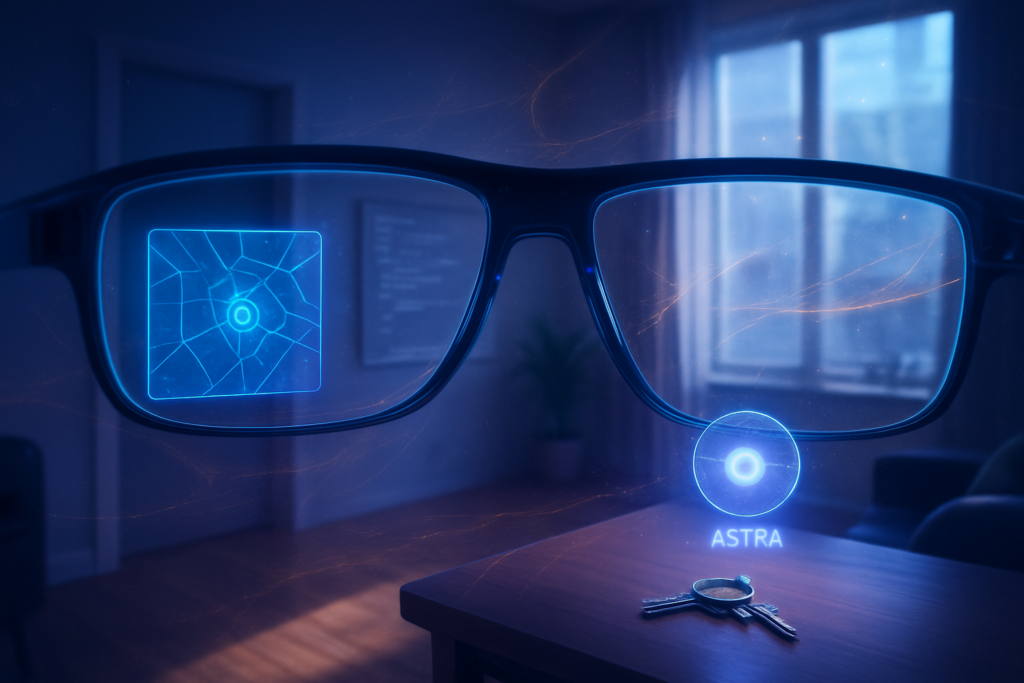
In the wearable space, Google is positioning Astra as the intelligence behind the Android XR platform, a collaborative hardware effort with Samsung (KRX:005930) and Qualcomm (NASDAQ: QCOM). This is a direct challenge to Meta Platforms Inc. (NASDAQ: META), whose Ray-Ban Meta glasses have dominated the early "smart eyewear" market. While Meta’s Llama 4 models offer impressive "Look and Ask" features, Google’s Astra-powered glasses aim for a deeper level of integration, offering real-time world-overlay navigation and a "multimodal memory" that remembers where you left your keys or what a colleague said in a meeting three days ago.
Startups are also feeling the ripples of Astra’s release. Companies that previously specialized in "wrapper" apps for specific AI tasks—such as automated scheduling or receipt tracking—are finding their value propositions absorbed into the native capabilities of the universal agent. To survive, the broader AI ecosystem is gravitating toward the Model Context Protocol (MCP), an open standard that allows agents from different companies to share data and tools, though Google’s "A2UI" (Agentic User Interface) standard is currently vying to become the dominant framework for how AI interacts with visual software.
Societal Implications and the Privacy Paradox
Beyond the corporate horse race, Project Astra signals a fundamental shift in the broader AI landscape: the transition from "Information Retrieval" to "Physical Agency." We are moving away from a world where we ask AI for information and toward a world where we delegate our intentions. This shift carries profound implications for human productivity, as "mundane admin"—the thousands of small digital tasks that consume our days—begins to vanish into the background of an ambient AI.
However, this "always-on" vision has sparked significant ethical and privacy concerns. With Astra-powered glasses and phone-sharing features, the AI is effectively recording and processing a constant stream of visual and auditory data. Privacy advocates, including Signal President Meredith Whittaker, have warned that this creates a "narrative authority" over our lives, where a single corporation has a complete, searchable record of our physical and digital interactions. The EU AI Act, which saw its first major wave of enforcement in 2025, is currently scrutinizing these "autonomous systems" to determine if they violate bystander privacy or manipulate user behavior through proactive suggestions.
Comparisons to previous milestones, like the release of GPT-4 or the original iPhone, are common, but Astra feels different. It represents the "eyes and ears" of the internet finally being connected to a "brain" that can act. If 2023 was the year AI learned to speak and 2024 was the year it learned to reason, 2025 is the year AI learned to inhabit our world.
The Horizon: From Smartphones to Smart Worlds
Looking ahead, the near-term roadmap for Project Astra involves a wider rollout of "Project Mariner," a desktop-focused version of the agent designed to handle complex professional workflows in Chrome and Workspace. Experts predict that by late 2026, we will see the first "Agentic-First" applications—software designed specifically to be navigated by AI rather than humans. These apps will likely have no traditional buttons or menus, consisting instead of data structures that an agent like Astra can parse and manipulate instantly.
The ultimate challenge remains the "Reliability Gap." For a universal agent to be truly useful, it must achieve a near-perfect success rate in its actions. A 95% success rate is impressive for a chatbot, but a 5% failure rate is catastrophic when an AI is authorized to move money or delete files. Addressing "Agentic Hallucination"—where an AI confidently performs the wrong action—will be the primary focus of Google’s research as they move toward the eventual release of Gemini 4.0.
A New Chapter in Human-Computer Interaction
Project Astra is more than just a feature update; it is a blueprint for the future of computing. By bridging the gap between digital intelligence and physical reality, Google has established a new benchmark for what an AI assistant should be. The move from a reactive tool to a proactive agent marks a turning point in history, where the boundary between our devices and our environment begins to dissolve.
The key takeaways from the Astra initiative are clear: multimodal understanding and low latency are the new prerequisites for AI, and the battle for the "AI OS" will be won by whoever can best integrate these agents into our daily hardware. In the coming months, watch for the public launch of the first consumer-grade Android XR glasses and the expansion of Astra’s "Computer Use" features into the enterprise sector. The era of the universal agent has arrived, and the way we interact with the world will never be the same.
This content is intended for informational purposes only and represents analysis of current AI developments.
TokenRing AI delivers enterprise-grade solutions for multi-agent AI workflow orchestration, AI-powered development tools, and seamless remote collaboration platforms.
For more information, visit https://www.tokenring.ai/.