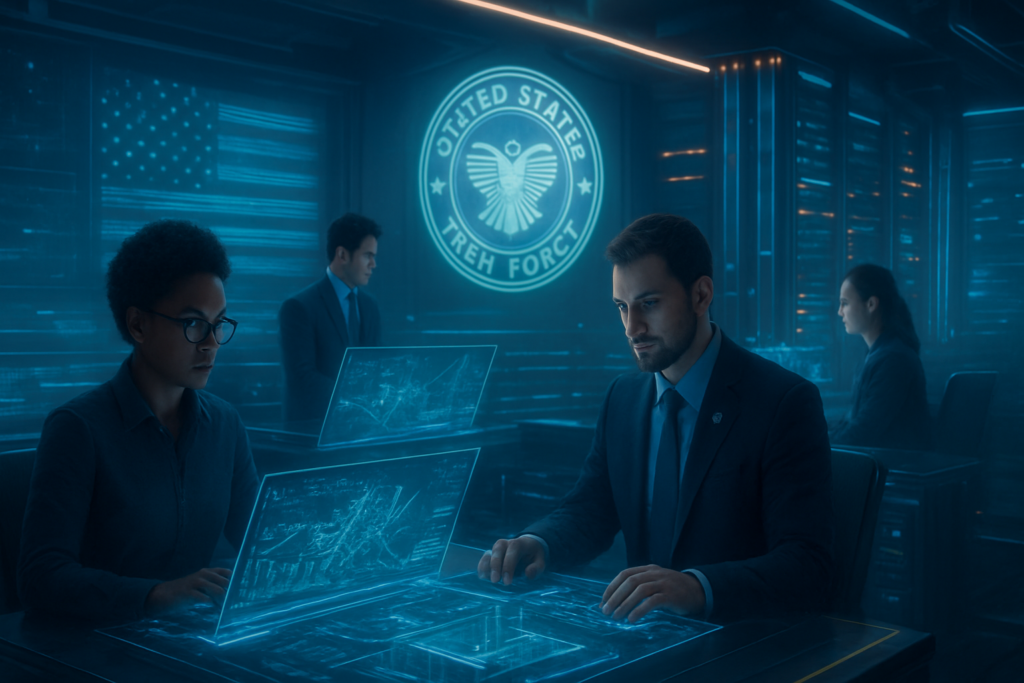
In a bold move to solidify American dominance in the global artificial intelligence race, the second Trump administration has officially launched the "United States Tech Force" (USTF). The initiative aims to recruit a specialized corps of 1,000 elite AI engineers and technologists to modernize the nation’s aging government infrastructure and spearhead the integration of advanced machine learning into federal operations. Announced on December 15, 2025, the program is a cornerstone of the administration’s broader "Winning the Race: America’s AI Action Plan," signaling a massive shift toward a tech-centric federal workforce.
The USTF is designed to bridge the widening gap between the private sector's rapid innovation and the government’s legacy systems. By offering high-tier salaries and bypassing traditional bureaucratic hurdles, the administration hopes to lure top-tier talent from Silicon Valley to Washington, D.C. This development comes at a critical juncture as the United States intensifies its competition with China for AI supremacy, positioning the federal government not just as a regulator, but as a primary architect of the next generation of AI-driven public services and national defense.
Technical Elite: 1,000 Engineers for the "Stargate" Era
The United States Tech Force is not a standard federal hiring surge; it is a highly selective "skills-first" recruitment drive. The program targets 1,000 engineers, data scientists, and cybersecurity specialists for two-year service terms. Unlike traditional civil service roles, the USTF does not require a college degree if applicants can prove "elite" technical proficiency through rigorous assessments and portfolios. These recruits will be placed in high-impact roles at the Department of War—the recently rebranded Department of Defense—and the Treasury, as well as the newly established "Trump Accounts" portal at the IRS.
Technically, the USTF is the human component of the "Stargate" project, a $500 billion public-private partnership focused on building massive AI data centers and energy infrastructure across states like Texas and Ohio. These engineers will be tasked with migrating fragmented federal data into secure, cloud-native AI environments. The technical specifications of the initiative emphasize "battle-hardened" software engineering and the deployment of autonomous systems. Initial reactions from the AI research community are mixed; while some praise the focus on technical merit over credentials, others worry that a two-year term is insufficient for the deep architectural overhauls required by the government’s complex, decade-old systems.
Silicon Valley Goes to Washington: Industry Impact and Corporate Synergy
The announcement has sent ripples through the tech industry, as major players move to align themselves with the federal surge. Companies like Microsoft (NASDAQ: MSFT), Nvidia (NASDAQ: NVDA), and Oracle (NYSE: ORCL) have already signed on as partners. These firms are not only providing the hardware and cloud infrastructure for the initiative but have also agreed to create a "revolving door" for talent, promising to prioritize USTF alumni for high-paying roles once their two-year government service concludes. This creates a powerful strategic advantage for these giants, essentially allowing them to help shape the very federal systems they may later bid to maintain.
However, the initiative poses a competitive challenge for smaller AI startups. With the federal government offering salaries between $150,000 and $200,000—placing recruits at the GS-13 and GS-14 pay grades—the USTF is competing directly for the same pool of "early-career" talent that typically fuels the startup ecosystem. Furthermore, the administration’s decision to allow recruits to retain their private-sector stock options has sparked debate. While it makes the roles more attractive to employees of Amazon (NASDAQ: AMZN) or Meta (NASDAQ: META), critics argue it creates a massive conflict of interest, potentially leading to "regulatory capture" where government tech policy is influenced by the financial interests of Big Tech.
A Post-DOGE Pivot: The Broader AI Landscape
The launch of the Tech Force is being viewed by many as a strategic "re-staffing" following the massive workforce reductions led by the Department of Government Efficiency (DOGE) earlier in 2025. After cutting over 200,000 federal roles and dismantling units like the U.S. Digital Service (USDS), the administration is now selectively "surging" specialized talent back into the fold. This "fire-and-hire" strategy is unprecedented in federal history and reflects a belief that the government should be leaner in bureaucracy but more potent in technical capability.
The broader significance lies in the "AI Arms Race." By embedding elite engineers directly into national security and infrastructure, the U.S. is signaling a shift toward an offensive AI posture. This mirrors previous milestones like the Manhattan Project or the Apollo program, but with a modern, decentralized twist. However, the focus on "coders" over "ethicists" has drawn fire from civil society groups. Organizations like Public Citizen have warned that sidelining AI safety and ethics experts in favor of pure engineering talent could lead to the deployment of biased or unaccountable algorithms in critical areas like law enforcement and financial oversight.
The Road Ahead: 2026 and the Future of Federal AI
As the first wave of recruitment begins in late December 2025, the tech world is watching to see how quickly these 1,000 engineers can be integrated. The first cohort is expected to be in place by March 2026. Near-term projects include the automation of federal procurement and the deployment of AI-driven predictive maintenance for the nation’s power grid. In the long term, the administration envisions the Tech Force as a permanent "surge capacity" that can be deployed to any agency facing a technical crisis or a major modernization hurdle.
Challenges remain, particularly regarding security clearances and the inherent friction between fast-moving tech culture and slow-moving federal bureaucracy. Experts predict that the success of the USTF will hinge on whether these engineers are given the actual authority to bypass legacy protocols. If successful, the program could serve as a blueprint for other nations looking to modernize their civil services. If it fails, it may be remembered as an expensive experiment that further blurred the lines between private corporate interests and public governance.
Conclusion: A New Era for the Federal Workforce
The United States Tech Force represents a paradigm shift in how the federal government views its workforce. By prioritizing elite technical skills and offering competitive compensation, the Trump administration is attempting to build a "digital vanguard" capable of navigating the complexities of the 21st century. The initiative’s deep ties to industry leaders like Palantir (NYSE: PLTR) and Apple (NASDAQ: AAPL) suggest a future where the boundary between public service and private enterprise is increasingly porous.
As we move into 2026, the USTF will be a primary indicator of the administration’s ability to execute its ambitious AI agenda. Whether this "Tech Force" can truly modernize the government or if it will simply become a high-tech extension of corporate Silicon Valley remains to be seen. For now, the recruitment drive is on, and the eyes of the global tech community are firmly fixed on Washington.
This content is intended for informational purposes only and represents analysis of current AI developments.
TokenRing AI delivers enterprise-grade solutions for multi-agent AI workflow orchestration, AI-powered development tools, and seamless remote collaboration platforms.
For more information, visit https://www.tokenring.ai/.