I. The Premise: When Iron Was Replaced by Code
Let’s be honest: the old rulebook is fit only for the recycling bin. For a century, the title of the "biggest car company" was a simple math problem—how much steel did you move, and how efficiently? That was the realm of Dearborn and Wolfsburg.
Today, that metric is a fantasy.
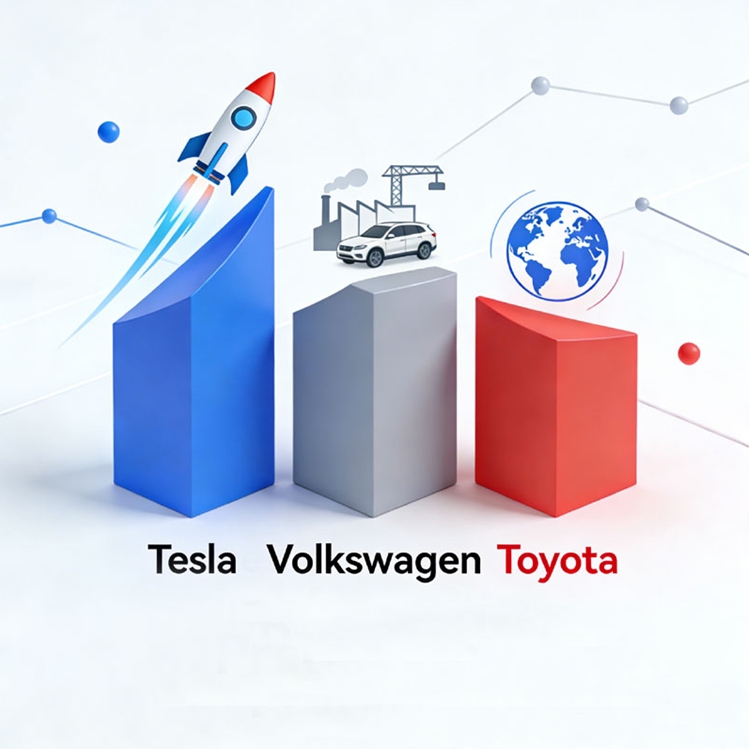
Tesla, selling barely two million cars, holds a market valuation four times larger than Toyota's. This isn't a market bubble; it's a declaration of war on traditional economics. The biggest company of the future won't be the one with the most factories. It will be the one with the most profitable code, the most unshakeable market narrative, and the most control over the customer’s digital wallet. If you’re still counting units, you've missed the flight.
II. The Core Fight: Efficiency, Subscription, and Survival
The old moats—massive plants and dealer networks—are now just expensive ballast. The game has changed to two brutally simple metrics: cost-cutting velocity and recurring revenue.
1. Vertical Integration: The Dictator of the Cost Curve
The most terrifying prospect for every CEO in Detroit is the realization that they are building their electric vehicles at a fundamentally higher cost than the competition.
Tesla didn't just build an EV; they tore down the century-old assembly line. Their fanatical commitment to vertical control—from owning their chip design to pioneering technologies like the 4680 battery and Gigacasting—allows them to pull down production costs faster than any rival. They are playing chess while others are playing checkers.
Meanwhile, the Legacy strategy relies on platforming—sharing the Ultium battery tray across a dozen different models. That sounds prudent, but it’s a strategy built for *moderation*. Against Tesla's scorched-earth efficiency, moderation is just another word for being too slow.
2. Software: The Toll Booth to Profit
This is the real fight. The car is no longer a product; it’s a high-cost hardware terminal for a stream of low-cost software services.
The high-margin gold mine lies in:
Autonomy Subscriptions: That $199 monthly fee for Tesla’s FSD is pure profit. It’s a recurring, high-margin revenue stream that traditional automakers—who still view the sale as the finish line—can’t touch.
The Digital Up-sell: Continuous OTA updates keep the car alive, justify higher resale values, and allow companies to unlock new features for a fee.
If you can't hire the best coders in the world, you are signing up to be the dumb pipe. You build the magnificent chassis, but someone else collects the toll money every time the driver engages a feature. That is the difference between valuation and liquidation.
III. The Three Contenders: The Stakes are Life and Death
1. The Tech Disrupters: Narrative as Capital
Tesla’s chief weapon isn't its car; it's its narrative. Its sky-high valuation—its $800 billion war chest—is a promise of future profit from robotaxis and energy, giving it access to cheaper capital than any competitor. They can expand aggressively and absorb losses where a traditional automaker would need a shareholder vote just to change the color of the factory floor.
The true shadow threat, however, comes from the Asset-Light players. If Apple decides to move beyond CarPlay and focus purely on the profitable software and data layer—outsourcing the manufacturing nightmare—the competition will change overnight.
2. The Legacy Giants: Trapped by the Golden Goose
The greatest hurdle for Ford and GM isn't technology; it's addiction. They are completely dependent on the immense, beautiful profits from the F-150 and the Silverado to subsidize every single electric initiative.
Here’s their big Catch-22: They can’t quit the ICE cash cow, but that cow is totally holding them back. Their transition efforts—like GM’s massive $27 billion investment and Ford’s ambitious truck lines—are pretty impressive, but they’re still dragging around the financial baggage of the past.
And then there's Toyota. Their quiet, persistent faith in the hybrid is viewed by Wall Street not as prudence, but as denial. They are treating a structural revolution like a minor product cycle, risking total technological irrelevance the moment the global EV tipping point is finally crossed.
3. The Eastern Shadow: The Cost Problem
This is the geopolitical variable that keeps executives sleepless.
Manufacturers like China's BYD have achieved a level of cost control and vertical integration that we in North America simply cannot match under current labor costs. They control the raw materials, the cell production, and the final assembly.
The IRA is a strategic firewall—a necessary defensive maneuver designed to force our supply chain back home. But protectionism only buys time. It doesn't solve the core financial problem. We are using billions in subsidies to prop up a high-cost manufacturing base. Unless we innovate past that cost barrier, we are simply postponing the day of reckoning.
IV. The Conclusion: The Architect, Not the Assembler
The era of a single, undisputed "King of Cars" is probably over. The market will break into segments.
But if a winner is crowned, it will be the one that perfectly fuses Silicon Valley's digital aggression with traditional manufacturing competence. The victory will not be measured by sheer volume. It will be defined by:
1. Highest-Quality Earnings: Profit derived from recurring subscriptions, not just the one-time sale.
2. Standard Hegemony: The control over protocols, just as Tesla's NACS standard forced the industry to follow its lead.
3. Superior Return on Invested Capital (ROIC): This is the metric Wall Street ultimately respects.
The largest automotive company will be the Ecosystem Architect, the entity that controls the software operating system, sets the prices for the services, and takes the tolls, regardless of who bolted the final fender on. If the legacy companies fail to shed the financial burden of the past and embrace the digital future, the crown will permanently belong to a tech company that merely uses the car as its most ambitious, profitable data terminal.
Media Contact
Company Name: CarLogos
Email: Send Email
Country: United States
Website: https://www.carlogos.org/