The big news from yesterday was Netflix (NFLX) dropping out of the race to buy the best parts of Warner Bros. Discovery (WBD), leaving Paramount Skydance (PSKY) as the winner of the hotly contested M&A battle.
While investors appear happy about Netflix’s decision -- its shares are up about 8% in pre-market trading, about an hour to the open -- consumers clearly shouldn’t be. This consolidation will result in higher streaming prices, movie ticket prices, and the list goes on.
Yesterday, I discussed Netflix’s unusual options activity from Wednesday's trading and concluded that the streaming service’s stock was about to move higher on an extended basis. Without the additional debt burden hanging over it, I have no doubt it will.
In Thursday’s unusual options activity, March 20 DTEs (days to expiration) were extremely popular. Of the top 100 Vol/OI (volume-to-open-interest) ratios -- they ranged from 291.16 for Hewlett Packard Enterprise (HPE) to 23.69 for Netflix -- 52 expire in three weeks.
Of the 52, 19 stocks have Vol/OI ratios of 23.69 or higher. Three of them have multi-leg options strategies with high profit-probability.
Have an excellent weekend.
Hewlett Packard Enterprise (HPE)

Hewlett Packard Enterprise had the highest Vol/OI ratio yesterday at 291.16. The stock had a volume of 120,075, nearly six times its 30-day average. The March 20 $17.50 put accounted for 30% of its total options volume.
The put/call ratio was 1.94, an extremely bearish number. Not surprisingly, the net trade sentiment was -3,432,000. Most large trades were at the bid price, which means traders were either taking profits on those puts or selling for premium, expecting the share price to remain where it is over the next 22 days, or move slightly higher.
The high profit-probability play here is a Bear Put Spread. The Barchart Technical Opinion is a Sell with a 58% chance it will continue to move lower in the next 22 days.
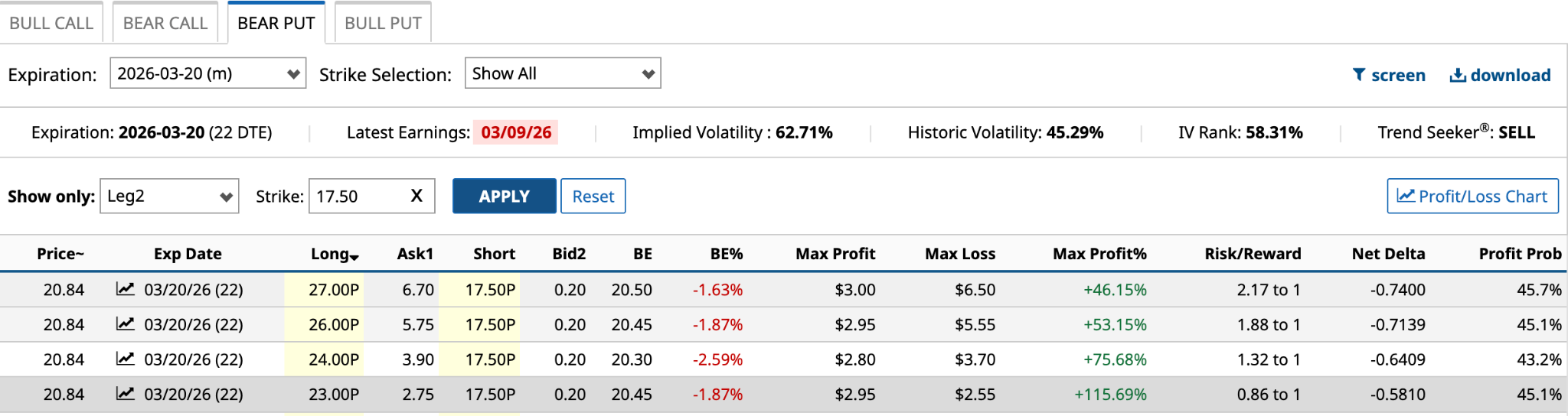
I’ve highlighted four of the long put strike prices that combine with the $17.50 short put. Of the four, I like the last one, the $23 long put, because it has the lowest cost at $2.55, the highest maximum profit, and a 45.1% likelihood of trading below $20.45 at expiration.
Wells Fargo & Co. (WFC)

Wells Fargo & Co. (WFC) had the 11th-highest Vol/OI ratio yesterday at 56.50. The stock had an options volume of 70,037, 1.4 times its 30-day average. The March 20 $81 put accounted for 19% of its total options volume.
The put/call ratio was 2.06, indicating extremely bearish conditions. However, the put/call OI (open interest) ratio of 1.16, although slightly bearish, is down from January. The volume from the $81 put had only five trades of less than 10 contracts, with two (10,000 and 3,100) accounting for 98.7% of it.
Wells Fargo's stock is down 12% in 2026, but up 7% for the past year. If you’re an income investor, its 2.2% dividend yield is about double the 1.14% dividend yield for the S&P 500 and 20 basis points higher than JPMorgan & Chase’s (JPM).
In the past 5 years, including dividends, the large-cap bank has an annualized total return of 20.75%. Long-term, say five years, you’ll likely double your money once more. Analysts generally like it, with 18 of 27 rating it a Buy (4.19 out of 5), and a target price of $101.86, well above its current price.
Its efficiency ratio at the end of Q4 2025 was 64.5%, down from 68.2% a year ago. In this case, lower is better. The efficiency ratio is the bank’s non-interest-related expenses divided by its revenue. It’s an indication that the bank is growing its deposits and loans without letting costs get away from it.
Based on Wall Street’s 2026 earnings-per-share estimate of $6.92, its shares trade at a reasonable 12.5 times that amount. It’s a good long-term hold.
As I write this in late morning trading, the markets are down, with WFC off more than 5%. That could put a wrinkle in my suggested strategy.
At a closing price of $86.30, I thought the $81 put could make up one-half of a Covered Strangle, where you own 100 shares of its stock, and sell one $81 put for premium, while also doing a Covered Call by selling a call OTM (out of the money) for additional income.
Now that the share price is hovering around $81.67, you might want to lower your put strike price by a few dollars to get about 6% OTM. That’s about $76 or $77. I went with the $77 because there’s more volume today.
 Your return on selling the put is 1.2%, which is 21.7% annualized, and an 81.39% chance that the share price at expiration in three weeks will be above the $76.05 breakeven.
As for the covered call, you also want the call strike price to be OTM.
 In this example, you’re buying 100 shares for $8,228 [$82.28 * 100] and selling one $95 call expiring on March 20 for $10 in premium. Now, normally, if you’ve owned the stock for some time and have significant unrealized gains, you’d want to lower the strike price, which raises the premium, while capping your profits.
Also, it’s important to note that if you do buy today and the stock rises above $95, the call buyer could exercise their right to buy the shares. At that point, you would have a short-term capital gain, which is taxed as regular income.
Dow (DOW)

Dow (DOW) had the second-highest Vol/OI ratio yesterday at 100.94. The stock had a volume of 401,360, eight times its 30-day average. The March 20 $20 call accounted for 10% of its total options volume.
The put/call ratio was 0.01, an extremely bullish number. However, it can often signal bearish sentiment, indicating that traders believe a stock has been overbought. Up over 30% in the first two months of 2026, the Barchart Technical Opinion is a Strong Buy with a 72% chance its share price will continue to move higher over the next 21 days.
The options strategy in this situation is a Poor Man’s Covered Call, also known as a Long Call Diagonal Debit Spread. It involves buying a deep ITM (in-the-money) call option that expires in 21 days and selling another call with a shorter DTE. It’s a bullish strategy that mimics a covered call without owning 100 shares.

 The long call $20 strike costs $10.50 and expires in three weeks, while the short call $33 strike provides $0.20 in premium, for a net debit of $10.30, or 33.8% of the share price. Note the leverage. The $33 short call expires in two weeks.
There are several risks involved with this strategy.
First, if the share price rises above $33 by March 13, you might have to buy them at the strike price. It’s important to watch this bet closely because you’ll want to roll the short call to a higher strike before expiration to keep the profits flowing. For example, if the share price rises $2 over the next two weeks and you buy to close before March 13, you will generate a 19.0% return, or 495% annualized.
The other possibility is that the share price crashes below $20 by March 20 and you’re out $1,030.
So, in this strategy, your maximum profit is $270 0r $2.70 [$33 short call - $20 long call - $10.30 net debit], while your maximum loss is $1,030 or $10.30, equal to your net debit. That’s a 3.81-to-1 risk/reward with a maximum profit percentage of 26.2%.
On the date of publication, Will Ashworth did not have (either directly or indirectly) positions in any of the securities mentioned in this article. All information and data in this article is solely for informational purposes. For more information please view the Barchart Disclosure Policy here.
More news from Barchart
- Coal Is Back at Tennessee Valley Authority — And Energy Investors Should Pay Attention
- 52 Massive Vol/OI Spikes Expire March 20—Profit Plays on Top 3
- Uber Air Is Officially Here. Does That Make Uber Stock a Buy on Flying Car Dreams?
- ‘This is Not Business as Usual. This is Risk’: Michael Burry Warns Nvidia Looks Strikingly Similar to Cisco Just Prior to Dot Com Bubble Crash