With a market cap of $124.4 billion, Bristol-Myers Squibb Company (BMY) is a global biopharmaceutical company that discovers, develops, manufactures, and markets innovative medicines worldwide. Its portfolio spans key therapeutic areas including oncology, hematology, immunology, cardiovascular disease, and neuroscience, with well-known products such as Opdivo, Eliquis, Revlimid, and Yervoy.
Companies valued at $10 billion or more are generally classified as “large-cap” stocks, and Bristol-Myers Squibb fits this criterion perfectly. The company serves patients through a broad commercial network that includes wholesalers, distributors, specialty pharmacies, hospitals, clinics, and government agencies.
Shares of the Princeton, New Jersey-based company have slipped 2.2% from its 52-week high of $63.33. The stock has soared 25.2% over the past three months, surpassing the Nasdaq Composite’s ($NASX) 2.5% decline over the same time frame.
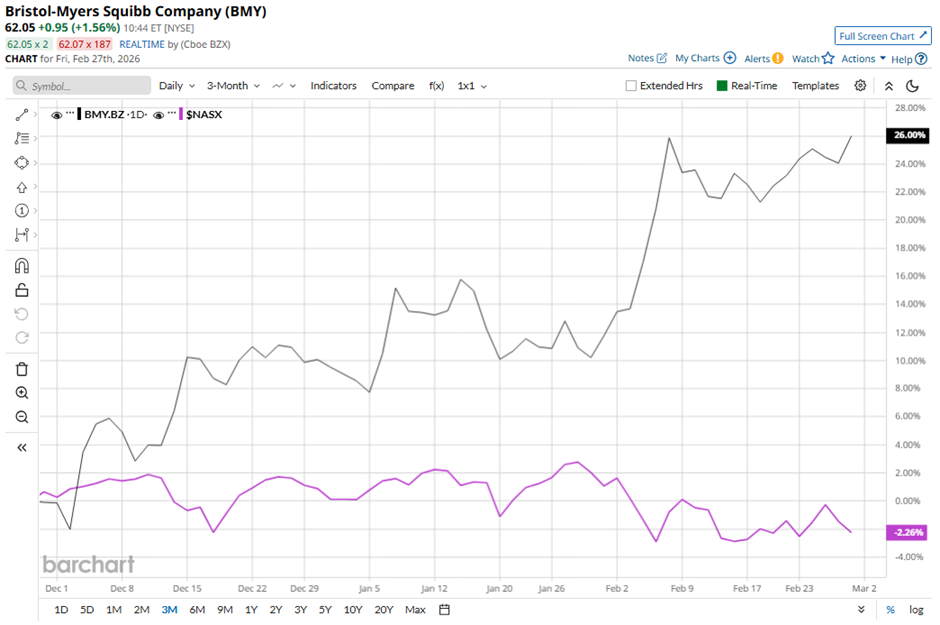
BMY stock is up 14.3% on a YTD basis, outperforming NASX’s 2.6% decrease. However, longer term, shares of the company have risen 4.9% over the past 52 weeks, lagging behind NASX’s 22.1% return over the same time frame.
The stock has been trading above its 50-day moving average since November 2025.
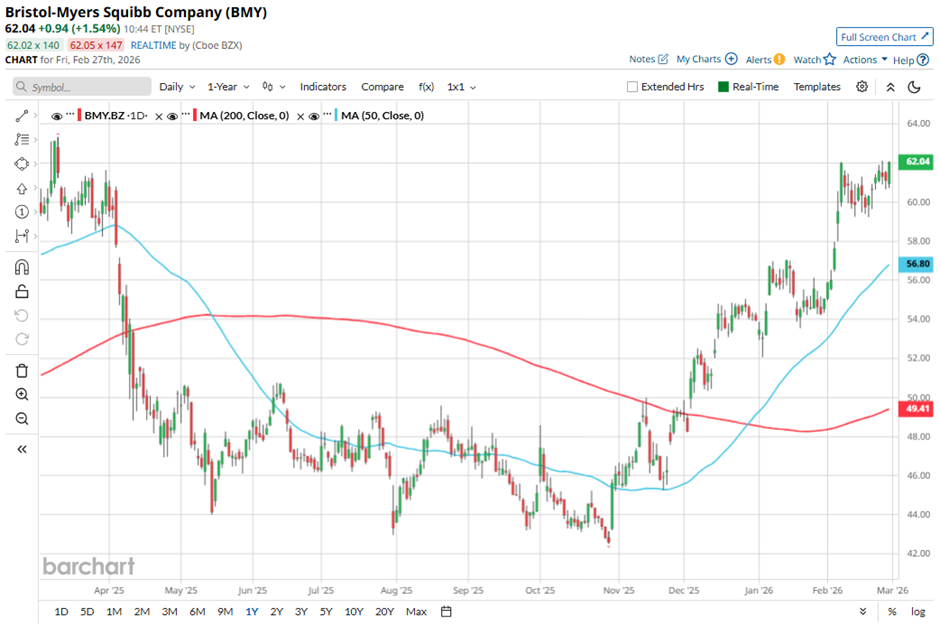
Shares of Bristol-Myers Squibb rose 3.3% on Feb. 5 after the company forecast 2026 revenue of $46 billion - $47.5 billion, well above Wall Street expectations, and projected adjusted EPS of $6.05 - $6.35, topping the consensus estimate. Investors were encouraged by management’s outlook that Eliquis revenue will grow 10% - 15% in 2026, despite Medicare price negotiations, as strategic price cuts help avoid inflation-related penalties and support volumes for the blockbuster blood thinner sold with Pfizer.
Sentiment was further boosted by Q4 2025 adjusted EPS of $1.26 (above estimates), revenue of $12.5 billion, and strong Opdivo sales up 9% to $2.69 billion, alongside $1 billion already achieved from a planned $2 billion cost-cutting program.
In contrast, rival Eli Lilly and Company (LLY) has lagged behind BMY stock on a YTD basis, with LLY shares down 4.5%. Nevertheless, over the past 52 weeks, Eli Lilly stock has risen 13.4%, outperforming Bristol-Myers Squibb shares.
Despite BMY’s underperformance over the past year, analysts remain moderately optimistic about its prospects. The stock has a consensus rating of “Moderate Buy” from 31 analysts in coverage, and as of writing, the stock is trading above the mean price target of $61.58.
On the date of publication, Sohini Mondal did not have (either directly or indirectly) positions in any of the securities mentioned in this article. All information and data in this article is solely for informational purposes. For more information please view the Barchart Disclosure Policy here.
More news from Barchart