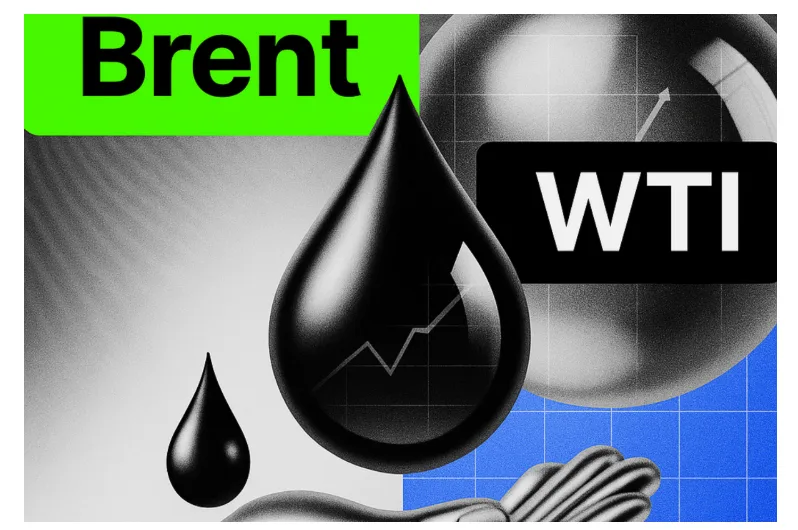
Oil isn’t just transportation fuel. It’s feedstock for chemicals and plastics, a barometer for inflation, and a line item that can swing national budgets. When crude prices move, ripple effects show up in airline fares, logistics costs, and headline CPI. That is why the oil market attracts both hedgers (e.g., airlines, shippers, refiners) and speculators (from retail traders to macro funds). The result: deep liquidity and fast tape.
Quick Fact: The global market transacts tens of millions of barrels per day, making crude oil one of the most actively traded commodities worldwide.
Key Takeaways
- Oil connects global finance, energy security, and speculation—few assets influence the macroeconomy as directly.
- Brent and WTI are the two key benchmarks; understanding their spread and liquidity is essential.
- Picking the right venue, doing real research, and enforcing risk rules matter more than any single “signal.”
Brent vs. WTI: The Benchmarks You’ll See Everywhere
What’s a benchmark?
Because crude varies by region and quality, the industry uses reference grades to standardize pricing and contracts. Benchmarks simplify deals, quotes, and risk management.
Brent (North Sea)
- Profile: Medium, low-sulfur (“sweet”), widely used as the international reference.
- Reach: Europe, Africa, much of Asia; seaborne routes make Brent globally accessible.
- Why traders care: It often reflects broad supply/demand shifts—think OPEC decisions, global growth, and shipping flows.
West Texas Intermediate (WTI)
- Profile: Light, sweet U.S. grade with low sulfur; historically inexpensive to refine.
- Venue: Traded on U.S. exchanges; storage and pipeline dynamics (e.g., Cushing, Oklahoma) can influence pricing.
- Why traders care: More sensitive to U.S. policy, shale output, inventory cycles.
The spread (Brent – WTI):
This differential ebbs and flows with logistics, geopolitics, and refinery margins. Many traders track (or trade) that spread to express views on regional tightness.
How Oil Is Traded: Contracts and Access
Futures
Standardized agreements to buy/sell a set quantity of crude at a future date and price (e.g., ICE Brent, NYMEX WTI).
- Used for:
- Hedging: Lock in input costs or selling prices.
- Speculation: Express directional views or structure spreads/time-spreads.
- Note: Most speculative positions are closed out before delivery; still, you must manage expiries and roll costs.
Spot (Physical) Trades
Prompt-delivery transactions that move actual barrels. Common for refiners, producers, and large consumers aligning near-term supply with operations. The spot price anchors many relative valuations.
Contracts for Difference (CFDs)
Derivatives that let traders go long/short on price changes without owning futures or physical barrels.
- Pros: Low barriers to entry, direct benchmark exposure, flexible sizing.
- Cons: Leverage cuts both ways; funding, spreads, and slippage matter.
- Fit: Tactically minded traders who use strict risk controls.
Tip: Some investors also use oil-themed ETFs to gain exposure with cash products instead of derivatives. Each vehicle carries its own cost and tracking profile—read the fund documents.
What Actually Moves Oil Prices?
Oil is a macro asset living at the intersection of supply, demand, and narrative. If you track only one thing, you’ll miss the others.
1) Supply
- OPEC+ policy: Quotas, compliance, and guidance can tighten or loosen balances.
- U.S. shale: Highly responsive to price; rig counts and productivity matter.
- Inventories & strategic reserves: Draws signal tightness; builds suggest slack.
- Logistics: Pipeline bottlenecks, sanctions, or shipping disruptions can shock prices.
2) Demand
- Global growth: Strong manufacturing and mobility boost consumption.
- Seasonality: Summer driving and winter heating can shift short-term demand.
- Substitution & efficiency: Fuel switching, EV penetration, and efficiency gains slowly reshape the curve.
3) Geopolitics
Conflicts, sanctions, and headlines from major producing regions can move prices before fundamentals catch up. Expect gap risk.
4) U.S. Dollar
Crude is dollar-denominated. A stronger USD can weigh on prices for non-U.S. buyers; a weaker USD can do the opposite.
5) Positioning & Psychology
Fund flows, CTA signals, and options positioning can amplify moves. Keep an eye on structure (contango/backwardation), volatility, and market depth.
Oil Doesn’t Live Alone: Gas, Power, and Renewables
Energy markets are entangled. In many regions, natural gas pricing correlates with oil benchmarks through indexation or competition. Power markets feel the knock-on effects via fuel costs and demand. Meanwhile, renewables continue to gain share, yet heavy transport, aviation, shipping, and petrochemicals still depend on liquid fuels. For traders, this means watching cross-asset cues—gas storage, power load, weather—alongside crude.
Diversification matters: If you only trade crude, you’re exposed to single-asset shocks (e.g., an OPEC surprise). Adding natural gas, refined products, or power-adjacent exposures can smooth the ride—if you understand their unique risks.
Getting Started: A Step-By-Step Playbook
- Choose your venue
Pick a regulated platform with reliable market access to Brent/WTI, strong uptime, transparent fees, and risk controls. Many traders practice on a demo before going live. (Example: brokers such as XBTFX provide access to global energy benchmarks, live charts, and advanced order types—evaluate any broker’s disclosures, jurisdiction, and fee schedule before funding.) - Set up and fund
Complete KYC/verification, understand margin requirements, and decide what you’ll risk per trade before you deposit. - Build a research loop
- Fundamental: OPEC meetings, inventory reports, refinery runs, macro prints.
- Technical: Trend, momentum, key levels, and market structure (term structure, basis).
- Sentiment: Options skew, spreads, COT data, and major headlines.
- Codify risk rules
Define stop-loss logic (price-based or volatility-based), max daily drawdown, position limits, and when to cut losers rather than “average down.” Put it in writing. - Start small; iterate
Trade a tiny size, log every decision, and review weekly. Scale only when your process—not just P&L—proves consistent.
Practical Strategies (Illustrative, Not Advice)
- Trend-following: Use moving-average filters or breakouts to align with medium-term direction. Works best when macro drivers are dominant and the curve is supportive.
- Mean reversion at key levels: Fade stretched moves into identified support/resistance when positioning looks one-sided—tight stops required.
- Spread trades:
- Brent/WTI: Express regional views.
- Calendar spreads: Trade time-spreads that reflect storage, refinery maintenance, and seasonal demand.
- Event-driven: Trade around scheduled releases (EIA inventories, OPEC statements) using predefined scenarios and smaller risk units.
Common Mistakes to Avoid
- Ignoring the calendar: Futures expiry, roll dates, OPEC meetings, and refinery turnaround season are not optional reading.
- Over-levering: Oil is volatile. Respect margin calls and volatility spikes.
- Chasing headlines: If you trade the first headline, know who else saw it and how it fits the bigger picture.
- No plan to exit: Define invalidation up front; hope is not a strategy.
Why Platform Choice Still Matters
Even the best setup can fall apart on the wrong venue. You need stable execution, transparent costs, clean margining, and charts that don’t lag—so your attention stays on the market, not the mechanics. That’s where XBTFX fits naturally into an oil trader’s workflow.
XBTFX provides direct access to Brent and WTI, competitive spreads, low-latency order routing, and clear risk controls (position limits, margin alerts, and stop/limit orders). You get pro-grade charting, an energy-focused calendar (EIA, OPEC+), and fast, trader-literate support—plus a demo that mirrors live conditions, so you can test before you scale.
Ready to put a process behind your edge? Open a free demo on XBTFX or create a live account to trade Brent/WTI with tight spreads and full risk controls.
Conclusion
Oil sits at the crossroads of economics, geopolitics, and market psychology. Mastering the basics—benchmarks (Brent vs. WTI), contract types (futures, spot, CFDs), and price drivers (supply, demand, USD, positioning)—gives you the foundation to operate with discipline. Pair that knowledge with a reliable venue, a repeatable research process, and hard risk limits, and you’re positioned to participate in one of the deepest markets on earth—responsibly.
FAQs
What is oil trading in simple terms?
Buying and selling exposure to crude oil (via futures, CFDs, ETFs, or physical barrels) to manage risk or express a view on price.
How do Brent and WTI differ?
Both are light, sweet crudes. Brent is the global seaborne benchmark; WTI is the U.S. inland benchmark. Logistics and regional fundamentals often drive their price spread.
How should beginners enter the market?
Start with education and a demo account. Choose a regulated venue, learn how margin works, and trade small with written risk rules.
What moves oil prices most?
A changing mix of OPEC+ policy, U.S. shale response, inventories, global growth, geopolitics, USD strength, and market positioning.