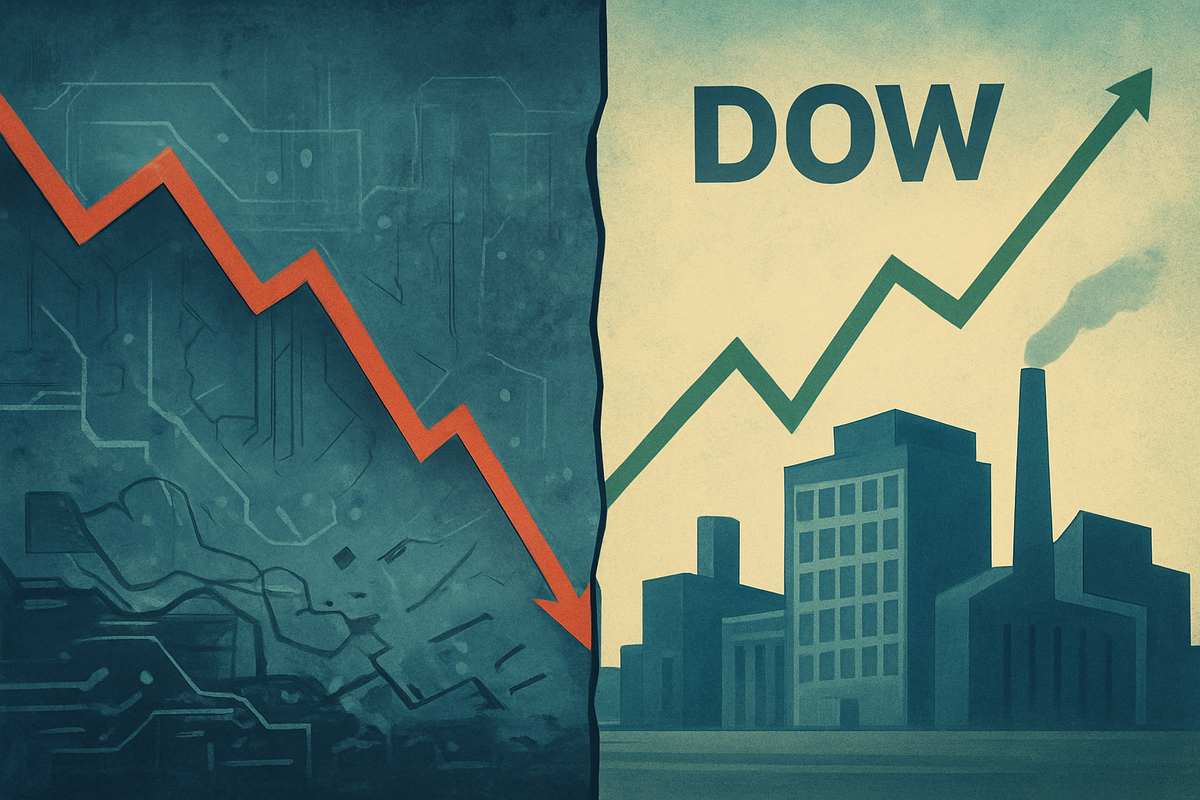
The U.S. stock market is currently experiencing a striking divergence, with the venerable Dow Jones Industrial Average demonstrating remarkable resilience and even gains, while its tech-heavy counterparts, the S&P 500 and Nasdaq Composite, navigate a period of decline. This notable split, particularly evident on December 11, 2025, signals a significant recalibration in investor sentiment, largely driven by renewed skepticism surrounding the profitability and immediate returns of substantial investments in artificial intelligence (AI) within the technology sector.
This market dynamic suggests a potential shift in investment strategy, moving away from the high-growth tech stocks that have fueled much of the 2025 rally towards more stable, value-oriented companies. The immediate implications point to heightened scrutiny of tech valuations, ongoing sector rotation, and a demand for clearer pathways to profitability, setting the stage for potential volatility and a redefinition of market leadership in the coming months.
The AI Reality Check: Oracle's Earnings Trigger Tech Sector Retreat
The recent market divergence crystallized on December 11, 2025, following a dramatic shift in investor sentiment. Just a day prior, on December 10, the broader market had celebrated a modest rally, with the Dow Jones Industrial Average, S&P 500, and Nasdaq Composite all closing higher. This optimism was spurred by the Federal Reserve's anticipated third quarter-point interest rate cut of the year, coupled with signals from Fed Chair Jerome Powell that further rate hikes were unlikely, pushing both the Dow and S&P 500 closer to their all-time highs. The Dow gained 1.1%, the S&P 500 rose 0.7%, and the Nasdaq advanced 0.3%.
However, the celebratory mood quickly dissipated. The primary catalyst for the subsequent downturn in tech and the broader market's mixed performance on December 11 was the disappointing earnings report from Oracle (NYSE: ORCL). The tech giant's stock plummeted significantly, over 10% in premarket trading and nearly 12% in after-hours, after its second-quarter revenue fell short of Wall Street's expectations. More critically, Oracle's report highlighted an alarming surge in capital spending, reported around $12 billion for the quarter—exceeding analysts' forecasts by over 40%. This substantial expenditure, largely attributed to investments in AI infrastructure, raised immediate concerns about the company's cash flow and, more broadly, whether the massive capital outlays in AI are genuinely translating into anticipated profitable growth across the sector.
This earnings miss served as a stark "AI reality check," chilling the very sector that had been the primary engine of the 2025 equity rally. It reignited persistent valuation concerns that had previously unsettled markets in November, when fears of an "AI bubble" first emerged. Key players and stakeholders across the technology landscape, from chipmakers to cloud service providers, found themselves under renewed scrutiny. Companies like Nvidia (NASDAQ: NVDA), a bellwether for AI hardware, and Microsoft (NASDAQ: MSFT), a leader in AI software and cloud services, followed Oracle's lead, experiencing declines as investors reassessed the "sky-high valuations" prevalent in the AI space. The market is now demanding concrete evidence that extensive AI investments will yield immediate and substantial returns, rather than simply rewarding growth at any cost.
In contrast to the tech sector's struggles, the Dow Jones Industrial Average, comprising more established and often value-oriented companies, exhibited remarkable resilience. While the S&P 500 futures slipped and Nasdaq futures saw sharper declines, Dow futures initially remained stable before rising by 0.4% (184 points) in early trading on December 11. This divergence signals a potential "sector rotation," where capital is being reallocated from speculative, high-growth technology stocks towards more stable, economically sensitive sectors. The initial market reaction underscores a pivotal moment, with investors making "selective bets" and demanding clearer pathways to profitability amidst a backdrop of mixed signals.
Shifting Tides: Winners and Losers in a Rebalancing Market
The current market environment, characterized by the Dow's stability amidst tech sector volatility, is creating a distinct landscape of winners and losers. Companies heavily invested in the AI boom, particularly those with high valuations and extensive capital expenditures, are facing immediate headwinds. Oracle (NYSE: ORCL), as the primary trigger for this sentiment shift, is undeniably in the "loser" category, with its stock plunging due to missed revenue expectations and concerns over AI investment profitability. This negative sentiment is rippling through other prominent AI players. Nvidia (NASDAQ: NVDA), a bellwether for AI hardware, and Microsoft (NASDAQ: MSFT), a leader in AI software and cloud services, are seeing their shares pressured as investors reassess their aggressive growth trajectories and demand more immediate returns on their substantial AI investments.
Conversely, the companies comprising the Dow Jones Industrial Average, largely representing mature, industrial, and financial sectors, are emerging as relative winners. These firms often boast more stable business models, established cash flows, and are less susceptible to the speculative swings associated with nascent technologies. For instance, major financial institutions like JPMorgan Chase (NYSE: JPM) and industrial giants such as Caterpillar (NYSE: CAT) are showing positive movement, benefiting from a potential "sector rotation." As investors pull back from high-flying tech, they are seeking refuge in companies with solid fundamentals and a clearer path to profitability, making these traditional stalwarts more attractive.
The implications for these companies are significant. For tech firms, this period necessitates a strategic pivot towards demonstrating tangible ROI from their AI initiatives. Companies that can clearly articulate how their AI investments are translating into enhanced efficiency, new revenue streams, or improved profitability will be better positioned to regain investor confidence. Those that cannot, or that continue to burn cash without clear returns, may face sustained pressure on their valuations. For the Dow components, this shift presents an opportunity to capture increased investment flows and potentially see their valuations rise. This could empower them to pursue strategic expansions, undertake share buybacks, or increase dividends, further solidifying their appeal to value-oriented investors.
Ultimately, the market is re-evaluating what constitutes a "growth" stock in this new paradigm. The focus is shifting from pure technological innovation at any cost to sustainable growth backed by robust financial performance. This means companies across the spectrum, from cutting-edge tech to traditional manufacturing, must adapt their narratives and business strategies to meet these evolving investor expectations. The companies that successfully navigate this rebalancing act, either by proving their AI investments are worthwhile or by offering reliable value, will be the ones that thrive in the months to come.
A Broader Economic Reassessment and the Echoes of Past Bubbles
This current market divergence extends beyond mere sector rotation; it signifies a broader economic reassessment, particularly concerning the sustainability of growth fueled by speculative technology investments. The event fits into wider industry trends that have seen a significant portion of market gains concentrated in a handful of mega-cap tech stocks throughout 2025. The "AI reality check" triggered by Oracle's earnings report suggests that investors are increasingly scrutinizing the underlying fundamentals of these companies, demanding more than just aspirational growth narratives. This trend echoes previous periods of market exuberance, where revolutionary technologies (like the internet in the late 1990s) led to inflated valuations that eventually corrected.
The potential ripple effects on competitors and partners within the tech ecosystem are substantial. Cloud providers, AI software developers, and hardware manufacturers that rely on continued, aggressive capital expenditure from major tech players could see their growth trajectories impacted if companies like Oracle, Microsoft, and Alphabet (NASDAQ: GOOGL) become more conservative with their AI spending. This could lead to a slowdown in certain segments of the tech supply chain, potentially affecting smaller, specialized firms. Furthermore, the increased scrutiny on AI profitability might prompt a broader industry shift towards more practical, immediately revenue-generating AI applications, rather than purely research-driven or long-term speculative projects.
Regulatory or policy implications, while not immediately apparent, could emerge if the "AI bubble" fears intensify. Policymakers might begin to examine the financial stability of companies making vast, speculative AI investments, or consider regulations around transparent reporting of AI-related expenditures and their projected returns. Historically, periods of market instability following speculative booms have often led to increased regulatory oversight. Comparisons to the dot-com bubble of the late 1990s are particularly relevant, where initial euphoria around internet companies gave way to a harsh correction as investors realized many firms lacked viable business models or clear paths to profitability. The current situation, while distinct, shares the characteristic of a significant portion of market value tied to a nascent, transformative technology whose immediate economic returns are still being fully understood.
This event also highlights the ongoing debate about market concentration. When a few large tech companies disproportionately influence market indices, their individual performance can create significant volatility. The Dow's resilience, composed of a more diversified set of mature companies, underscores the benefits of a broader market exposure during periods when specific sectors face headwinds. This situation could prompt a re-evaluation among institutional investors and fund managers regarding portfolio diversification and risk management, potentially leading to a more balanced allocation across sectors rather than an overreliance on a few high-growth narratives.
Navigating the Crossroads: What Comes Next for the Markets
The current market divergence marks a critical juncture, with several short-term and long-term possibilities emerging. In the short term, investors should anticipate continued volatility in the tech sector, particularly among companies heavily exposed to AI investments. The "AI reality check" is likely to persist, leading to uneven trading as the market differentiates between firms with clear, demonstrable returns on their AI capital expenditures and those that are still in the speculative phase. This could translate into further declines for some high-valuation tech stocks, while others that can prove their profitability may stabilize or even recover. The Dow Jones Industrial Average, conversely, is likely to maintain its relative stability, potentially continuing to attract capital as a safe haven.
Looking further ahead, the long-term implications could include a fundamental shift in how technology companies are valued. The era of rewarding growth at any cost may be fading, replaced by a demand for efficiency, profitability, and sustainable business models, even within the innovative tech space. This could lead to strategic pivots for many tech firms, forcing them to streamline operations, prioritize projects with immediate revenue potential, and potentially consolidate through mergers and acquisitions to achieve economies of scale. Market opportunities may emerge for value investors seeking overlooked companies with strong fundamentals outside of the tech sector, as well as for discerning investors who can identify tech firms that genuinely translate AI innovation into robust financial performance.
Potential scenarios and outcomes range from a prolonged period of sector rotation, where value and cyclical stocks consistently outperform growth stocks, to a more severe correction in the tech sector if AI investment concerns deepen. Another scenario could see a "flight to quality" within tech itself, where established giants with diversified revenue streams and strong balance sheets weather the storm better than smaller, more specialized AI startups. The challenges will include managing investor expectations, navigating a potentially higher interest rate environment (even with recent cuts, future hikes remain a possibility), and adapting to a market that is increasingly demanding accountability for capital allocation.
Investors and market participants should prepare for a period of increased scrutiny and selective investing. The emphasis will be on robust balance sheets, clear pathways to profitability, and prudent capital management. Companies that can demonstrate these attributes, regardless of their sector, will be best positioned to thrive in this evolving market landscape.
A New Chapter for Market Leadership: Focus on Fundamentals
The recent market divergence, characterized by the Dow Jones Industrial Average's resilience amidst the S&P 500 and Nasdaq's decline due to tech sector woes, marks a significant turning point in the financial markets. The key takeaway is a pronounced "AI reality check," where investors are no longer blindly rewarding growth narratives in the artificial intelligence space but are instead demanding tangible returns on massive capital expenditures. Oracle's disappointing earnings report served as the catalyst, exposing underlying concerns about the immediate profitability and sustainability of extensive AI investments. This event has triggered a noticeable sector rotation, with capital shifting from high-growth, often speculative technology stocks towards more stable, value-oriented companies.
Moving forward, the market is likely to operate with a heightened sense of caution and a renewed focus on fundamental strength. The era of "growth at any cost" appears to be giving way to a more disciplined approach, where profitability, cash flow, and efficient capital allocation will be paramount. This recalibration is not merely a short-term fluctuation but signifies a potential long-term evolutionary shift in market leadership. While technology will undoubtedly remain a crucial driver of economic progress, the way tech companies are valued and the expectations placed upon them are undergoing a profound transformation.
The lasting impact of this event could be a more balanced market, where diversification across sectors gains renewed importance. Investors are being reminded of the inherent risks associated with concentrated bets on a few high-flying stocks or a single transformative technology. What investors should watch for in the coming months includes how tech companies adapt their strategies to demonstrate clearer pathways to profitability from their AI investments, the continued performance of value and cyclical stocks, and any further signals from central banks regarding monetary policy, which can significantly influence investor appetite for risk. This period will reward prudence, adaptability, and a keen eye for underlying business fundamentals.
This content is intended for informational purposes only and is not financial advice