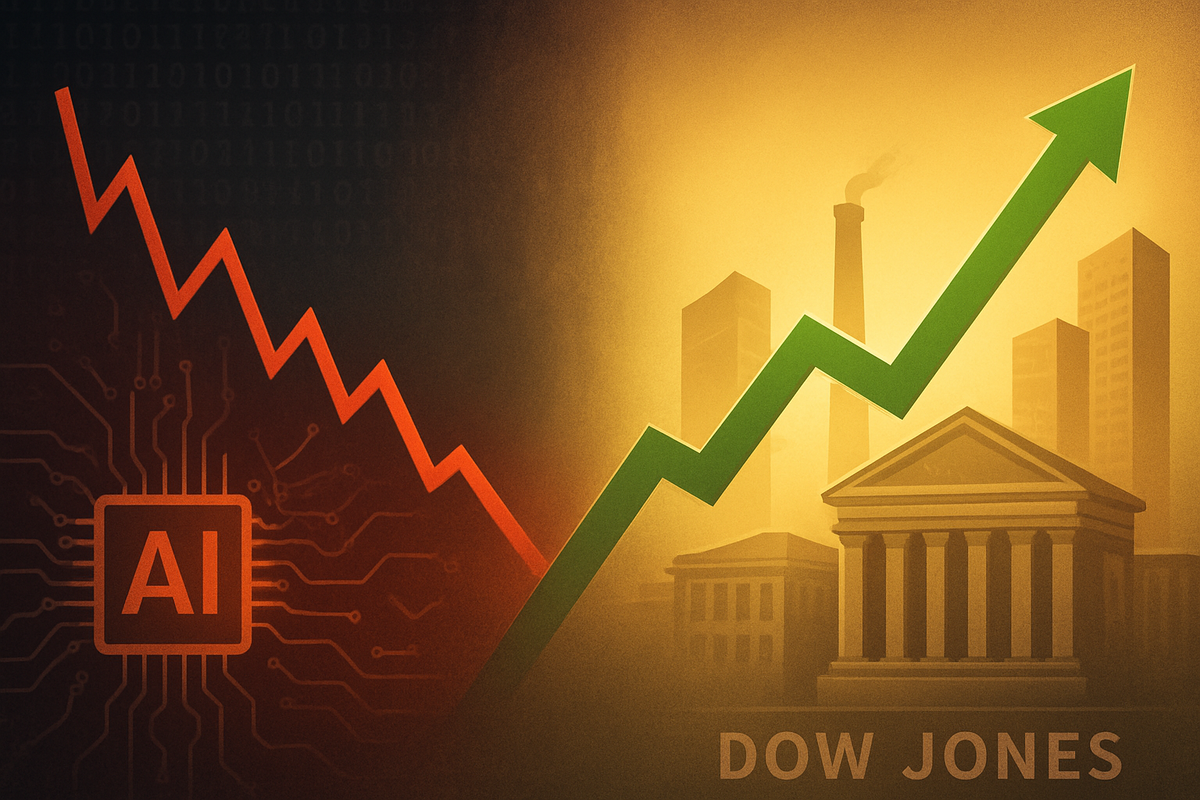
As of December 12, 2025, the financial markets are witnessing a striking divergence: the venerable Dow Jones Industrial Average (DJIA) continues its ascent, notching new all-time highs, even as the once-unassailable technology sector grapples with significant volatility and investor skepticism. This "Great Rotation" of capital from high-growth tech stocks to more traditional, value-oriented industries is reshaping the investment landscape and prompting a fundamental reassessment of market leadership. The Dow's resilience suggests a renewed focus on stable earnings and established business models, contrasting sharply with the tech sector's struggle to justify soaring valuations amidst "AI bubble fears."
The Dow's Steady Climb Amidst Tech's Turbulent Descent
The Dow Jones Industrial Average has demonstrated remarkable strength throughout 2025, culminating in an all-time high of 48,704.01 on December 11, 2025, and an intraday record on December 12. With an approximate 14.5% year-to-date return, the index is poised for its third consecutive week of gains, driven by robust corporate profits from traditional sectors and expectations of continued accommodating monetary policy from the Federal Reserve. This stability is largely attributable to the Dow's composition, which includes established giants in industrials, financials, healthcare, consumer staples, and defense, all sectors known for consistent cash flows and defensive characteristics.
In stark contrast, the technology sector, despite a strong early 2025 performance (the tech-heavy Nasdaq was up around 22% year-to-date), is now experiencing significant turmoil. Investors are increasingly questioning the "lofty valuations" of AI-linked companies and demanding concrete evidence of immediate and substantial returns from extensive AI investments. This recalibration became acutely evident on December 11, 2025, when Oracle's (NYSE: ORCL) stock plummeted nearly 11% following a disappointing earnings report that revealed higher capital spending and lower-than-expected revenue and operating income. This triggered broader concerns, dragging down other prominent AI-related firms. The next day, on December 12, Broadcom's (NASDAQ: AVGO) shares dropped more than 12% despite better-than-expected fiscal fourth-quarter results, reflecting growing investor skepticism around the AI trade and its financial forecasts.
Adding to the broader market dynamics, the Federal Reserve cut its key interest rate by a quarter-percentage point to a range of 3.5% to 3.75% in December 2025, following multiple cuts earlier in the year. While generally supportive of the broader market, these rate cuts have also subtly encouraged a reallocation of assets as investors reassess risk, particularly in the tech and AI sectors. Geopolitical tensions and U.S. tariff policies, which caused market fluctuations in April 2025, also highlighted the market's underlying resilience with swift recoveries, though these policies are expected to remain a dominant macro theme in 2026. Persistent inflation pressures and volatile job gains further contribute to market sentiment and the Fed's policy decisions, creating a complex backdrop for investment strategies.
Companies Navigating the Shift: Potential Winners and Losers
The ongoing market rotation is creating clear distinctions between potential winners and losers. Companies within the Dow Jones Industrial Average, particularly those in established, value-oriented sectors, stand to benefit. Firms like those in industrials (e.g., Caterpillar (NYSE: CAT), 3M (NYSE: MMM)), financials (e.g., JPMorgan Chase (NYSE: JPM), Goldman Sachs (NYSE: GS)), healthcare (e.g., Johnson & Johnson (NYSE: JNJ), UnitedHealth Group (NYSE: UNH)), and consumer staples (e.g., Procter & Gamble (NYSE: PG), Coca-Cola (NYSE: KO)) are likely to attract capital due to their stable cash flows, consistent profitability, and often attractive dividend yields. Their established business models offer a defensive hedge against the volatility seen elsewhere, appealing to investors seeking more tangible and less speculative returns. The defense sector, represented by companies like Boeing (NYSE: BA) (though also impacted by other factors), also benefits from its inherent stability.
Conversely, many high-growth technology and AI-linked companies face significant headwinds. While some may continue to innovate and eventually justify their valuations, the immediate future appears challenging for those whose stock prices have outpaced their current earnings and operational realities. Oracle (NYSE: ORCL) and Broadcom (NASDAQ: AVGO) are prime examples, experiencing sharp declines as investors scrutinize their AI investments and future profitability. Other prominent AI-related firms such as Micron Technology (NASDAQ: MU) and Nvidia (NASDAQ: NVDA), despite their crucial roles in the AI ecosystem, are also feeling the pressure as market sentiment shifts. The demand for concrete returns over speculative potential means that companies reliant on future growth narratives, without robust current earnings to back them up, will likely continue to struggle to maintain their elevated valuations.
Wider Significance: A Return to Fundamental Value
This "Great Rotation" signifies a broader industry trend away from the narrow, tech-led rallies that have dominated the market for several years and a return to fundamental value investing. Investors are increasingly prioritizing companies with strong balance sheets, consistent earnings, and proven business models over those promising revolutionary future growth. This shift could have significant ripple effects on competitors and partners across various industries. Companies that have heavily invested in or relied on the growth of the tech sector might need to recalibrate their strategies, while those in traditional sectors could find new opportunities for expansion and market leadership.
Regulatory and policy implications also play a crucial role. The Federal Reserve's accommodating monetary policy, characterized by rate cuts, while broadly supportive, has also nudged investors to reassess risk and seek out more stable assets. Furthermore, ongoing geopolitical tensions and U.S. tariff policies, expected to remain prominent in 2026, could continue to influence global supply chains and trade, impacting both tech and traditional manufacturing sectors. Historically, periods of such divergence often precede a rebalancing of market leadership, where different sectors take turns driving overall market performance. This current environment echoes past shifts where speculative bubbles eventually yield to a more disciplined focus on earnings and value, suggesting a maturing market cycle.
What Comes Next: Navigating a Realigned Market
In the short term, the market is likely to see a continued emphasis on value stocks and traditional sectors, bolstering the Dow's performance. The tech sector, meanwhile, may undergo a period of recalibration, with investors becoming more selective and demanding clearer paths to profitability for AI and other high-growth ventures. Companies within the tech space will need to demonstrate tangible returns on their AI investments to regain investor confidence. This could lead to strategic pivots, with some tech firms focusing on immediate monetization and cost efficiencies rather than pure growth.
Long-term possibilities include a more balanced market where both value and growth sectors contribute to overall market performance, albeit with different drivers. While the "AI bubble" may deflate for some, the underlying technological advancements are real, and companies that successfully integrate AI into profitable business models will eventually thrive. Market opportunities may emerge for investors willing to identify undervalued tech companies with strong fundamentals that have been unfairly penalized by the broader sector downturn. Conversely, challenges will include navigating continued volatility in the tech space and adapting to a potentially slower growth environment for certain high-flying stocks. Potential scenarios range from a sustained period of value outperformance to a eventual tech rebound driven by concrete AI applications and renewed investor confidence.
Comprehensive Wrap-Up: A Market in Transition
The current market environment, characterized by the Dow Jones Industrial Average's robust performance amid tech sector turmoil, signals a significant transition. Key takeaways include the ongoing "Great Rotation" towards value, the increasing scrutiny on tech valuations and AI profitability, and the resilience of traditional industries. The market is moving towards a more discerning approach, prioritizing established profitability and stable business models over speculative growth narratives.
Moving forward, investors should closely watch the Federal Reserve's monetary policy decisions, global geopolitical developments, and, crucially, the earnings reports of both traditional and technology companies for signs of sustained profitability and tangible returns from AI investments. The ability of tech companies to adapt their strategies and demonstrate clear paths to profitability will be critical for their future performance. While the broader market, as represented by the Dow, appears robust, underlying anxieties about concentrated gains in specific tech segments are prompting a strategic shift in investment portfolios. This period of recalibration suggests that while the Dow may maintain its resilience, the tech sector's path forward will depend on its capacity to deliver on its ambitious promises.
This content is intended for informational purposes only and is not financial advice