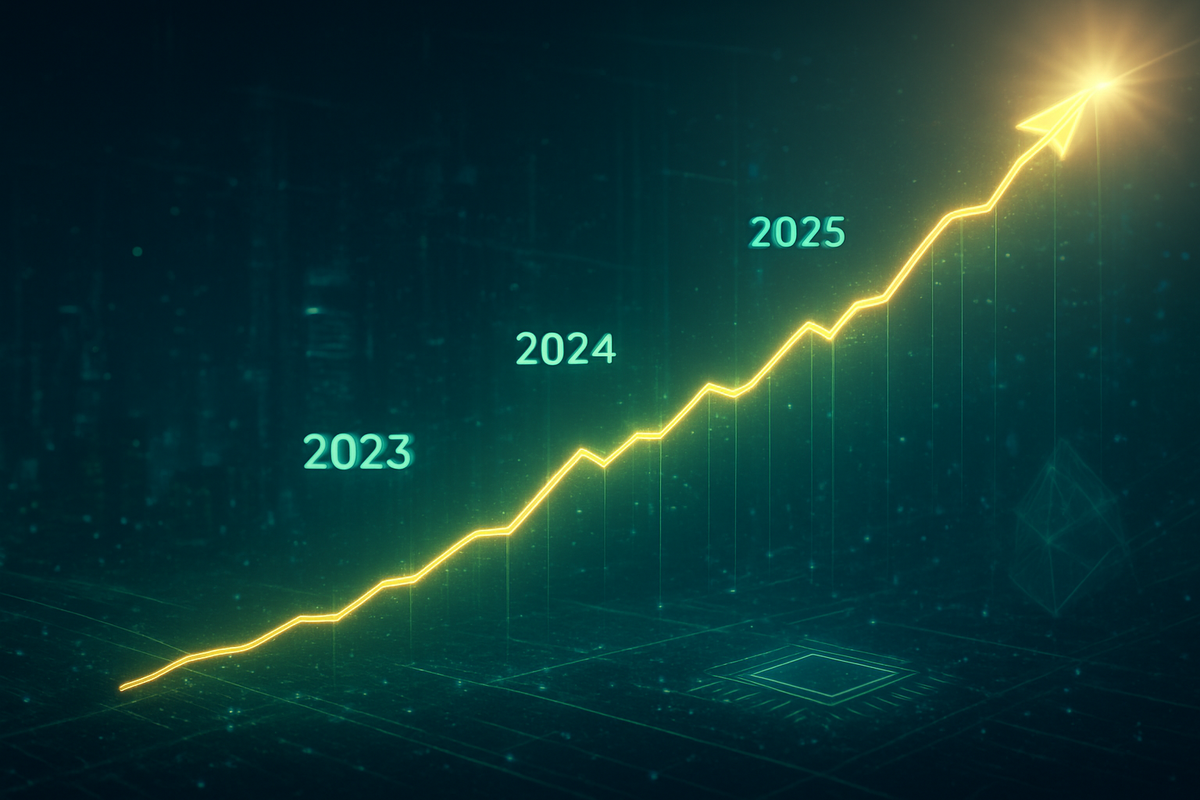
As the final trading days of 2025 approach, the S&P 500 (INDEXSP: .INX) is on the verge of cementing a historic financial milestone. With a year-to-date return currently hovering between 15% and 19%, the benchmark index is poised to deliver its third consecutive year of double-digit percentage gains. This rare "triple crown" of performance—following a stellar 26.2% total return in 2023 and a robust 24.5% in 2024—marks one of the most prolific periods of wealth creation in the history of the American equity markets.
For long-term investors, this streak is more than just a statistical anomaly; it is a testament to the resilience of the U.S. economy and the transformative power of technological innovation. While the rally has been punctuated by bouts of volatility, particularly surrounding shifting trade policies and geopolitical tensions in late 2025, the underlying strength of corporate earnings and a supportive Federal Reserve have kept the momentum firmly in the bulls' favor.
The journey to this three-year peak began in the ashes of the 2022 bear market. In 2023, the market defied recessionary fears, propelled by the sudden and explosive emergence of generative artificial intelligence. What began as a speculative frenzy matured into a fundamental shift in 2024, as the Federal Reserve, led by Chair Jerome Powell, successfully navigated a "soft landing." By the time the Fed initiated its rate-cutting cycle in September 2024, the market had already priced in a transition from a high-inflation environment to one of stable growth.
In 2025, the narrative shifted from AI potential to AI implementation. Corporate America began showing tangible productivity gains from integrated AI tools, which helped sustain double-digit earnings growth across the S&P 500. Throughout the year, the index marched steadily upward, crossing the psychological 6,000 barrier and eventually trading near the 7,000 mark by December. Even as the market faced headwinds from renewed trade rhetoric and tariff discussions following the 2024 election cycle, investor appetite for growth remained unsated.
The timeline of this streak is characterized by a "wall of worry" that the market consistently climbed. From the regional banking crisis of early 2023 to the "higher-for-longer" interest rate fears of mid-2024, each potential derailment was met with stronger-than-expected corporate balance sheets. By late 2025, the market's reaction to volatility has become almost reflexive, with "buy the dip" remaining the dominant strategy for institutional and retail traders alike.
The undisputed champion of this three-year run has been NVIDIA (NASDAQ: NVDA). As the primary provider of the silicon "picks and shovels" for the AI gold rush, NVIDIA’s stock has seen astronomical growth, including a 35% jump in 2025 alone. The successful rollout of its Blackwell Ultra series chips solidified its dominance, making it a cornerstone of almost every winning portfolio. Joining NVIDIA in the winner's circle is Apple (NASDAQ: AAPL), which staged a massive comeback in 2025. Apple’s 38% gain this year was driven by an "AI Supercycle," as consumers flocked to the iPhone 17 to utilize advanced on-device AI features, proving that the hardware giant could successfully pivot its ecosystem for the new era.
Microsoft (NASDAQ: MSFT) also remains a primary beneficiary, despite facing "capital expenditure fatigue" from investors early in 2025. The company’s ability to monetize its AI Copilot software and maintain Azure’s growth trajectory allowed it to finish the year up approximately 18%. Meanwhile, the broader financial sector, represented by giants like JPMorgan Chase & Co. (NYSE: JPM), benefited from a steeper yield curve and increased deal-making activity as interest rates stabilized at lower levels, providing a necessary counterbalance to the tech-heavy gains.
However, the streak has not been kind to everyone. Companies with high debt loads that failed to refinance before the 2023-2024 rate peaks have struggled, as have traditional retailers unable to compete with the logistical efficiency of AI-driven competitors like Amazon.com (NASDAQ: AMZN). Furthermore, sectors like Utilities and Consumer Staples have largely underperformed the broader index on a relative basis, as investors rotated out of defensive "bond proxies" and into high-growth equities to capture the historic upside.
The historical significance of this three-year run cannot be overstated. Since 1928, the S&P 500 has risen for three consecutive years about a dozen times, but achieving double-digit gains in each of those years is a much rarer feat. This 2023-2025 period mirrors the legendary "Roaring 90s," specifically the 1995-1999 streak where the market benefited from the early adoption of the internet. Like the late 90s, the current era is defined by a technological paradigm shift that is fundamentally altering how business is conducted.
This event also highlights a major shift in Federal Reserve policy. The transition from the most aggressive tightening cycle in 40 years to a steady easing cycle without triggering a recession is a "Goldilocks" scenario that many economists thought was impossible. This policy backdrop has allowed valuations to remain elevated; the S&P 500’s price-to-earnings (P/E) multiple is significantly above historical averages, reflecting a market that is willing to pay a premium for future AI-driven growth.
The ripple effects extend beyond the stock market. The sustained growth has bolstered consumer confidence and retirement accounts, creating a "wealth effect" that has supported broader economic spending. However, it also raises questions about market concentration. With a handful of tech titans responsible for a disproportionate share of the index's gains, the S&P 500 has become more sensitive to the fortunes of a single industry than perhaps at any time in its history, save for the peak of the Dot-com bubble.
As we look toward 2026, the primary question for investors is whether this momentum can be sustained for a fourth year. Most Wall Street analysts are calling for a "return to normalcy," with projections suggesting more modest single-digit gains in the 3% to 5% range. The primary challenge will be valuation compression; after three years of massive expansion, the "easy money" has likely been made, and the market may need a period of consolidation to allow earnings to catch up with stock prices.
Strategic pivots will be required as the market enters a more mature phase of the AI cycle. Investors are expected to move away from "pure-play" AI hardware providers and toward "second-derivative" winners—companies in sectors like healthcare, energy, and manufacturing that are successfully using AI to expand margins. Additionally, the geopolitical landscape remains a wild card. Potential trade conflicts and the implementation of new tariffs in early 2026 could introduce the kind of volatility that hasn't been seen during this three-year bull run.
Short-term opportunities may emerge in small-cap stocks, which have lagged their large-cap counterparts during this streak. If the Fed continues to lower rates and the economy avoids a downturn, the Russell 2000 (INDEXRUSSELL: RUT) could see a catch-up trade as borrowing costs fall for smaller enterprises. However, the risk of a "mean reversion" event remains the "elephant in the room" for those who have grown accustomed to 20% annual returns.
The S&P 500’s performance from 2023 through 2025 will be remembered as a golden era for equity investors. By navigating a path through inflation, high interest rates, and global uncertainty, the index has proven its remarkable durability. The key takeaway for long-term investors is the importance of staying the course; those who exited the market during the 2022 downturn missed one of the fastest and most significant recoveries in financial history.
Moving forward, the market is likely to be characterized by greater dispersion. The "tide that lifts all boats" may be receding, replaced by a "stock picker's market" where fundamental analysis and sector selection become paramount. Investors should keep a close eye on upcoming earnings reports in January 2026 to see if corporate guidance aligns with the lofty expectations currently baked into stock prices.
While the streak of double-digit gains may eventually cool, the structural changes brought about by AI and the stabilization of the monetary environment have set a new floor for the market. As 2025 draws to a close, the S&P 500 stands as a monument to American corporate ingenuity, though the watchful investor knows that after such a long climb, the air at the top is always a bit thinner.
This content is intended for informational purposes only and is not financial advice.