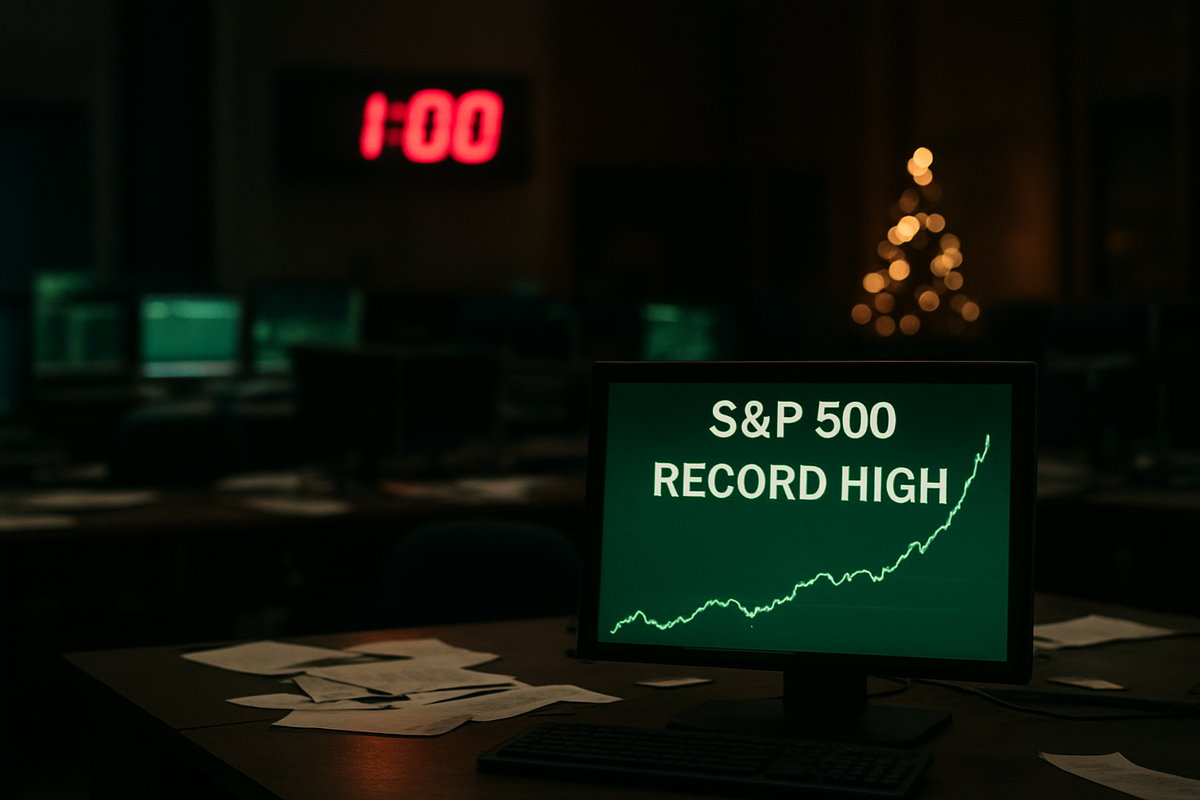
NEW YORK — As the clock struck 1:00 p.m. ET on this Wednesday, December 24, 2025, the floor of the New York Stock Exchange fell silent, but the digital tickers told a story of quiet triumph. In a session characterized by "ghost town" trading volumes—estimated at barely 20% of the yearly average—the S&P 500 (NYSE: SPY) managed to carve out a new intraday all-time high of 6,927.46. While the physical hallways of Wall Street were empty, the absence of institutional resistance allowed a thin stream of optimistic retail and algorithmic buying to push the broader market into uncharted territory.
This phenomenon, known as a holiday-thinned session, has once again demonstrated how low liquidity can act as a force multiplier for market sentiment. With most major desks closed and high-frequency trading (HFT) algorithms operating on reduced parameters, the usual "friction" of the market—thousands of limit orders standing in the way of price movement—evaporated. The result was a record-breaking session that felt more like a gentle drift than a frantic rally, marking the 38th time the index has hit a record in 2025.
The Mechanics of the "Thin" Market
The 2025 Christmas Eve session followed a classic script of seasonal contraction. Markets opened at their usual 9:30 a.m. ET but shuttered early, leaving investors with a truncated three-and-a-half-hour window to settle their year-end affairs. Historically, such sessions are prone to exaggerated moves because the "order book"—the list of buy and sell orders at various price levels—is remarkably shallow. When liquidity is this low, even a relatively small trade can "slice" through multiple price levels, causing the kind of volatility that would be impossible on a high-volume day in October.
This year’s climb to record highs stands in stark contrast to the infamous "Christmas Crash" of 2018. In that year, a similar low-liquidity environment weaponized panic, leading to a -2.71% drop in a single shortened session as investors fretted over Federal Reserve policy and trade wars. In 2025, however, the vacuum worked in the opposite direction. A combination of cooling inflation data (PCE at 2.8%) and a resilient Q3 GDP print of 4.3% created a "bid" that faced almost no selling pressure. With no one left to say "no" to higher prices, the market simply drifted upward into the record books.
Key stakeholders in today's move were not the usual hedge fund titans, many of whom have already shuttered their books for the year, but rather automated rebalancing programs and retail investors participating in the early stages of the "Santa Claus Rally." This official seven-day period, which began today and runs through January 5, 2026, has historically seen positive returns 79% of the time. In the thin air of today's market, that historical bias was amplified into a milestone performance.
Winners and Losers in the Holiday Vacuum
While the indices moved higher, individual stocks saw varied reactions as the low-volume environment exposed them to idiosyncratic moves. Apple Inc. (NASDAQ: AAPL) was a notable winner, rising 0.54% to $273.84. The tech giant has been a primary beneficiary of the 2025 AI-integration cycle, and today's move was further bolstered by news of high-profile institutional interest. Conversely, Nvidia Corp. (NASDAQ: NVDA) experienced the downside of thin liquidity, slipping 0.76% as a few large sell orders met a shallow pool of buyers, though the stock remains up over 34% for the year.
Retail and consumer stocks also saw outsized moves. Nike Inc. (NYSE: NKE) surged nearly 4.6% in the final hour of trading, a move that analysts attributed to a "liquidity gap" following reports of significant personal stock purchases by high-profile tech executives. In a normal session, such news might cause a 1% bump; in a thinned holiday market, it triggered a vertical climb. Meanwhile, Amazon.com Inc. (NASDAQ: AMZN) traded flat, closing down a marginal 0.08% at $231.96, as investors weighed a record-breaking $44.2 billion Cyber Week against concerns over service-sector inflation.
On the losing end, Intel Corp. (NASDAQ: INTC) dropped 1.8% following reports that major partners were shifting testing away from its 18A process. In a high-volume market, this news might have been absorbed more gradually, but the lack of active market makers on Christmas Eve meant the stock had to fall further to find a "floor" of buyers. Microsoft Corp. (NASDAQ: MSFT) remained the steady hand of the session, gaining a modest 0.07% to $487.20, effectively acting as a digital mattress for the broader index.
A Symptom of the 2025 Macro Landscape
The ability of the S&P 500 to hit a record on such low volume is a testament to the broader industry trends of 2025. This has been the year of the "Soft Landing," where the Federal Reserve successfully navigated away from a recession while cooling the post-pandemic inflationary spike. The December 0.25% rate cut acted as the final green light for investors, and today’s low-volume rally is effectively a "victory lap" for that policy shift.
Furthermore, the dominance of the "Magnificent Seven" and AI-centric firms has changed the nature of holiday trading. Because these few companies carry such immense weight in the S&P 500, a minor move in Apple or Microsoft during a low-volume session can disproportionately lift the entire market. This creates a feedback loop where the index hits a record, triggering automated momentum-following algorithms to buy even more, regardless of the underlying volume.
This trend toward "passive dominance" means that holiday sessions are becoming less about price discovery and more about momentum maintenance. Compared to the volatile holiday sessions of the early 2010s, the 2025 market is more heavily influenced by the "vacuum effect," where the absence of active human traders allows systematic flows to dictate the direction. This shift has regulatory implications, as some observers worry that the lack of liquidity could just as easily lead to a "flash crash" if a negative headline were to hit during the quiet hours.
The Road to 7,000: What Comes Next?
As we look toward the final week of 2025 and the dawn of 2026, the question is whether this "hollow" rally can sustain its momentum. Short-term, the Santa Claus Rally is expected to provide a tailwind that could push the S&P 500 toward the psychological 7,000 level by the first week of January. Market strategists are watching for the "January Effect," where tax-loss harvesting in December is replaced by fresh capital inflows as the new year begins.
However, the risks of a "liquidity hangover" remain. As institutional traders return to their desks in the second week of January, they will be greeted by a market that has been priced in a vacuum. If the economic data in early 2026—specifically the upcoming jobs report—shows any signs of cooling too rapidly, the record highs set during this holiday period could be tested. Investors should expect a return to higher volatility as volume normalizes and the market undergoes its annual "re-weighting" process.
Strategic pivots are already appearing on the horizon. With valuations for the S&P 500 now sitting at a forward P/E of 24x, some fund managers are signaling a move toward defensive sectors like healthcare and utilities to hedge against a potential mid-2026 correction. The "easy money" of the AI-driven 2025 rally may be reaching its plateau, making the first quarter of 2026 a critical period for stock-picking over index-tracking.
Closing the Books on 2025
The record-breaking close of December 24, 2025, serves as a fitting capstone to a year that defied the skeptics. The key takeaway for investors is that while today's record high was achieved on thin volume, it was built on a foundation of genuine economic resilience and a pivot in monetary policy. The holiday-thinned session didn't create the rally; it simply removed the obstacles in its path.
Moving forward, the market remains in a "goldilocks" zone, but the air is getting thinner at these heights. Investors should watch the 7,000 mark on the S&P 500 as a key resistance level and keep a close eye on the VIX, which remains unusually low at 15. A spike in volatility in early January would be the first sign that the holiday magic is wearing off.
Ultimately, the 2025 Christmas Eve session will be remembered as a moment when the market’s internal mechanics and external optimism aligned perfectly. Whether this record-setting drift is a precursor to a booming 2026 or a final peak before a consolidation remains to be seen, but for today, the bulls are in full control of the empty floor.
This content is intended for informational purposes only and is not financial advice.