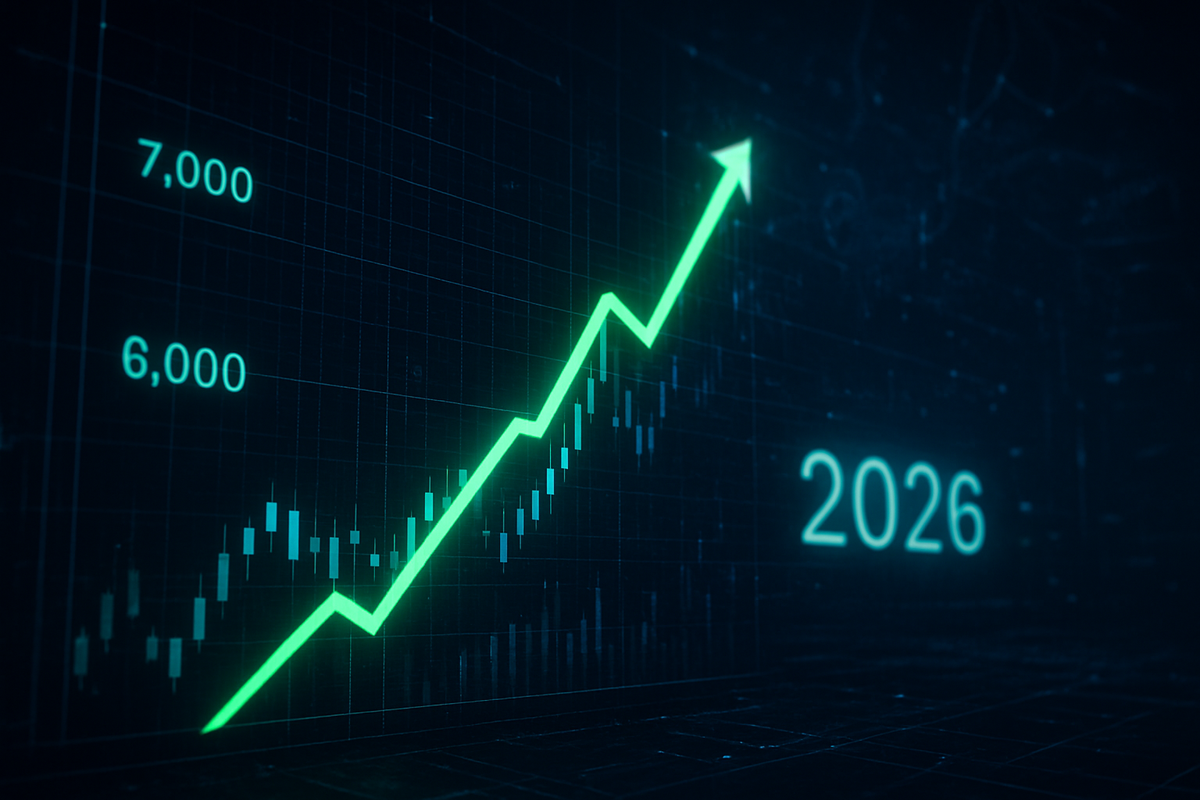
As the clock struck midnight and ushered in 2026, investors across the globe are pausing to reflect on a year that defied both the skeptics and the historical averages. The S&P 500 closed out 2025 at a record-shattering 6,845.50, securing a 16.4% price return for the year. This performance marks the third consecutive year of double-digit gains for the benchmark index—a statistical "triple-double" that has occurred only six times since the 1940s, cementing this era as one of the most powerful secular bull markets in modern financial history.
The immediate implications of this rally are profound. Household wealth has surged to new heights, fueled by a broadening market where, for the first time since 2021, all 11 sectors of the S&P 500 finished in positive territory. However, the euphoria is tempered by a growing debate over valuations. With the index trading at roughly 21.8 times forward earnings, the margin for error in 2026 has narrowed significantly. Investors are now entering the new year with a mix of "FOMO" (fear of missing out) and a cautious eye on whether the "One Big Beautiful Bill Act" and Federal Reserve easing can continue to outpace the headwinds of global trade tensions.
The Year of the "Tariff Tantrum" and Fiscal Firepower
The journey to 6,845 was anything but a straight line. The year 2025 began with a surge of optimism as the index broke the 6,000 barrier for the first time on January 26, driven by a 3.1% GDP growth surprise. However, the market’s resilience was put to a severe test in April during what traders dubbed the "Tariff Tantrum." Following the announcement of sweeping new trade levies on "Liberation Day," the S&P 500 plummeted nearly 19% in a matter of weeks, hitting its annual closing low on April 8. The panic was palpable, with many analysts declaring the end of the AI-led bull run.
The recovery, however, was the fastest of its kind in market history. Within 89 days, the index had recouped all its losses, catalyzed by a 90-day pause in tariff implementation and the subsequent signing of the "One Big Beautiful Bill Act" on July 4. This landmark legislation, which made 2017 tax cuts permanent and introduced popular deductions for tips and overtime, provided a massive "fiscal impulse" that recharged corporate earnings. By the time the Federal Reserve delivered its third interest rate cut of the year in December, bringing the federal funds rate to 3.5%–3.75%, the "soft landing" narrative had been replaced by one of "re-acceleration."
Winners and Losers: From AI Hype to Earnings Reality
The clear winners of 2025 were the "hyperscalers" who successfully transitioned from AI experimentation to monetization. Nvidia (NASDAQ: NVDA) continued its dominance as the backbone of the AI revolution, while Microsoft (NASDAQ: MSFT) and Meta (NASDAQ: META) saw their massive capital expenditures begin to yield tangible productivity gains across their software ecosystems. These tech titans led the Information Technology and Communication Services sectors to gains of 25.3% and 32.7%, respectively. The narrative shifted from "if" AI would pay off to "how much," as these companies reported record-breaking bottom-line growth.
On the other side of the ledger, the path was more difficult for interest-rate-sensitive and regional banking stocks. While the broader market soared, Real Estate was the year's laggard, gaining a meager 0.6% as long-term yields remained stubbornly high despite Fed cuts. The banking sector also faced a mid-year scare when Moody’s downgraded several regional lenders in August, sparking a "mini-contagion" fear that briefly weighed on firms like Bank of America (NYSE: BAC). While large-cap institutions like J.P. Morgan (NYSE: JPM) eventually benefited from the "flight to quality," the year served as a reminder that the "higher for longer" shadow still looms over capital-intensive industries.
Historical Precedents and the Secular Shift
The significance of 2025 lies in its place within the broader historical context. The three-year streak of double-digit returns (2023, 2024, and 2025) mirrors the legendary run of the late 1990s. This has led many institutional strategists at firms like Goldman Sachs (NYSE: GS) and Morgan Stanley (NYSE: MS) to argue that we are in the midst of a secular productivity boom driven by generative AI, similar to the internet boom of thirty years ago. The integration of AI into traditional sectors like industrials and healthcare suggests that the market’s gains are becoming more structural than speculative.
However, historical precedents also offer a warning. Data shows that after the S&P 500 gains 10% or more for three consecutive years, the fourth year often sees a "valuation reset," with average returns dropping to roughly 4.6%. The last time the index saw such an explosive three-year run (2019–2021), it was followed by the painful 19.4% bear market of 2022. The regulatory landscape also remains a wild card; as the "One Big Beautiful Bill Act" takes full effect, the long-term implications of increased federal deficits and shifting trade policies will be closely scrutinized by global bond markets.
The 2026 Outlook: A "Year of Risk Reboot"
As we look toward 2026, the consensus among Wall Street's top brass is one of "cautious optimism." The average year-end target for the S&P 500 sits at approximately 7,635, implying a more modest but still healthy upside of about 11.5%. Firms like Oppenheimer are more bullish, eyeing the 8,100 level, while others warn that the market must now rely entirely on earnings growth rather than P/E multiple expansion. The "Year of Risk Reboot" will likely require investors to pivot away from pure momentum plays and toward companies with high "quality" factors—strong balance sheets and reliable cash flows.
The short-term challenge for 2026 will be navigating the "data-dependent" pause signaled by the Fed in late December. If inflation remains sticky or if the fiscal stimulus from 2025 leads to overheating, the anticipated "soft landing" could become a "bumpy ride." Furthermore, the "Other 493" stocks—the companies in the S&P 500 outside the mega-cap tech giants—are expected to take the baton in 2026. This rotation will be critical for the health of the broader market, as a failure of the mid-cap and small-cap sectors to participate could leave the index vulnerable to a top-heavy correction.
Final Reflections on a Historic Run
The 2025 market will be remembered as the year that proved resilience is the ultimate asset. From the depths of the "Tariff Tantrum" to the heights of the 6,800 level, the S&P 500 has rewarded those who stayed the course. The key takeaway for investors is that while the "triple-double" streak is historic, it is not a guarantee of future performance. The market has moved from a phase of speculative excitement into a phase of fundamental execution, where every dollar of valuation must be backed by a dollar of profit.
Moving forward, the focus will shift to how companies adapt to a post-stimulus environment and whether AI can continue to deliver on its promise of efficiency. Investors should watch for the first-quarter earnings season of 2026 as a litmus test for the market's high expectations. While the momentum of the last three years is undeniable, the lessons of history suggest that the most successful investors in 2026 will be those who balance their enthusiasm with a disciplined approach to risk management.
This content is intended for informational purposes only and is not financial advice.