The creator economy has officially transitioned from a fragmented frontier of independent influencers into a high-stakes industrial asset class. As of January 12, 2026, the market is witnessing a massive surge in merger and acquisition (M&A) activity, marking what analysts are calling the "sophomore year" of a sustained rebound. Following a record-breaking 2025 that saw over 80 major deals, the first weeks of 2026 have already signaled that institutional capital is no longer sitting on the sidelines. The primary drivers are a stabilization of interest rates and the resolution of long-standing regulatory clouds that previously dampened investor enthusiasm.
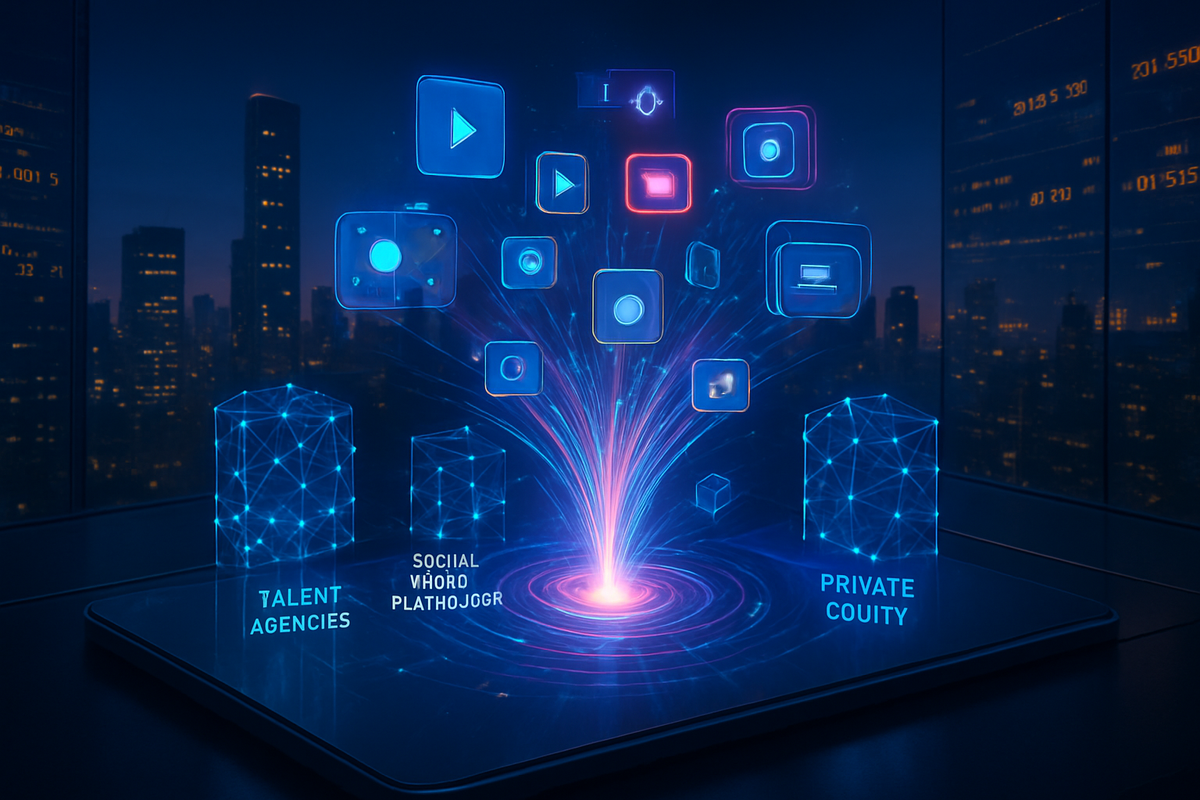
This wave of consolidation is being led by a dual-track strategy: traditional advertising holding companies are acquiring tech-heavy influencer platforms to own first-party data, while private equity firms are rolling up boutique talent agencies into "scaled media ecosystems." With the total creator economy projected to surpass a $500 billion valuation by 2030, the current land grab is about more than just talent—it is about controlling the infrastructure of modern commerce.
The momentum leading into 2026 was fueled by a pivotal 2025, which served as a recovery year for the sector. After the "funding winter" of 2023 and early 2024, the industry saw 81 significant M&A transactions last year, a nearly 18% increase year-over-year. A major catalyst for the current heat was the recent finalization of the TikTok USDS Joint Venture, involving Oracle (NYSE: ORCL) and Silver Lake. Completed in early January 2026, this deal effectively removed the existential threat of a U.S. ban on TikTok, providing the regulatory certainty needed for multi-year M&A planning.
The timeline of this rebound is marked by several landmark deals that set the stage for 2026. In late 2024, Publicis Groupe (ENXTPA:PUB) acquired Influential for $500 million, a move that signaled to the market that "creator-first" marketing was no longer an experimental budget item but a core corporate requirement. This was followed by Bending Spoons’ massive $1.38 billion acquisition of Vimeo (NASDAQ: VMEO) in 2025, which repositioned the video platform as a central hub for professional-grade creator tools.
Key players currently dominating the deal flow include aggressive advertising conglomerates and specialized private equity firms like TPG (NASDAQ: TPG). These entities are moving away from simple talent management and toward "Workflow Wedges"—software tools that integrate creator content directly into the supply chains of major retailers. The market reaction has been overwhelmingly positive, with valuation multiples for creator-centric SaaS businesses stabilizing at a healthy 5.8x Annual Recurring Revenue (ARR), a significant improvement from the volatile lows of two years ago.
The clear winners in this era of consolidation are the large-scale advertising holding companies and tech-enabled agencies that have successfully integrated AI into their discovery engines. Stagwell (NASDAQ: STGW), for instance, has aggressively expanded its footprint by acquiring AI platforms like LEADERS, allowing it to offer brands a performance-first approach to influencer marketing. These companies benefit from economies of scale, using their vast data repositories to predict creator ROI with a precision that smaller, independent agencies simply cannot match.
On the other side of the ledger, small, "pure-play" talent agencies that lack proprietary technology are finding themselves in a difficult position. These firms are increasingly being forced to choose between being swallowed by larger roll-ups or facing obsolescence as brands demand more sophisticated data-tracking and social commerce integration. Similarly, niche platforms that only offer a single feature—such as basic link-in-bio tools—are losing ground to "unified ecosystems" that handle everything from content creation to native checkout and tax compliance.
Public tech giants like Alphabet Inc. (NASDAQ: GOOGL) and Meta Platforms (NASDAQ: META) are also adapting. While they are not necessarily the primary acquirers of small agencies, they are winners in the sense that a more professionalized, consolidated creator economy leads to higher-quality content and more stable ad revenues on YouTube and Instagram. However, they face new competition from the likes of Amazon.com (NASDAQ: AMZN), which has been quietly acquiring creator-facing logistics and "Foundry" tools to tighten the link between influencer content and its massive e-commerce engine.
The broader significance of this M&A fever lies in the "industrialization" of influence. We are seeing a historical parallel to the consolidation of the Hollywood studio system in the early 20th century. Just as the film industry moved from independent production houses to a few dominant studios that controlled both talent and distribution, the creator economy is moving toward a model where a few "super-agencies" and tech platforms control the flow of attention and capital.
This trend is deeply intertwined with the rise of "Agentic AI"—autonomous software agents that can manage entire influencer campaigns, from scouting to contract negotiation. The acquisition of AI startups by firms like Dulcedo Group and Collective Artists Network highlights a shift where human talent is supported by a robust digital infrastructure. This reduces overhead and increases margins, making the sector even more attractive to institutional investors who previously viewed influencer marketing as too "unpredictable" or "unscalable."
Regulatory implications are also shifting. As these entities grow larger, they are beginning to attract the attention of the FTC and other global regulators concerned with transparency in sponsored content and data privacy. The precedent set by the TikTok-Oracle deal suggests a future where "data sovereignty" and localized control of creator data will be a prerequisite for any major cross-border acquisition in the space.
Looking ahead to the remainder of 2026 and into 2027, the market should expect a "bifurcation" of the industry. We will likely see a clear split between infrastructure providers—the SaaS platforms that power the backend—and creative services. Strategic pivots will be required for companies like Fiverr (NYSE: FVRR) and Upwork (NASDAQ: UPWK), which are already moving to acquire creator-specific toolsets to ensure they remain the go-to marketplaces for the "gig" side of the creator economy.
The next frontier for M&A will likely be in social commerce. As "native checkout" becomes the standard on every major social platform, any startup that can bridge the gap between a creator’s video and a completed transaction will be a prime acquisition target. We may also see the emergence of "Creator REITs" or similar investment vehicles that allow public investors to buy into the diversified earnings of a large portfolio of creators, much like royalty trusts in the music industry.
The rebound of M&A in the creator economy marks the end of the sector’s "wild west" phase. The consolidation seen in 2025 and early 2026 has proven that influencers are no longer just a marketing trend; they are the primary drivers of consumer behavior and brand loyalty in the digital age. For investors, the key takeaway is the shift from investing in individual "stars" to investing in the platforms and agencies that own the data and the distribution.
Moving forward, the market will be defined by how well these newly consolidated entities can integrate AI and social commerce into their offerings. Investors should keep a close eye on the quarterly earnings of Endeavor Group Holdings (NYSE: EDR) and other major talent conglomerates to see how their "creator" divisions are performing relative to traditional sports and film. The "deal heat" of 2026 is not just a temporary spike; it is the foundation of a new, more mature media landscape where the creator is the storefront, and the platform is the mall.
This content is intended for informational purposes only and is not financial advice.