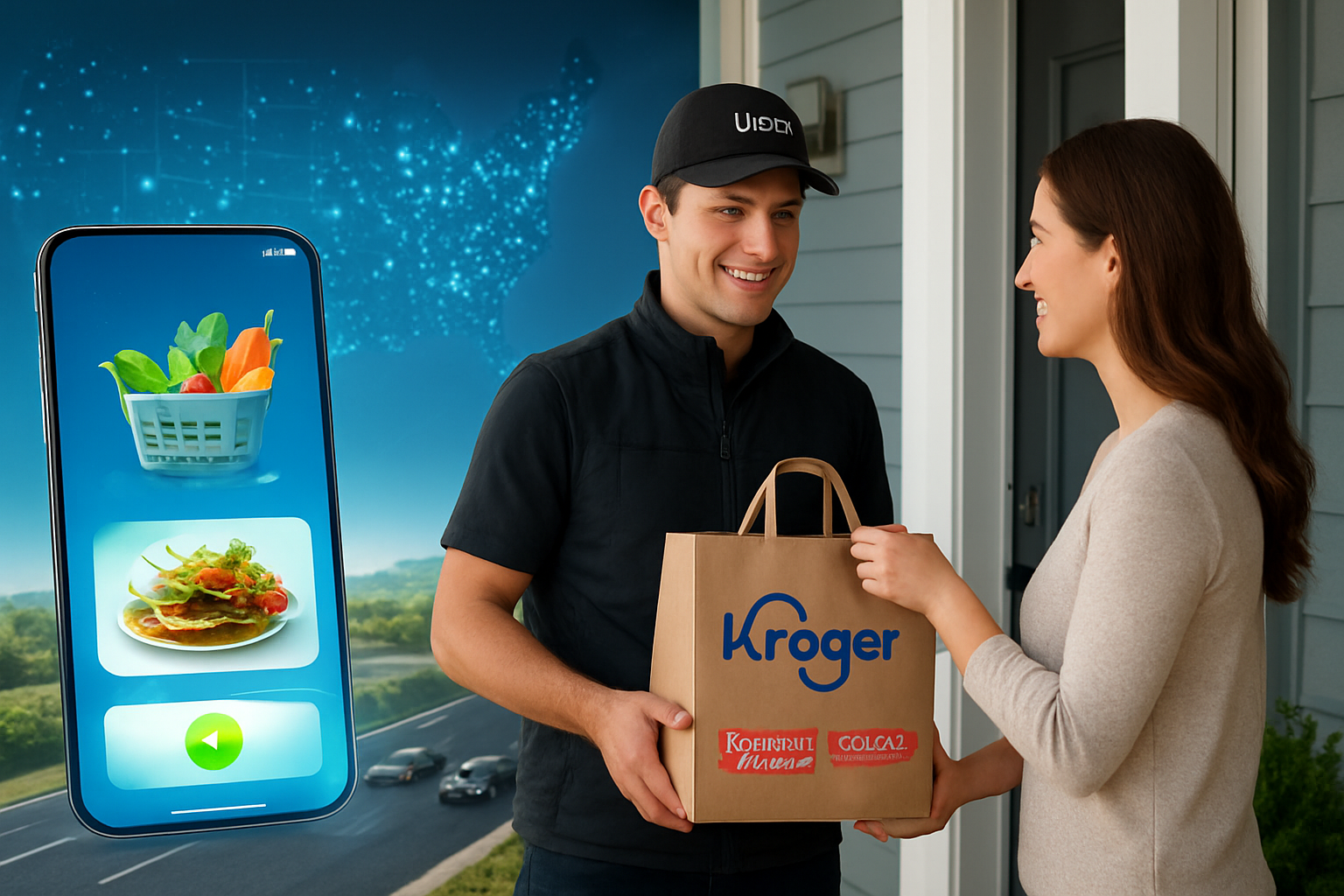
In a move that signals a tectonic shift in the retail landscape, The Kroger Co. (NYSE: KR) and Uber Technologies, Inc. (NYSE: UBER) officially launched their nationwide delivery partnership today, January 15, 2026. This full-scale integration across nearly 2,700 stores marks a definitive attempt by the grocery giant to reclaim its digital momentum and compete directly with the likes of Walmart and Amazon. By merging Kroger’s fresh grocery footprint with Uber’s massive fleet of 9.4 million drivers, the two companies aim to redefine "convenience" in a post-delivery-startup era.
The immediate implications are significant: Kroger is effectively pivoting away from a capital-heavy infrastructure model toward a "cap-light" strategy that leverages existing third-party logistics. For Uber, the deal solidifies its transition from a ride-hailing app into a foundational piece of local commerce infrastructure. As of this morning, shares of Kroger were trading up 1.6% on the news, as investors reacted to the potential for improved digital margins and a stronger foothold in the high-frequency grocery segment.
A Massive National Rollout: The Hybrid Integration
The formal launch today follows a series of strategic maneuvers throughout late 2025. In October of last year, Kroger began a quiet expansion of its pilot programs with Uber Eats and Postmates, aiming for a seamless nationwide presence by early 2026. The partnership is not a mere delivery agreement; it includes several industry-first technological integrations. Most notably, Kroger has become the first major U.S. retailer to embed Uber Eats’ restaurant selection directly into its own proprietary digital app. This allows a customer to order a hot meal for tonight and their weekly groceries for tomorrow in a single checkout experience, effectively bridging the gap between dining and pantry stocking.
This moment follows a challenging 2025 for Kroger. In the third quarter of last year, the company took a substantial $2.6 billion impairment charge related to the closure of several automated fulfillment centers. This signaled a retreat from the "dark store" model that once dominated grocery strategy. Instead, Kroger is now doubling down on store-based picking and third-party delivery. Key stakeholders, including Kroger Chief Digital Officer Yael Cosset, have framed this as "ecosystem access," suggesting that the future of retail lies in being where the customer already spends their time—whether that is in a grocery app or a ride-sharing platform.
Market reaction has been generally favorable, particularly regarding the loyalty reciprocity built into the deal. Kroger Boost members are now eligible for an extended free trial of Uber One, while Uber’s millions of subscribers can access the benefits of Kroger’s fuel points and specialized delivery. This "subscription swap" is designed to create a walled garden of users, making it more difficult for competitors to lure loyalists away with simple price discounts.
Winners and Losers in the New Retail Order
The Kroger Co. (NYSE: KR) stands as the most immediate potential winner from this alliance. By offloading the logistical burden to Uber, Kroger is expected to see a $400 million boost in eCommerce operating profit in 2026. This shift addresses a long-standing concern among analysts: the thin margins associated with grocery delivery. By utilizing Uber’s drivers, Kroger avoids the massive capital expenditures of maintaining its own fleet, allowing the company to scale into new markets with minimal overhead.
Uber Technologies, Inc. (NYSE: UBER) also gains a critical victory. Its advertising business, which crossed the $1.5 billion annual revenue mark in 2025, will benefit immensely from Kroger’s first-party purchase data. By combining Kroger’s knowledge of what people buy with Uber’s knowledge of where people go, the two companies can offer Consumer Packaged Goods (CPG) brands unprecedented targeting capabilities. This "retail media" collaboration is a high-margin revenue stream that could significantly outpace the growth of the delivery service itself.
However, the partnership creates a complicated future for Instacart (NASDAQ: CART). While Kroger remains a partner with Instacart, the Uber deal introduces a high-frequency "meal-plus-grocery" component that Instacart currently lacks. As Kroger prioritizes Uber for "last-minute" and "quick-trip" occasions, Instacart may find itself relegated to the slower, less profitable weekly-shop segment. Furthermore, traditional regional grocers who lack the scale to negotiate such massive partnerships with Uber or DoorDash (NASDAQ: DASH) may find themselves further squeezed by Kroger’s newfound technological and logistical reach.
Shifting Tides: The Industry’s Pivot to "Cap-Light" Models
This event fits into a broader industry trend where retailers are abandoning the dream of owning the entire supply chain. In 2022 and 2023, the industry was obsessed with high-tech automated warehouses and dedicated delivery fleets. By 2026, the reality of high interest rates and labor costs has forced a return to "cap-light" strategies. Kroger’s move is a validation of the "hybrid" model: using existing physical stores as micro-fulfillment hubs and gig-economy drivers for the last mile.
The ripple effects on competitors will be profound. Walmart (NYSE: WMT), which has invested billions in its own Spark delivery network, now faces a Kroger that can match its delivery speed without the same level of capital risk. Amazon (NASDAQ: AMZN), meanwhile, continues to struggle with the physical store component of its grocery business. Kroger’s strategy of leveraging its 2,700 "Family of Companies" banners (including Ralphs, Fred Meyer, and Harris Teeter) gives it a physical density that Amazon has yet to replicate.
Historically, this partnership can be compared to the early days of airlines partnering with hotels. The goal is to capture the "full trip" of the consumer’s wallet. As retailers become media companies and delivery apps become logistics networks, the lines between different sectors of the economy are blurring. There are also regulatory implications to watch; as these two giants share deep troves of consumer data, privacy advocates and antitrust regulators may begin to scrutinize the depth of their "retail media" integration.
The Horizon: What’s Next for the Kroger-Uber Alliance?
In the short term, the success of this partnership will be measured by "stickiness"—how many users who take advantage of the 50% off launch promotions today will remain active users in six months. Strategic pivots may still be required, particularly in how the companies handle driver compensation and delivery fees as state-level regulations on gig work continue to evolve in 2026.
Long-term, the most significant opportunity lies in the data. If the Kroger-Uber retail media collaboration can prove it delivers a higher Return on Ad Spend (ROAS) than Google or Meta, it could become a cornerstone of the digital advertising market. We may also see Kroger explore "white label" delivery, where Uber drivers deliver goods in Kroger-branded vehicles or uniforms to maintain brand consistency, a move that would further blur the lines between the two entities.
However, challenges remain. The reliance on a third party means Kroger has less control over the customer experience. A rude driver or a late delivery reflects on the Kroger brand, not just Uber. Managing this reputation risk while scaling to 2,700 locations will be the primary operational hurdle for Kroger’s leadership throughout the remainder of 2026.
Summary: A New Chapter in Grocery Retail
The nationwide launch of the Kroger and Uber partnership marks a pivotal moment in the evolution of digital grocery. By choosing a path of collaboration over total ownership of the logistics chain, Kroger has positioned itself as a nimble competitor capable of taking on the scale of Walmart. The integration of restaurant delivery into a grocery app, coupled with a sophisticated retail media play, suggests that the "app wars" are no longer just about who can deliver the fastest, but who can offer the most comprehensive ecosystem.
For the market, this move signals a maturation of the eCommerce sector. The "growth at all costs" mentality of the early 2020s has been replaced by a focus on sustainable margins and data-driven revenue. Investors should keep a close eye on Kroger’s quarterly digital sales growth and Uber’s advertising revenue metrics in the coming months. If this partnership successfully drives the predicted $400 million in incremental profit, it could serve as a blueprint for the future of the entire retail industry.
This content is intended for informational purposes only and is not financial advice.