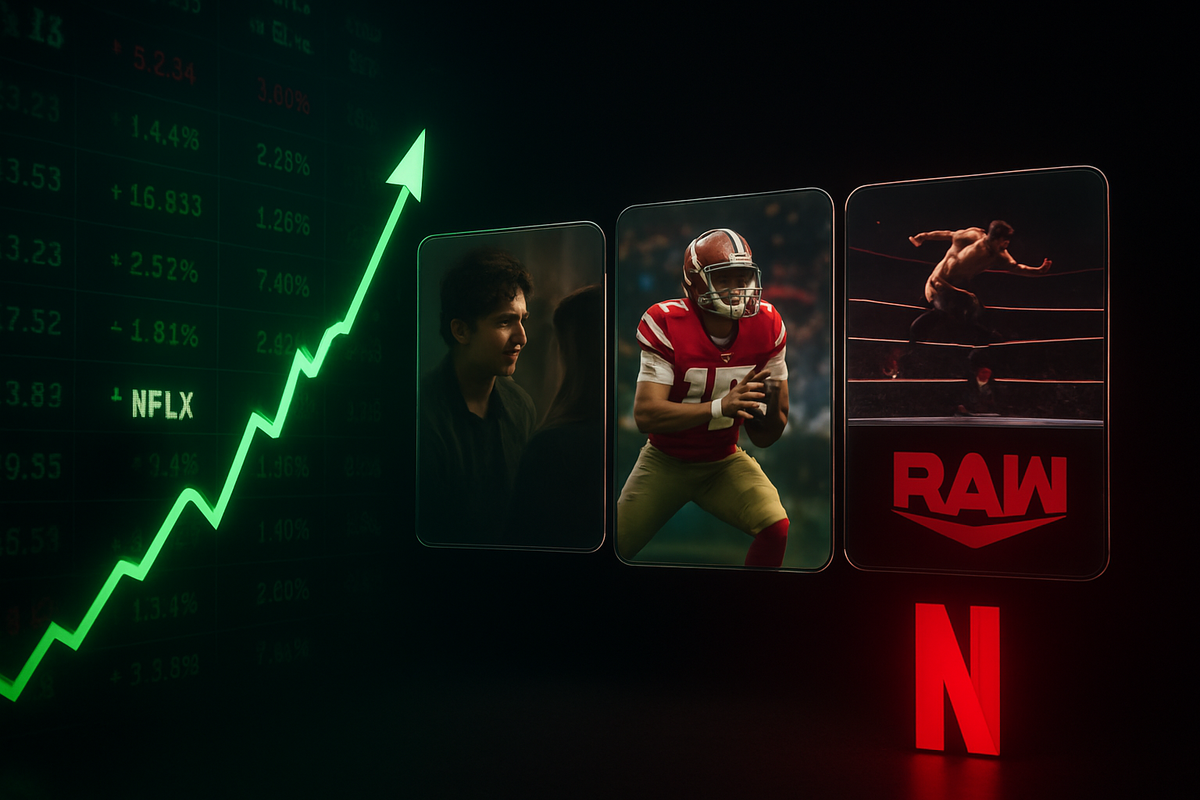
Netflix Inc. (Nasdaq: NFLX) shares skyrocketed nearly 10% in early trading today, Jan. 19, 2026, following a blockbuster fourth-quarter earnings report that silenced skeptics and reaffirmed the company’s iron grip on the global streaming market. The streaming giant reported a massive jump in subscriber numbers, fueled by a successful foray into live sports and the continued maturation of its ad-supported tier, leading management to aggressively raise its revenue guidance for the full year of 2026.
The market's euphoric reaction reflects a growing consensus that Netflix has successfully transitioned from a high-growth tech disruptor into a diversified media powerhouse with high-margin recurring revenue. As traditional Hollywood studios struggle with legacy television declines, Netflix’s ability to pair premium content with live "appointment viewing" has created a financial profile that many analysts now describe as the gold standard for the modern entertainment era.
The quarterly results, released after the closing bell on Jan. 15, 2026, revealed that Netflix added 12.4 million net new subscribers in the final three months of 2025, bringing its total global base to a staggering 318 million. This figure handily beat Wall Street’s consensus estimate of 9 million. Revenue for the quarter hit $11.2 billion, a 15% increase year-over-year, while earnings per share (EPS) came in at $4.85, surpassing the $4.60 projected by analysts. Perhaps most importantly, the company raised its 2026 revenue outlook to a range of $44 billion to $46 billion, citing a surge in high-value ad impressions and price-tier optimization.
The timeline leading up to this moment was defined by a strategic pivot toward live events. Throughout 2025, Netflix integrated WWE Raw into its weekly lineup, a move that secured millions of "appointment viewers" every Monday night. This was punctuated by a record-breaking Christmas Day 2025 NFL broadcast, which reportedly drew over 30 million concurrent viewers globally. These events served as the ultimate proof of concept for Netflix’s infrastructure, proving the platform could handle the massive traffic spikes that once belonged exclusively to cable and broadcast television.
Initial market reactions were swift. Within minutes of the report, Netflix stock surged 8% in after-hours trading, eventually settling at a 9.8% gain as the opening bell rang this morning. Major institutional investors, including BlackRock and Vanguard, noted that Netflix's free cash flow—now approaching $8 billion annually—is being deployed effectively through its $15 billion share repurchase program, further sweetening the deal for long-term shareholders.
The primary winner of this earnings cycle is undoubtedly Netflix (Nasdaq: NFLX). By proving that it can scale its ad-supported tier to over 200 million monthly active users (MAUs), the company has tapped into a new well of high-margin revenue that remains resilient even during economic fluctuations. Furthermore, its dominance in "eventized" content has allowed it to command premium ad rates that rival traditional Super Bowl pricing on a per-viewer basis.
Conversely, the "losers" in this scenario are the legacy media conglomerates that continue to struggle with the fragmentation of the streaming market. Warner Bros. Discovery (Nasdaq: WBD) and Paramount Global (Nasdaq: PARA) find themselves under renewed pressure to consolidate or seek a buyer. With Netflix now generating enough cash to potentially acquire their prestige assets—such as HBO or the Paramount film library—these companies are facing a "buy or be bought" ultimatum. Warner Bros. Discovery, in particular, saw its shares dip 3% on fears that Netflix’s aggressive revenue outlook will allow it to outbid WBD for future sports rights, including upcoming NBA and MLB packages.
Walt Disney Co. (NYSE: DIS) presents a mixed picture. While Disney+ remains the closest competitor to Netflix in terms of subscriber volume, the House of Mouse is still grappling with the high costs of its transition away from linear TV. However, Netflix's success in live sports provides a roadmap for Disney’s ESPN+ integration. If Disney can successfully bundle its assets as effectively as Netflix has integrated live wrestling and football, it stands to benefit from the overall expansion of the digital ad market. Meanwhile, tech giants like Amazon (Nasdaq: AMZN) and Apple (AAPL) remain formidable rivals, but Netflix’s pure-play focus on entertainment gives it a specialized edge that generalist platforms have yet to fully replicate.
This event marks the definitive end of the "Streaming Wars" and the beginning of what analysts call the "Great Re-Aggregation." For years, the industry was defined by a race for subscriber volume at any cost. Today’s report proves that the focus has shifted toward Average Revenue Per Member (ARM) and profitability. Netflix’s ability to raise its outlook despite a saturated North American market indicates that "monetization" is the new keyword for 2026. The shift toward ad-supported tiers has effectively turned Netflix into a hybrid of a premium cable network and a digital advertising giant like Google or Meta.
The ripple effects on competitors are profound. As Netflix becomes the "default" platform for both scripted drama and live sports, the barrier to entry for smaller services is becoming insurmountable. This creates a regulatory environment where antitrust concerns may begin to surface, particularly as Netflix explores the acquisition of rival content libraries to fuel its massive algorithm. Historical precedents, such as the consolidation of the American film industry in the 1940s or the rise of cable monopolies in the 1990s, suggest that we are entering a period of extreme market concentration.
Furthermore, the impact on the advertising industry cannot be overstated. With 318 million subscribers, Netflix is now a "must-buy" for global brands. This shift is siphoning billions of dollars away from traditional linear TV ad budgets, accelerating the demise of local affiliate networks and regional sports networks (RSNs). The eventized nature of Netflix's live broadcasts has effectively solved the "skipping commercials" problem that plagued the digital era, as live sports remain one of the few content types viewers watch in real-time with ads.
Looking ahead, the next 12 to 24 months will likely see Netflix double down on its "platformization" strategy. Rumors of a massive $80 billion bid for Warner Bros. Discovery's premium assets continue to circulate, a move that would integrate HBO’s "prestige" brand directly into the Netflix interface. Such a strategic pivot would require Netflix to navigate complex regulatory hurdles, but it would effectively end the competition for high-end content.
In the short term, investors should prepare for a period of "aggressive experimentation" in live programming. Following the success of the NFL and WWE, Netflix is expected to bid on major tennis tournaments and perhaps even regional rights for international soccer leagues. The challenge will be maintaining the high margins that investors have come to expect while absorbing the skyrocketing costs of sports licensing. Additionally, as AI-driven discovery becomes the norm, Netflix will need to ensure its recommendation engine remains superior to the OS-level AI assistants being developed by Apple (Nasdaq: AAPL) and Google.
The key takeaway from this earnings report is that Netflix has solved the streaming puzzle. By combining the "binge-watch" model with "appointment-viewing" live sports and a low-cost ad tier, the company has created a flywheel of growth that appears unstoppable in the current market. The 10% surge in share price is not just a reaction to a single quarter of growth; it is a validation of a multi-year strategy to transition from a library of licensed content to a global cultural gatekeeper.
As we move forward into 2026, the market will be watching two things closely: the scaling of ad revenue and the potential for a transformative M&A deal. For investors, Netflix has moved from a speculative growth play to a foundational "blue-chip" tech stock. While challenges remain—specifically in the form of content costs and global regulatory scrutiny—the company’s current trajectory suggests that it will remain the dominant force in entertainment for the foreseeable future.
This content is intended for informational purposes only and is not financial advice.