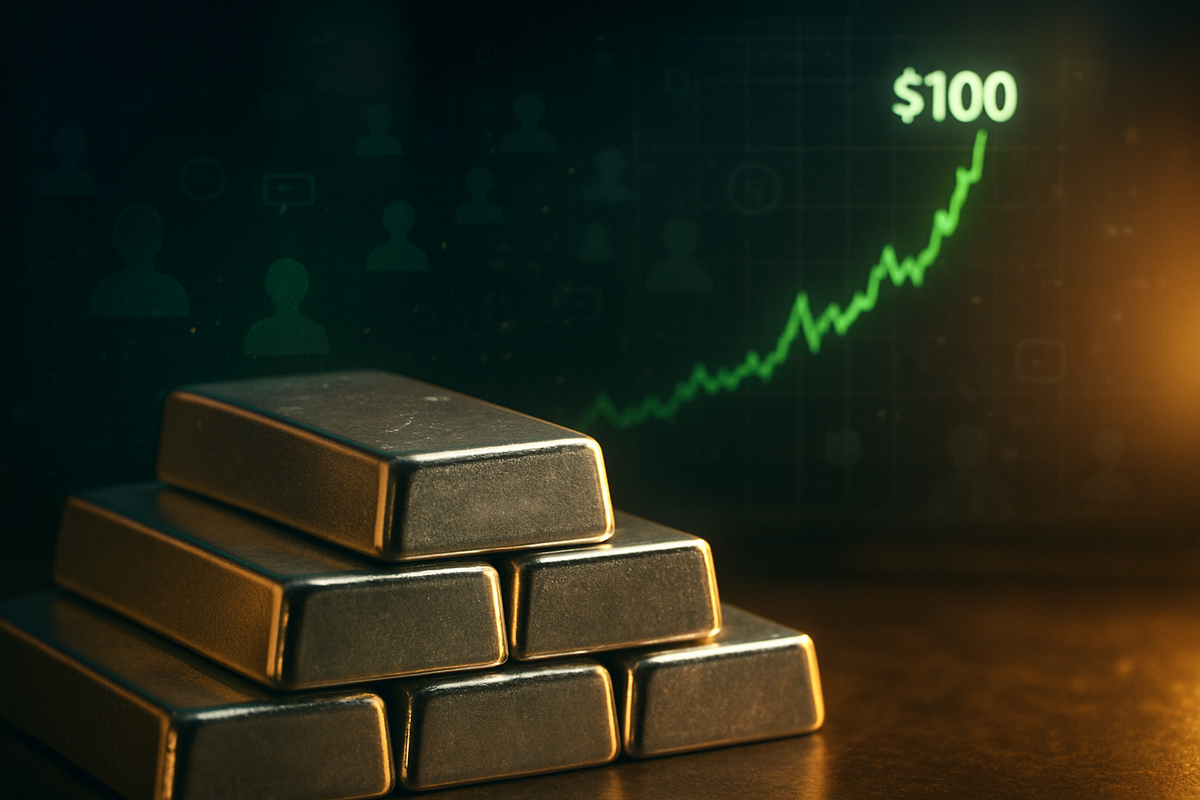
The global financial markets are currently witnessing what analysts have dubbed the "Retail Stampede" of 2026—a massive, social-media-fueled rush into the silver market that has pushed the precious metal to record-breaking heights. As of January 19, 2026, spot silver has surged to an all-time high of approximately $94 per ounce, marking a staggering 25% gain in the first two weeks of the year alone. This rally has caught institutional players off guard, as a wave of individual investors—driven by fears of currency devaluation and a "hard asset" narrative—pours into everything from physical bullion to high-leverage mining stocks.
The immediate implications of this surge are being felt across the globe. In India, the MCX silver futures crossed the historic ₹300,000 per kg threshold today, signaling that the demand is not just a Western phenomenon but a global retail movement. With the $100-per-ounce psychological barrier now within striking distance, the market is grappling with extreme volatility, including massive intraday swings that have liquidated billions in short positions and forced regulators to rethink margin requirements.
The Anatomy of the Rally and the January 8 Flash Event
The road to $94 has been anything but linear. The rally began in late 2025 as structural deficits in the silver market became impossible to ignore, but the "stampede" truly accelerated in the first week of January 2026. Retail traders, congregating on platforms like Reddit and decentralized finance forums, began a coordinated effort to "break the COMEX" by demanding physical delivery and piling into the iShares Silver Trust (NYSE: SLV). This narrative of silver as "real money" in an era of "fiat rot" resonated with millions, leading to a record-breaking 169 consecutive days of positive inflows for major silver ETFs.
However, the rally faced a severe test on January 8, 2026. In an attempt to cool the speculative fever, the CME Group implemented a massive 47% increase in maintenance margins for silver futures. This triggered a "flash crash" where silver plummeted 5% in minutes, briefly dipping back toward the $70 range. Instead of the intended cooling effect, the crash was met with a wall of "buy-the-dip" orders from retail participants, who viewed the regulatory move as an attempt by the "establishment" to suppress prices. The market recovered its losses within 48 hours and has been in a state of "backwardation"—where the spot price is higher than future prices—ever since, indicating an acute shortage of physical metal.
Mining Titans and ETFs Reaping the Rewards
The primary beneficiaries of this price explosion have been the major silver mining companies, whose profit margins have expanded at an exponential rate. First Majestic Silver Corp (NYSE: AG) has emerged as a retail favorite due to its high leverage to the silver price and its CEO’s vocal support for the retail movement; the stock has surged to levels not seen in over a decade. Similarly, Hecla Mining Company (NYSE: HL) has seen its share price nearly triple over the last year, benefiting from its stable North American operations as geopolitical tensions elsewhere make safe-jurisdiction mining more attractive.
Streaming companies have also seen a windfall. Wheaton Precious Metals Corp (NYSE: WPM) is currently generating record-breaking free cash flow, as it maintains the right to purchase silver at fixed costs—often as low as $6 per ounce—while selling it into a market nearing $100. Other major players like Pan American Silver Corp (NYSE: PAAS) and Coeur Mining, Inc. (NYSE: CDE) have seen their valuations balloon, with Pan American recently receiving multiple analyst upgrades to "Strong Buy" based on its massive silver reserves. For investors seeking broader exposure, the Global X Silver Miners ETF (NYSE: SIL) has provided a diversified vehicle to ride the mining boom, outperforming almost every major equity index in 2025.
A Fundamental Shift: Strategic Industrial Demand and Policy Fallout
While the retail frenzy is the most visible driver, the rally is underpinned by a shift in how silver is viewed by major world powers. On January 1, 2026, China officially reclassified silver as a "strategic dual-use" metal, placing strict restrictions on exports to protect its own domestic supply for high-tech industries. Silver is an essential component in photovoltaic (solar) cells, AI data centers, and the nascent 6G telecommunications infrastructure. This move by Beijing created a vacuum in Western markets, further fueling the price surge as industrial users scrambled to secure supply.
The rally also fits into a broader trend of distrust in traditional monetary systems. Concerns over the U.S. Federal Reserve’s independence, amid ongoing Department of Justice investigations into the central bank's leadership, have led many to abandon the dollar in favor of precious metals. When compared to gold, silver’s performance has been dominant. The Gold-to-Silver ratio, which spent much of 2025 above 80:1, has plummeted to approximately 51:1. While gold has reached its own record highs above $4,600, silver’s high-beta nature has allowed it to significantly outperform its yellow counterpart on a percentage basis.
The Road to $100: What Lies Ahead
The short-term focus for the market is now the $100 psychological level. Many technical analysts believe that if silver can hold above $95 through the end of January, a move to $120 is possible by the end of Q1 2026. However, this path is fraught with challenges. Further margin hikes from exchanges are almost certain if volatility continues to escalate, and there is a growing risk of government intervention if physical shortages begin to hamper industrial production in sectors like renewable energy and aerospace.
Longer-term, the silver market is entering a "new normal." The structural deficit—where annual demand outstrips mine supply—is projected to persist for years, as the development of new primary silver mines remains slow due to environmental regulations and long lead times. Companies like First Majestic and Hecla may need to pivot their strategies toward aggressive exploration and acquisitions to replace reserves that are being depleted at record valuations. The potential for a "strategic silver reserve" in the United States, similar to the Strategic Petroleum Reserve, is also being debated in Congress, which could create a permanent floor for prices.
Conclusion: A Market Forever Changed
The "Silver Stampede" of early 2026 represents a landmark moment in financial history, marking the point where retail collective action and industrial scarcity collided. The movement has proven that silver is no longer just "gold's poorer cousin" but a vital strategic asset that commands its own premium. The key takeaways for investors are the sheer power of retail sentiment and the undeniable reality of a physical supply deficit that cannot be quickly solved by increased mining activity.
As we move forward, the market will likely remain highly volatile. Investors should keep a close eye on physical bullion availability and premiums, as these often serve as a leading indicator for the next leg of the rally. Furthermore, regulatory actions and trade policies from China will continue to dictate the ceiling for prices. While the $100 milestone remains the immediate target, the lasting impact of this rally will be the fundamental repricing of silver in the modern industrial and monetary landscape.
This content is intended for informational purposes only and is not financial advice