The euphoria that defined much of 2025 appears to have hit a wall of reality as the 2026 trading year began with a tentative and "wobbly" session on January 2. While the previous year saw the S&P 500 (INDEXSP: .INX) and Nasdaq Composite (INDEXNASDAQ: .IXIC) post impressive double-digit gains, the first trading day of the new year suggests that investors are entering 2026 with a defensive mindset. A combination of missed corporate targets, shifting policy expectations, and the official failure of the "Santa Claus rally" has left Wall Street searching for a clear direction.
The Dow Jones Industrial Average (INDEXDJX: .DJI) managed a modest gain to start the year, but the tech-heavy Nasdaq continued its downward slide, marking its fifth consecutive losing session. This divergence highlights a growing rift in market sentiment: a rotation away from the high-flying "AI darlings" that fueled the 2025 surge and toward more cyclical, value-oriented sectors. As the dust settles on the first day of trading, the prevailing question is whether this early-year turbulence is a temporary correction or a harbinger of a more prolonged period of volatility.
Mixed Signals on Day One
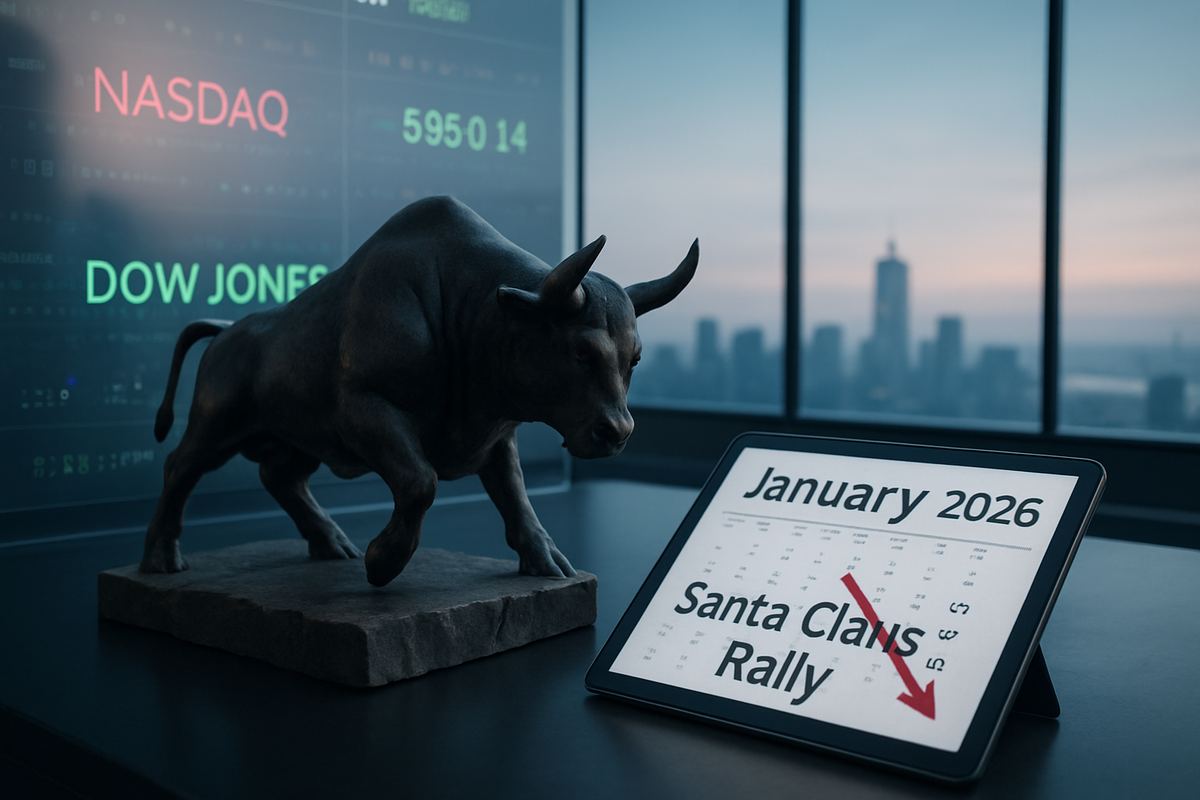
The first trading day of 2026 was a study in contrast, as the major indices struggled to find a collective footing. The Dow Jones Industrial Average rose 319.10 points, or 0.7%, to close at 48,382.39, buoyed by strong performances in the industrial and financial sectors. Meanwhile, the S&P 500 edged up a marginal 0.2% to 6,858.47, while the Nasdaq Composite fell 0.1% to 23,235.63. This "tepid" start officially confirmed the failure of the traditional Santa Claus rally—the seven-session period spanning the end of December and the start of January—marking the third consecutive year this seasonal phenomenon has failed to materialize.
The immediate catalyst for the tech sector's weakness was a disappointing delivery report from Tesla (NASDAQ: TSLA). The electric vehicle giant reported fourth-quarter deliveries that fell short of analyst expectations, leading to a 2.6% drop in its stock price on January 2. This miss, marking Tesla's second straight year of annual sales declines, reignited concerns about softening consumer demand and increased competition in the EV space. Simultaneously, a sense of "AI fatigue" permeated the market, with investors questioning whether the massive capital expenditures by software giants like Microsoft (NASDAQ: MSFT) and Meta Platforms (NASDAQ: META) would translate into immediate productivity gains.
The lead-up to this wobbly start was defined by a volatile December. While 2025 was a banner year—with the S&P 500 rising over 16% and Alphabet (NASDAQ: GOOGL) surging 65%—the final weeks of the year were marred by uncertainty regarding the Trump administration’s 2026 agenda. The market had already weathered a record-breaking government shutdown in October and significant tariff-related swings earlier in 2025. By the time the closing bell rang on December 31, the momentum that had carried Nvidia (NASDAQ: NVDA) to a $4.5 trillion market cap earlier in the summer had clearly begun to wane.
Winners and Losers in the New Year Rotation
The early-year rotation has created a clear divide between potential winners and losers. Industrial and blue-chip stocks emerged as the primary beneficiaries of the first day's trading. Boeing (NYSE: BA) saw its shares climb 4.7%, while Caterpillar (NYSE: CAT) rose 4.5%, as investors bet on continued infrastructure spending and a potential easing of regulatory hurdles. Goldman Sachs (NYSE: GS) also posted a 3.8% gain, benefiting from the anticipation of a more deregulated financial environment and the prospect of a new, market-friendly Federal Reserve Chair.
On the losing side, the high-growth tech sector is facing a rigorous valuation audit. Beyond Tesla's delivery miss, the "Magnificent Seven" stocks that dominated 2025 are seeing increased skepticism. Meta Platforms and Microsoft both faced selling pressure as analysts from major firms like Barclays warned that the market had become "over-reliant" on AI success. For these companies, 2026 will likely be a year where they must prove the return on investment for their multi-billion-dollar AI infrastructure projects.
The energy sector presents a more complex picture. While crude oil prices are forecast to face a "year of the glut," with Brent crude potentially falling to $55 per barrel in Q1, companies involved in power generation are seeing a surge in interest. The "AI supercycle" has driven electricity demand to its highest growth rate in 15 years, creating a unique opportunity for utility and energy infrastructure firms that can meet the frantic race for power.
Policy Shifts and Historical Precedents
The current market "wobble" is more than just a seasonal fluke; it reflects deep-seated concerns about the transition in U.S. monetary and fiscal policy. A primary focus for investors is the search for a successor to Federal Reserve Chair Jerome Powell, whose term expires in May 2026. With candidates like Kevin Hassett, Kevin Warsh, and BlackRock (NYSE: BLK) executive Rick Rieder on the shortlist, the market is bracing for a potential shift in the Fed's independence. President Trump’s public demand for a Chair committed to a low-interest-rate agenda has introduced a layer of political risk that has historically preceded periods of market instability.
Furthermore, the administration's proposed housing reforms are set to be a cornerstone of the 2026 economic agenda. Plans to introduce 50-year mortgages and open 1.5 million acres of federal land for residential development represent a massive supply-side experiment. While these moves aim to combat the affordability crisis, they also carry the risk of further inflating housing bubbles or disrupting existing mortgage-backed security markets. The "Housing for the 21st Century Act" will be a critical piece of legislation for the market to digest in the coming months.
Historical precedents for a failed Santa Claus rally are also weighing on investor sentiment. In years like 1999 and 2007, the absence of a year-end rally preceded significant structural shifts and eventual market downturns. While a "soggy" start does not guarantee a bear market, statistics show that the S&P 500 typically averages a 1.0% loss in the first quarter following a failed rally. This historical context is forcing many institutional investors to adopt a more cautious, "wait-and-see" posture as the new year unfolds.
Navigating the Q1 Landscape
Looking ahead, the short-term trajectory of the market will likely be determined by the upcoming "One Big Beautiful Act" (OBBBA) tax refunds, expected to inject $80 billion into the economy starting in February. This fiscal stimulus could provide a much-needed buffer for the consumer discretionary sector, which is currently grappling with a "spending hangover" from persistent inflation and high debt levels. If these refunds successfully spur retail activity, it could stabilize the broader market and prevent a deeper Q1 retreat.
In the long term, the market will need to navigate the transition at the Federal Reserve and the implementation of aggressive deregulatory policies. Companies may need to pivot their strategies to align with the "supply-side" focus of the administration, particularly in the housing and energy sectors. The potential for "tariff rebates" on construction materials could provide a tailwind for builders, while the tech sector will likely continue to face a "show-me" period regarding AI profitability. Market participants should prepare for a year where "stock picking" becomes more essential than simply riding the broad index wave.
A Year of Transition and Scrutiny
The cautious start to 2026 serves as a reminder that even the most powerful bull markets must eventually contend with shifting fundamentals. The combination of AI valuation concerns, a failed seasonal rally, and looming policy transitions has created a climate of uncertainty that is likely to persist through the first quarter. While the Dow's resilience on January 2 offers some hope for value-oriented sectors, the broader market remains in a state of flux.
Investors should keep a close eye on two major catalysts in the coming months: the official announcement of the next Fed Chair and the first wave of economic data following the OBBBA tax refunds. These events will provide critical clues as to whether the 2026 "wobble" is a healthy consolidation or the beginning of a more significant market realignment. For now, a defensive posture and a focus on quality, cash-flow-positive companies appear to be the order of the day.
This content is intended for informational purposes only and is not financial advice