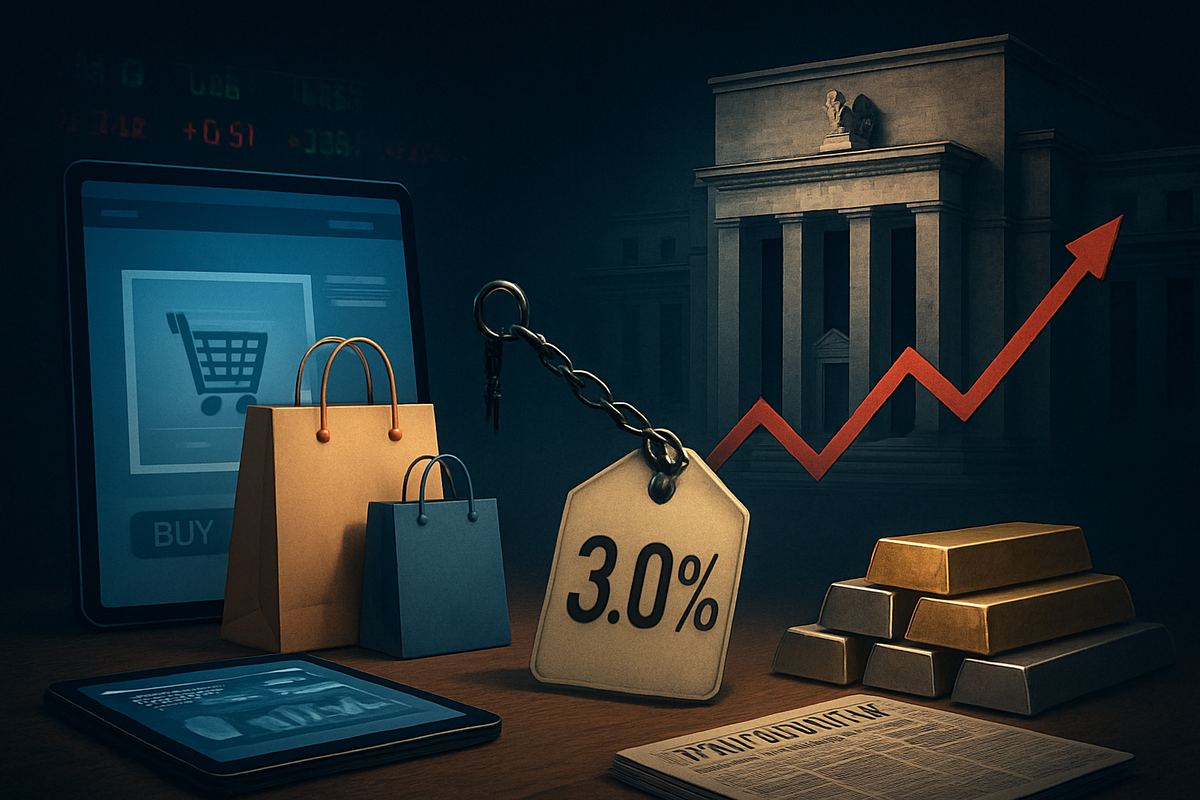
The United States economy finds itself at a complex crossroads following the delayed release of critical macroeconomic data that paints a picture of a surprisingly robust consumer base tempered by stubborn wholesale inflation. On January 14, 2026, the Department of Commerce and the Bureau of Labor Statistics finally broke a "data blackout" caused by a 43-day federal government shutdown, revealing that November 2025 Retail Sales surged by 0.6% while the Producer Price Index (PPI) climbed by 0.2%. These figures have immediately shifted the narrative on Wall Street, cooling hopes for further interest rate cuts in early 2026 and cementing the Federal Reserve's current stance of "cautious observation."
The immediate implication of this data is a recalibration of the "soft landing" theory. While the 0.6% jump in retail spending suggests that the American consumer remains the economy's primary engine, the 0.2% rise in PPI—bringing the annual wholesale inflation rate to a structurally problematic 3.0%—indicates that price pressures are not fading as quickly as the Federal Reserve had hoped. Consequently, market probability for a rate cut at the upcoming late-January FOMC meeting has plummeted to near zero, as policymakers grapple with an economy that refuses to cool down enough to justify lower borrowing costs.
The Data Blackout Ends: A Deep Dive into the November Numbers
The release of these reports was not merely another routine update; it marked the end of a period of intense market blindness. A prolonged 43-day federal government shutdown in late 2025 had frozen the collection and dissemination of economic statistics, leaving investors and the Federal Reserve to fly blind through the crucial holiday shopping season. When the gates finally opened on January 14, the "catch-up" data revealed that despite the political gridlock, economic activity had continued at a brisk pace. The 0.6% surge in Retail Sales, which significantly beat the 0.4% consensus estimate, was primarily driven by a late-year rebound in motor vehicle sales and robust holiday spending in the e-commerce sector.
Simultaneously, the PPI report served as a sobering reminder that the "last mile" of the inflation fight remains the hardest. A 0.2% monthly rise might appear modest in isolation, but it pushed the annual headline PPI to 3.0%, surpassing the forecasted 2.7%. This acceleration in wholesale prices suggests that manufacturers and producers are still facing high input costs, which may eventually trickle down to consumer prices (CPI). The timeline leading to this moment has been defined by geopolitical instability in the Middle East and the implementation of new U.S. tariff policies, both of which have introduced fresh volatility into supply chain costs.
Market reaction was swift and decisive. Upon the data’s release, the S&P 500 and the Nasdaq posted their first back-to-back losses of 2026, as the "higher-for-longer" interest rate mantra was revitalized. Treasury yields remained firm, with the 10-year yield trading just under 4.15%, while safe-haven assets like gold and silver reached new record highs of $4,650 and $92 per ounce, respectively. Investors are now pricing in a world where the Federal Reserve’s current benchmark rate of 3.50% – 3.75% may be the floor for the foreseeable future.
Corporate Winners and Losers in a Bifurcated Economy
The divergence in the economic data has created a clear rift between sector winners and those struggling to adapt to the current climate. Among the primary beneficiaries of the resilient consumer are retail giants like Walmart (NYSE: WMT) and Amazon (NASDAQ: AMZN). Walmart has seen a significant uptick in same-store sales as high-income households increasingly "trade down" to seek value, while Amazon continues to dominate the e-commerce landscape, benefiting from the 0.6% surge in retail activity. These "big-box" and digital leaders are leveraging their scale to absorb some of the wholesale price increases that smaller competitors cannot.
Conversely, the luxury and traditional retail sectors are showing signs of severe distress. On the same day the retail data was released, Saks Global—the parent company of Saks Fifth Avenue—filed for Chapter 11 bankruptcy protection. This move highlights the "K-shaped" nature of the current economy, where mid-to-high-end consumers are tightening their belts on discretionary luxury while maintaining spending on essentials. Additionally, Tesla (NASDAQ: TSLA) saw its shares slide by 2.5% following the news; the electric vehicle pioneer is facing pressure from both the PPI increase in manufacturing components and a strategic shift toward a monthly subscription model for its Full Self-Driving (FSD) software to shore up recurring revenue amidst cooling yearly sales.
The financial sector has also faced headwinds, though for different reasons. Shares of major institutions like JPMorgan Chase & Co. (NYSE: JPM), Bank of America (NYSE: BAC), and Citigroup (NYSE: C) fell between 3.5% and 4.6% following the data release. While higher rates generally benefit bank margins, the market is wary of "political noise" regarding a potential 10% cap on credit card interest rates—a policy proposal gaining traction in Washington as a way to alleviate the strain on lower-income households who are feeling the brunt of the 3.0% annual PPI growth.
Wider Significance: The Return of Structural Inflation
This latest batch of data fits into a broader trend of "sticky" inflation that has plagued the global economy throughout 2025 and into 2026. The 0.2% rise in PPI is not just a domestic issue; it reflects a global shift toward protectionism and a reconfiguration of supply chains. The ripple effects of new tariff policies are starting to manifest in the producer data, suggesting that the era of ultra-low inflation may be a historical relic. For competitors and partners in the global manufacturing space, this means that "cost-plus" pricing models are likely to return, ending the period of aggressive price wars.
Historically, periods following government shutdowns often see a "bounce" in economic activity, but the current situation is unique due to the simultaneous rise in commodity prices. With oil prices hovering around $60 per barrel and precious metals at record highs, the "cost-push" inflation reflected in the PPI report is becoming more difficult for the Federal Reserve to ignore. The regulatory environment is also shifting; the Fed is now less likely to pursue aggressive easing if it risks reigniting the inflationary fire, even as some sectors of the economy begin to show cracks from high borrowing costs.
Looking Ahead: The Fed’s Next Move
In the short term, the Federal Reserve is expected to maintain a "wait-and-see" approach. The upcoming late-January FOMC meeting is now widely expected to result in no change to interest rates. Strategically, companies may need to pivot toward efficiency and margin preservation rather than aggressive expansion. We are already seeing this with Tesla’s move toward subscription models and the banking sector’s focus on risk management amidst potential interest rate caps.
Long-term, the market must prepare for a scenario where interest rates do not return to the "zero-bound" levels seen in the previous decade. If retail sales continue to surge while PPI remains elevated, the Fed might even be forced to consider a "hawkish hold" or a surprise rate hike later in 2026—a scenario that would likely trigger significant volatility in the equity markets. The challenge for investors will be identifying companies that possess the "pricing power" to pass on wholesale costs to consumers without dampening the 0.6% spending momentum.
Final Assessment and Investor Takeaways
The January 2026 data dump has provided a reality check for a market that had become overly optimistic about a rapid return to low-interest rates. The key takeaway is that the U.S. consumer is resilient, but that resilience is providing the Federal Reserve with the "cover" it needs to keep rates restrictive to combat 3.0% annual wholesale inflation. The economy is currently in an equilibrium that is stable but fragile, threatened by geopolitical tensions and shifting domestic policies.
Moving forward, the market is likely to remain range-bound as it digests the "K-shaped" recovery. Investors should keep a close watch on upcoming CPI (Consumer Price Index) reports to see if the PPI surge is indeed being passed on to the public. Furthermore, the performance of bellwethers like Walmart and Amazon will serve as the definitive barometer for whether the 0.6% retail surge was a holiday anomaly or a sustainable trend. In this environment, caution remains the watchword, and diversification into "value" and "inflation-hedged" assets like precious metals may continue to be a winning strategy.
This content is intended for informational purposes only and is not financial advice.