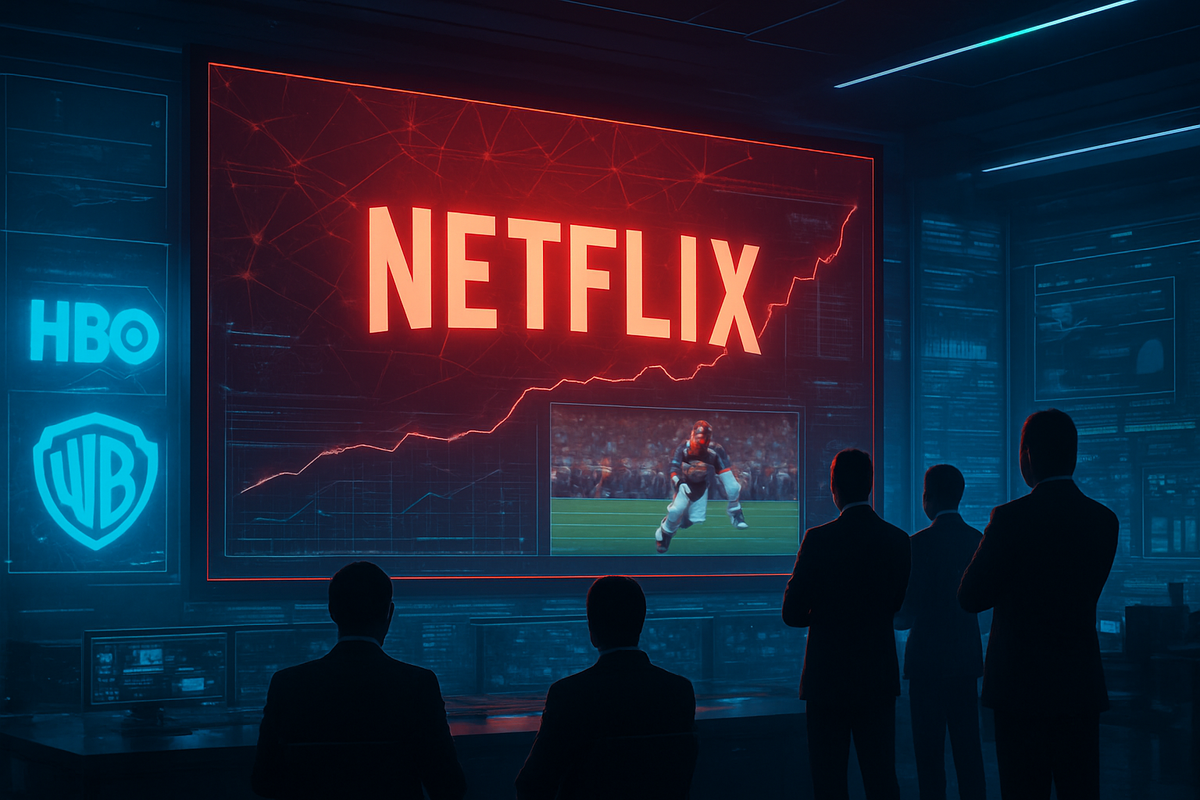
As the financial world turns its gaze toward Netflix’s (NASDAQ: NFLX) Q4 2025 earnings report this week, the conversation has shifted from simple subscriber counts to a fundamental reimagining of the media landscape. Netflix enters this reporting period not just as the "King of Streaming," but as a predatory titan of industry, currently locked in a high-stakes $72 billion bid to acquire the core assets of Warner Bros. Discovery (NASDAQ: WBD). With the fourth quarter bolstered by a record-shattering foray into live NFL broadcasting and the rapid scaling of its proprietary ad-tech platform, the upcoming results are expected to cement Netflix's position in a "Tier 1" category of its own.
Analysts are bracing for a blockbuster set of numbers that could see Netflix surpass 325 million global subscribers, a feat once thought impossible in a saturated market. The convergence of premium live sports, a maturing advertising business, and the potential absorption of HBO and the Warner Bros. film studio has transformed this earnings call into the most anticipated financial event in the media sector in over a decade.
The centerpiece of Netflix’s Q4 performance was undoubtedly its Christmas Day NFL double-header, featuring the Kansas City Chiefs vs. the Pittsburgh Steelers and the Baltimore Ravens vs. the Houston Texans. This wasn't merely a programming experiment; it was a stress test for Netflix’s global infrastructure. The games drew a staggering 30 million concurrent viewers worldwide, with a domestic average of 24 million. More importantly for investors, the "Beyoncé Halftime Show" during the Ravens-Texans game acted as a massive customer acquisition tool, with internal estimates suggesting the event drove over 2 million new sign-ups in the final weeks of December alone.
Leading up to this moment, Netflix has spent much of 2025 refining its "paid sharing" initiative, which successfully converted millions of "borrowed" accounts into high-margin revenue streams. This, combined with a content slate that included the long-awaited second season of Squid Game, has analysts projecting Q4 revenue to hit $12.05 billion—a 17.6% increase year-over-year. The company’s operating margin is expected to hover near 24.5% for the quarter, reflecting a leaner, more efficient organization that has finally mastered the art of making streaming profitable at a massive scale.
Key stakeholders, including CEO Greg Peters and Co-CEO Ted Sarandos, have signaled that the era of "streaming wars" is over, replaced by a "war for engagement." By integrating live sports and high-profile spectacles into their rotation, Netflix has successfully reduced churn—the industry’s silent killer—while simultaneously creating "must-see" moments that traditional linear television once monopolized.
While subscriber growth captures the headlines, the real engine of Netflix’s 2026 valuation is its advertising business. In 2025, the company successfully severed its technical dependence on Microsoft (NASDAQ: MSFT), launching its first-party "Netflix Ads Suite." The results have been transformative. By the end of 2025, the ad-supported tier reached a milestone 190 million monthly active viewers (MAUs), with more than 55% of all new sign-ups in ad-supported markets opting for the cheaper, commercial-laden plan.
This shift has allowed Netflix to capture a significant portion of the "upfront" ad market that was previously reserved for legacy networks like Disney (NYSE: DIS) or Comcast’s (NASDAQ: CMCSA) NBCUniversal. In Q4 specifically, Netflix’s new Dynamic Ad Insertion (DAI) technology allowed the company to serve hyper-localized, personalized ads during the NFL Christmas games. This precision targeting—coupled with interactive "pause ads" and AI-driven mood-based segmentation—has allowed Netflix to command premium CPMs (cost per mille) that are reportedly 8x higher than standard Connected TV benchmarks.
The "winners" in this scenario include ad-tech firms like The Trade Desk (NASDAQ: TTD), which has partnered closely with Netflix to facilitate these programmatic buys. On the losing end are traditional cable networks, which saw a double-digit decline in holiday ad spend as brands followed the eyeballs to Netflix’s live events.
Perhaps the most significant cloud—or golden opportunity—hanging over the Q4 report is the ongoing negotiation for Warner Bros. Discovery. Netflix has moved aggressively to acquire WBD’s premium assets (HBO, Max, and the Warner Bros. Film/TV Studios) for a $72 billion all-cash equity bid. To navigate the complex regulatory waters of 2026, the deal includes a proposed spinoff of WBD’s linear assets—including CNN and TNT—into a new entity called "Discovery Global."
This move represents a historical pivot. For years, Netflix prided itself on being a tech-first disruptor that didn't need the "baggage" of legacy Hollywood. However, the 2026 landscape demands a massive library of intellectual property to fuel its global ad machine. If the deal closes, Netflix would control nearly one-third of global streaming revenue, effectively ending the competition for everyone except potentially YouTube (NASDAQ: GOOGL) and Amazon (NASDAQ: AMZN).
The regulatory environment in 2026, overseen by a more merger-friendly FTC and DOJ, appears cautiously receptive to the deal, provided Netflix adheres to strict behavioral remedies regarding content licensing. Analysts believe the acquisition is Netflix’s "final form," turning it into a vertically integrated powerhouse that owns the content, the platform, and the ad-tech stack.
Looking beyond the Q4 numbers, the next 12 to 18 months will be defined by integration and diversification. If the WBD merger is approved by shareholders in April 2026, Netflix will face the Herculean task of migrating the HBO and Max libraries into its ecosystem while managing the "Discovery Global" spinoff. Short-term, investors should expect some volatility in free cash flow as the company absorbs the debt associated with the $72 billion bid.
Furthermore, 2026 will see the full integration of WWE Raw into the Netflix platform, marking a shift toward year-round live weekly programming. This move is expected to push the ad-tier MAUs toward the 250 million mark by year-end. The company is also expected to lean harder into "predictive AI behavior models," using viewer data to serve ads before a user even knows they want a product—a move that could trigger new privacy debates but will almost certainly drive ad revenue toward an estimated $5 billion annually.
Netflix’s Q4 2025 report is expected to confirm that the company has moved past the "growth at all costs" phase and into an era of structural dominance. The key takeaways for investors are clear: Average Revenue per Member (ARM) is rising due to the ad-tier's success, live sports have become a permanent and profitable fixture of the content strategy, and the WBD acquisition could create an unassailable moat.
As we move into the first half of 2026, the market will be watching two things closely: the specific progress of the "Netflix Ads Suite" in international markets and any regulatory "red flags" regarding the Warner Bros. deal. Netflix is no longer just a streaming service; it is the new infrastructure of global media. For investors, the question is no longer if Netflix can survive the streaming wars, but how much larger this "Tier 1" giant can truly grow.
This content is intended for informational purposes only and is not financial advice.