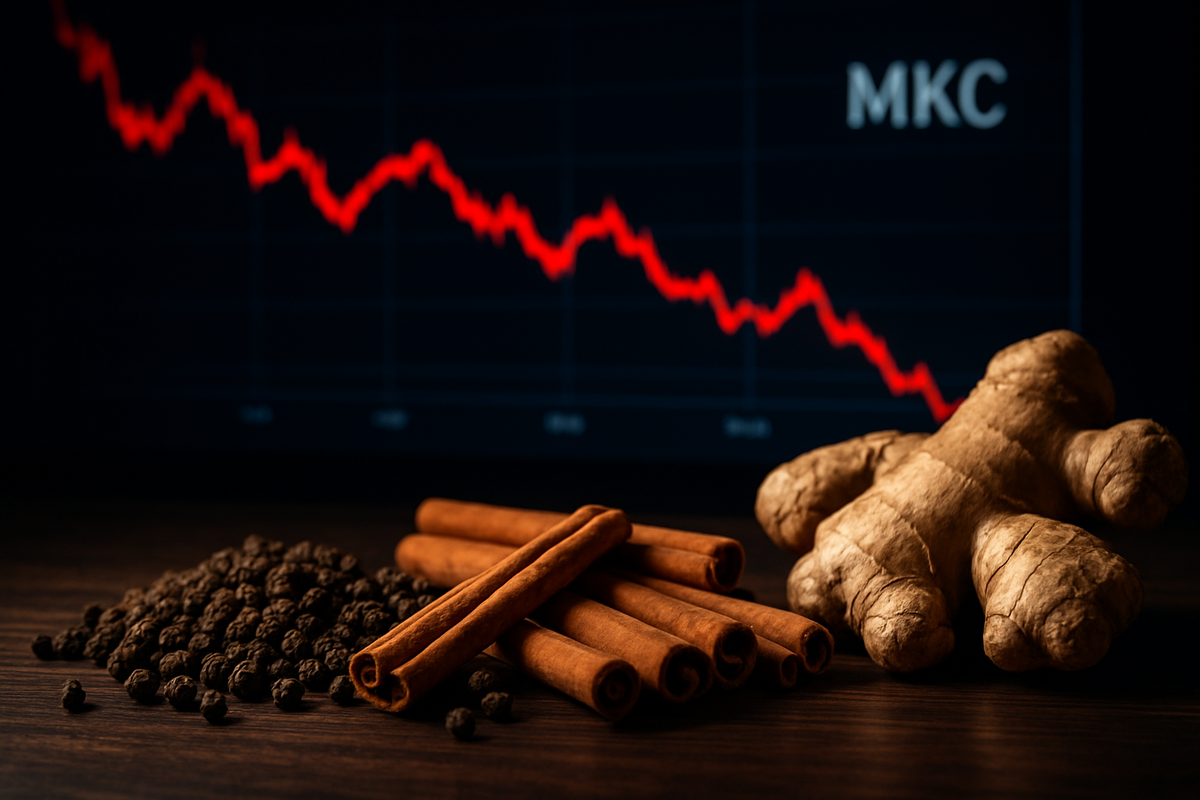
McCormick & Company (NYSE: MKC) saw its shares retreat by 5.2% in early Thursday trading following the release of its fourth-quarter fiscal results, which fell short of analyst expectations. The spice and flavor leader reported an adjusted earnings per share (EPS) of $0.86, missing the consensus estimate of $0.87, as the company grapples with a tightening vice of rising commodity costs and an escalating global tariff environment.
The sell-off was further fueled by a cautious fiscal 2026 forecast. McCormick projected a full-year EPS range of $3.05 to $3.13, a target that failed to inspire confidence among investors who had hoped for a more robust rebound. While the company is banking on a major acquisition in Mexico to drive top-line growth, the underlying narrative of shrinking margins and trade-related headwinds has cast a shadow over the "Flavor Maker's" near-term prospects.
Quarterly Stumble and the Margin Squeeze
The fourth-quarter results, released on January 22, 2026, revealed a complex picture of a company fighting to maintain its footing. Despite a 3% increase in total revenue to $1.85 billion, McCormick’s profitability was eroded by a significant 130-basis-point drop in gross profit margins, which settled at 38.9%. This contraction was primarily attributed to the "unrelenting" pressure of higher input costs for staple spices like black pepper and ginger, coupled with the initial financial impact of broad reciprocal tariffs enacted over the past year.
The timeline of this downturn began to accelerate in late 2025 as global trade tensions escalated. McCormick's management confirmed that their annualized tariff exposure has swelled from $90 million to a staggering $140 million. This increase reflects the new reality for multinational manufacturers who must navigate a 10% or higher tariff regime on imports from over 60 nations. For a company that sources raw materials from nearly every corner of the globe, these policy shifts have moved from theoretical risks to direct bottom-line liabilities.
Internal reactions from the board focused on the "Consumer segment's volume resilience," which grew for the seventh consecutive quarter. However, the market’s focus remained squarely on the bottom-line miss. Investors reacted sharply to the realization that even a dominant market leader like McCormick is not immune to the inflationary pressures that continue to plague the consumer staples sector.
Winners, Losers, and the Battle for the Pantry
The immediate "loser" in this scenario is undoubtedly McCormick & Company (NYSE: MKC) shareholders, who have seen years of steady growth interrupted by the volatility of international trade policy. However, the ripple effects extend to the broader consumer landscape. Competitors like The Kraft Heinz Company (NASDAQ: KHC) and Conagra Brands, Inc. (NYSE: CAG) are facing similar margin pressures, but McCormick's specific reliance on specialized agricultural imports makes it a "canary in the coal mine" for the broader seasonings and ingredients industry.
On the other side of the ledger, domestic commodity processors and private-label spice producers might see a strategic window. As McCormick is forced to raise prices to defend its margins, budget-conscious consumers may shift toward store-brand alternatives. Retailers with strong private-label programs, such as Walmart Inc. (NYSE: WMT), could potentially "win" by capturing market share from premium brands that are more exposed to international supply chain costs. Additionally, companies specializing in supply chain logistics and tariff mitigation consulting are seeing a surge in demand as manufacturers scramble to reconfigure their sourcing routes.
Tariffs and the New Global Inflationary Trend
This event serves as a stark illustration of how the "New Protectionism" is reshaping the financial markets in 2026. The 4-6% drop in McCormick’s stock is not just a reaction to a one-cent earnings miss; it is a recalibration of how investors value companies with extensive global footprints. The "liberation day" tariffs, as they have been dubbed by policy analysts, are creating a 12-to-18-month lag in cost pass-throughs. This suggests that the inflationary peak for grocery shoppers may not arrive until late 2026, as companies like McCormick exhaust their existing lower-cost inventories.
Historically, McCormick has been a defensive powerhouse, often outperforming during economic downturns because people tend to cook more at home. However, the current environment is unique because the cost of the ingredients for home cooking is rising faster than general inflation. This mirrors the commodity shocks of the 1970s but is exacerbated by a modern, hyper-connected supply chain that is being systematically uncoupled by geopolitical shifts.
The Path Forward: A Mexican Pivot and Efficiency Gains
Looking ahead, McCormick is betting heavily on its recent acquisition of a controlling interest in McCormick de Mexico to right the ship. The company increased its stake from 50% to 75% for $750 million, a move expected to contribute 11% to 13% to total sales growth in 2026. This strategic pivot toward Latin America is intended to provide a more stable growth platform and potentially offer a near-shore alternative to some of the more tariff-heavy Asian supply routes.
Short-term, the company will lean on its Comprehensive Continuous Improvement (CCI) program to harvest $100 million or more in annual cost savings. Whether these internal efficiencies can outpace the external headwinds of $140 million in tariff costs remains the critical question for the next fiscal year. Investors will be watching for "price elasticity"—specifically, whether McCormick can hike prices on a jar of cinnamon or black pepper without driving the average shopper toward a cheaper generic brand.
Summary: A Season of Uncertainty
McCormick’s Q4 performance and 2026 guidance underscore a pivotal moment for the consumer staples sector. The combination of an EPS miss and soft guidance highlights the fragility of profit margins in an era of trade wars and volatile commodity markets. While the company’s volume growth remains a bright spot, the escalating cost of doing business globally has forced a painful revaluation of its stock.
Moving forward, the market will be hyper-focused on McCormick's ability to integrate its Mexican operations and whether the April-to-October window will bring further price hikes to retail shelves. For investors, the takeaway is clear: in 2026, brand loyalty is being tested by the bottom line, and even the most seasoned market veterans must now account for the high cost of a changing global trade map.
This content is intended for informational purposes only and is not financial advice