The global financial landscape has been pushed to the brink this January 2026 as an unprecedented trade dispute over the status of Greenland sent shockwaves through international markets. The crisis, sparked by the second Trump administration’s aggressive push to secure the resource-rich territory, saw the United States threaten a sweeping new tariff regime against key European allies. This "Greenland Ultimatum" led to a violent repricing of geopolitical risk, resulting in a dramatic mid-month sell-off that wiped out trillions in market value before a fragile de-escalation was reached at the World Economic Forum in Davos.
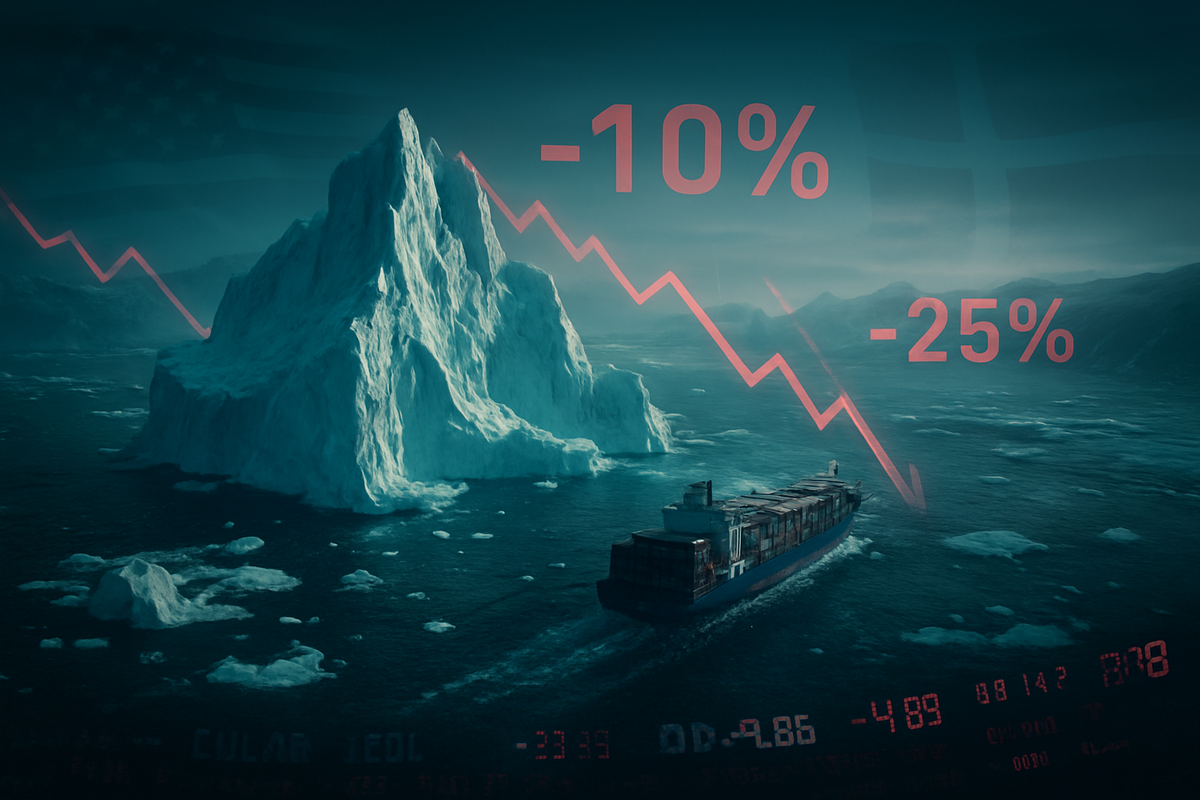
While a temporary "thaw" was announced on January 21, the volatility of the past two weeks has fundamentally altered investor sentiment. The threat of 10% to 25% tariffs on major European economies and a staggering 200% levy on French luxury goods has left traders questioning the stability of the transatlantic alliance. Even as equity markets staged a relief rally following the Davos framework, the "geopolitical risk premium" remains firmly embedded in asset prices, with safe havens like gold and silver hovering near record highs.
The Greenland Ultimatum: A Timeline of Escalation
The crisis began in earnest on January 17, 2026, when the White House issued a formal ultimatum to Denmark and several other European nations. Citing the "urgent necessity" of securing rare earth mineral supplies and countering Chinese and Russian influence in the Arctic, the U.S. announced an immediate 10% tariff on all imports from eight nations: Denmark, Norway, Sweden, France, Germany, the Netherlands, Finland, and the United Kingdom. The administration warned that these rates would climb to 25% by June 1, 2026, unless a deal for the "complete and total purchase of Greenland" was finalized.
The market reaction was swift and brutal. On January 19 and 20—now being referred to in trading pits as "Black Monday and Tuesday"—the S&P 500 fell 2.1% and the Nasdaq Composite dropped 2.4%, a combined loss of over $1.2 trillion in capitalization. In Europe, the Danish C25 Index plunged 2.5%, while the Euro fell sharply against the dollar as investors braced for a full-scale trade war. The European Union responded by dusting off its "Anti-Coercion Instrument" (ACI), a trade defense mechanism that would have allowed for €93 billion in retaliatory measures against U.S. firms.
Key players in the drama included U.S. Vice President JD Vance, who led the negotiation team, and Danish Prime Minister Mette Frederiksen, who called the U.S. demands "absurd and deeply insulting." The tension only broke on January 21, when President Trump met with NATO Secretary-General Mark Rutte at Davos. The resulting "framework for a future deal" on Arctic security—though short on specifics—was enough to prompt the U.S. to withdraw the tariff threats and settle the markets. However, the damage to diplomatic trust and the precedent of using Greenland as trade leverage have left deep scars.
Corporate Winners and Losers in the Arctic Crossfire
The volatility created a stark divide between companies caught in the tariff crosshairs and those positioned to benefit from the scramble for Arctic resources. Among the biggest "winners" was Critical Metals Corp (Nasdaq: CRML), which saw its stock price triple to nearly $21 during the height of the crisis. Investors viewed the company as a "geopolitical option" on Greenland’s untapped rare earth minerals. Similarly, Bluejay Mining (LSE: JAY) gained significant attention and volume due to its existing joint ventures and exploration projects within the territory.
On the losing side, European giants with heavy U.S. exposure felt the heat. The shipping titan A.P. Moller - Maersk (CPH: MAERSK-B) saw its shares tumble as analysts warned that a prolonged trade war could jeopardize its lucrative U.S. military logistics contracts. In the luxury sector, LVMH (EPA: MC) was hit particularly hard by the specific threat of 200% tariffs on French wine and champagne. The biotech sector was not spared either; the Danish-based giant Genmab (CPH: GMAB) saw its shares fall over 6% as the prospect of transatlantic pharmaceutical cooperation dimmed.
The contagion even reached the U.S. tech sector, which led the domestic sell-off. Heavyweights like Nvidia (Nasdaq: NVDA), Amazon (Nasdaq: AMZN), and Tesla (Nasdaq: TSLA) all saw losses exceeding 3% on January 20 as investors moved into defensive positions. Meanwhile, traditional havens like Colgate-Palmolive (NYSE: CL) and Campbell Soup Company (NYSE: CPB) lived up to their "recession-proof" reputations, gaining roughly 1.5% as the broader market bled. Perhaps the most alarming corporate reaction came from AstraZeneca (LSE: AZN), which briefly announced plans to explore delisting its American Depositary Shares (ADS) from the Nasdaq, citing "untenable geopolitical volatility."
The Wider Significance: A New Era of Resource Protectionism
The Greenland crisis is not merely a localized dispute but a signal of a broader shift toward extreme resource protectionism. It fits into an accelerating global trend where strategic minerals—essential for the green energy transition and advanced weaponry—are being treated with the same urgency as oil was in the 20th century. By targeting Greenland, the U.S. has signaled that it is willing to bypass traditional diplomatic norms and even pressure its closest NATO allies to ensure domestic supply chain security.
This event has also forced the European Union to reconsider its "strategic autonomy." The activation of the Anti-Coercion Instrument indicates that Europe is no longer willing to rely solely on diplomatic appeals to the U.S. and is moving toward a more combative trade posture. This ripple effect could lead to a fragmented global market where trade blocks are defined by security alliances rather than economic efficiency. For competitors in the mining sector based in Australia or Canada, this could mean a flurry of new investment as Western firms look to diversify away from politically contested zones.
Historically, the "purchase" of territory or the use of massive tariffs to force land deals has little precedent in the modern post-WWII era. While the U.S. has previously expressed interest in Greenland—most notably in 1946 and 2019—the 2026 crisis marks the first time such ambitions have been backed by the direct threat of economic warfare against allies. This shift suggests that "geopolitical risk" is no longer an outlier for equity analysts but a core metric that must be priced into every multinational corporation's valuation.
Looking Ahead: The Fragile Peace
In the short term, markets appear to have stabilized, but the underlying tensions remain unresolved. The Davos framework is a non-binding agreement that merely kicks the can down the road. Strategically, the U.S. administration is expected to continue pressuring Denmark and the Greenlandic government for increased military access and mining concessions. Investors should expect "headline risk" to remain high throughout the spring of 2026, with any breakdown in negotiations likely to trigger another flight to safety in gold and defensive stocks.
Over the long term, we may see a significant strategic pivot by European companies. Many may choose to reduce their reliance on the U.S. market or move manufacturing facilities to "neutral" ground to avoid being held hostage by future tariff threats. Conversely, for the mining and defense industries, the Arctic is now the world’s most significant new frontier. Market opportunities in sub-sea cable infrastructure, Arctic-capable shipping, and rare earth processing are likely to attract billions in capital as the U.S. and Europe vie for dominance in the region.
The Investor’s Takeaway
The events of January 2026 have served as a wake-up call for the global investment community. The primary takeaway is that traditional "safe" alliances are now subject to the same volatility as emerging markets. The "Greenland Ultimatum" proved that trade policy is increasingly being used as a tool of territorial and resource ambition, rather than just economic balance. Moving forward, the market will likely reward companies with diversified supply chains and those providing essential "safe haven" services or commodities.
As we look toward the coming months, investors should closely monitor the specific terms of the Arctic security framework and any movement in the EU’s retaliatory tariff lists. While the immediate threat of a 200% tariff on luxury goods has subsided, the volatility of the past week suggests that a single social media post or diplomatic slight could reignite the flame. For now, the "Arctic Chill" remains, and the market’s focus has permanently shifted toward the frozen north.
This content is intended for informational purposes only and is not financial advice.