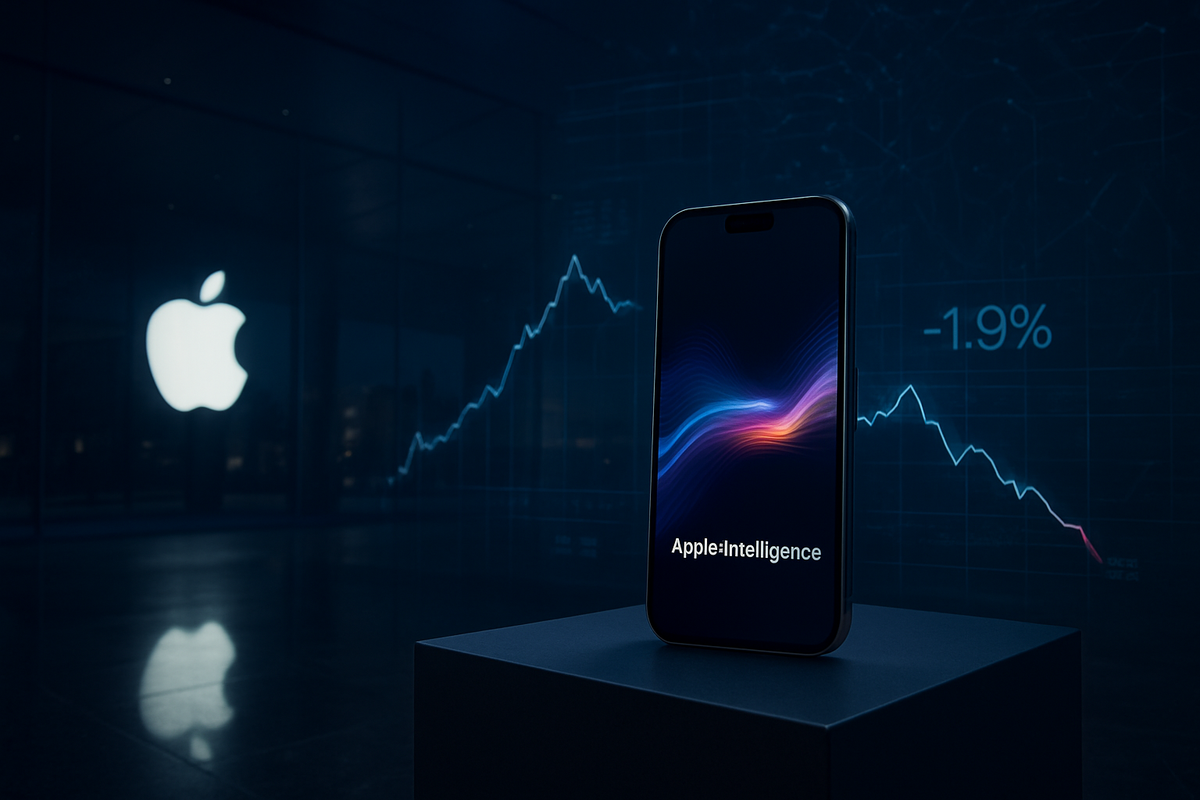
Apple Inc. (NASDAQ: AAPL) delivered a commanding performance in its fiscal first-quarter earnings report on January 29, 2026, shattering revenue and profit records on the back of explosive demand for the iPhone 17. Despite exceeding analyst expectations across nearly every major metric, the tech giant saw its stock price decline by 1.9% in the following trading session on January 30, 2026. This paradoxical market reaction highlights a growing tension on Wall Street: even as the world’s most valuable company proves its operational resilience, investors are becoming increasingly skeptical of "priced for perfection" valuations in a high-interest, AI-focused landscape.
The reported figures were undeniably historic. Apple posted total revenue of $143.8 billion, a 16% year-over-year increase that comfortably bypassed the $138.4 billion consensus estimate. Diluted earnings per share (EPS) hit $2.84, significantly ahead of the projected $2.67. While the numbers suggest a company in its prime, the subsequent sell-off signals that for Big Tech, simply beating the street is no longer enough to sustain momentum in 2026.
Record Gains and the "Sell the News" Reality
The fiscal Q1 report, covering the crucial 2025 holiday season, was spearheaded by a massive "supercycle" for the iPhone 17. Revenue from the flagship device reached an all-time high of $85.3 billion, a 23% jump from the previous year. This growth was fueled largely by a resurgence in Greater China, where Apple saw a 38% revenue increase, effectively silencing critics who had predicted a permanent decline in the region. Furthermore, Apple’s Services division continued its ascent, reaching $30 billion in revenue with a staggering 76.5% gross margin, proving that the company's ecosystem remains as sticky—and profitable—as ever.
However, the timeline of the stock's performance leading up to the announcement tells a different story. AAPL shares had climbed more than 33% in the latter half of 2025 as anticipation for the AI-integrated iPhone 17 reached a fever pitch. By the time CEO Tim Cook took the stage for the earnings call, the market had already factored in a significant beat. When Cook cautioned that Apple is currently in a "supply chase" mode due to constraints on advanced manufacturing nodes and rising memory chip prices, the optimism quickly cooled.
The immediate industry reaction was a mixture of awe at the hardware numbers and caution regarding future margins. Investors focused heavily on the "sideways" margin guidance for the upcoming March quarter. With the cost of DRAM and NAND memory spiking 20–30% due to AI data center demand, the market became concerned that Apple’s hardware profitability might have reached a temporary ceiling. This "sell the news" event on January 30 reflects a broader shift in 2026 investor psychology, where macro-economic headwinds and supply chain bottlenecks are starting to outweigh record-breaking quarterly reports.
The Winners and Losers of the 2026 Hardware Surge
While Apple's stock faced a minor correction, the earnings report illuminated a clear hierarchy of winners and losers across the global supply chain. Taiwan Semiconductor Manufacturing Company (NYSE: TSM) emerges as a dominant winner, as it remains the sole provider of the A-series and M-series chips that power Apple's devices. TSMC has already signaled a 5–10% price hike for 2026, capitalizing on the intense demand for 3nm and the upcoming 2nm technology. As long as Apple remains in "supply chase" mode, TSMC’s pricing power remains absolute, though this comes at the expense of Apple's component costs.
On the other end of the spectrum, Mac and iPad segments showed signs of fatigue. Mac sales fell 7% to $8.4 billion, struggling against difficult year-over-year comparisons and a lack of major hardware refreshes in the quarter. Competitors like Microsoft (NASDAQ: MSFT) and Alphabet Inc. (NASDAQ: GOOGL) are also navigating a complicated landscape. Microsoft, in particular, saw its shares tumble 7% earlier this week after reporting slowing Azure growth despite its own earnings beat. This suggests that the market is beginning to punish tech giants that cannot show an immediate, massive return on their multi-billion-dollar AI capital expenditures.
The standout winner in the broader tech sector remains Meta Platforms (NASDAQ: META), which surged 10% following its recent results. Unlike Apple and Microsoft, Meta has successfully demonstrated how AI tools are directly boosting advertising revenue in the short term. For Apple, the challenge remains translating "Apple Intelligence" into a direct software revenue stream, rather than relying solely on hardware upgrade cycles to carry the financial weight of their AI investments.
AI Integration and the High Bar for Big Tech
Apple’s Q1 results offer a window into how the "AI Revolution" is maturing in 2026. The integration of "Apple Intelligence"—which includes advanced visual intelligence and a revamped Siri powered by a strategic partnership with Google—has clearly driven hardware sales. However, the broader industry trend shows that investors are no longer satisfied with AI being a "feature." They are looking for AI to be a fundamental driver of margin expansion. The historical precedent for this was the mobile internet boom of the 2010s; today, the stakes are higher because the capital requirements for AI infrastructure are exponentially larger.
The regulatory and policy environment also looms large. Apple’s rebound in China was a highlight of the quarter, but it remains vulnerable to shifting geopolitical tensions and local competition. Simultaneously, the company’s alliance with Google for AI models is under constant scrutiny from antitrust regulators who are wary of "mega-partnerships" that could stifle smaller AI startups. This quarterly report proves that while Apple can still execute flawlessly on a global scale, it is operating in a much more constrained and scrutinized environment than it was five years ago.
Furthermore, the rise in memory prices highlights a ripple effect from the AI boom that few anticipated: the competition for silicon between consumer devices and enterprise data centers. As companies like Nvidia and Microsoft buy up high-bandwidth memory, consumer electronics giants like Apple are forced to pay a premium. This dynamic is creating a new "supply chain inflation" that could haunt the tech industry through the remainder of 2026, regardless of how many iPhones Apple manages to sell.
Strategic Pivots and the Road to the iPhone 18
Looking ahead, Apple’s short-term path involves navigating the supply constraints highlighted by Tim Cook. The company is expected to make a strategic pivot toward securing more long-term supply agreements for memory and specialized AI chips to insulate its margins. There is also persistent speculation about a late-2026 launch of a more affordable "Vision Pro" or a foldable iPhone, which could provide a new revenue pillar as the iPhone 17 cycle begins to normalize.
The long-term challenge for Apple will be the monetization of its AI ecosystem. While features like "Live Translation" and "Writing Tools" are popular, analysts are watching for the introduction of an "Apple Intelligence+" subscription model. If Apple can successfully transition some of its AI capabilities into a recurring revenue stream, it may decouple its stock price from the volatility of hardware cycles. However, any move toward a "subscription for Siri" would likely face significant pushback from a consumer base that has grown accustomed to these features being included in the hardware price.
Market opportunities may also emerge in the automotive and home integration sectors, though these remain "wild card" scenarios. The primary challenge for the next several quarters will be managing investor expectations. With Apple’s valuation still sitting near historic highs, the company must not only beat estimates but also provide a roadmap for AI profitability that satisfies a market increasingly weary of tech hype.
Navigating the Post-Beat Paradigm
Apple’s fiscal Q1 2026 earnings are a testament to the company’s enduring brand power and operational excellence. By delivering record revenue and a massive earnings beat in a challenging global market, Tim Cook has proven that the iPhone remains the world’s premier consumer product. However, the 1.9% dip in share price on January 30 serves as a stark reminder that in the 2026 market, "good" is no longer good enough. Investors are demanding clarity on AI monetization, margin protection against rising component costs, and a sustainable path forward that doesn't rely solely on hardware supercycles.
For investors, the coming months will be defined by how well Apple manages its supply chain and whether it can maintain its dominance in China. Watch for updates on the Google-Siri integration and any shifts in memory pricing, as these will be the primary drivers of Apple’s fiscal Q2 and Q3 performance. While the immediate reaction was one of caution, Apple's record-breaking quarter suggests that the company is well-positioned to weather the "priced for perfection" storm, provided it can continue to turn its AI ambitions into tangible bottom-line results.
This content is intended for informational purposes only and is not financial advice.