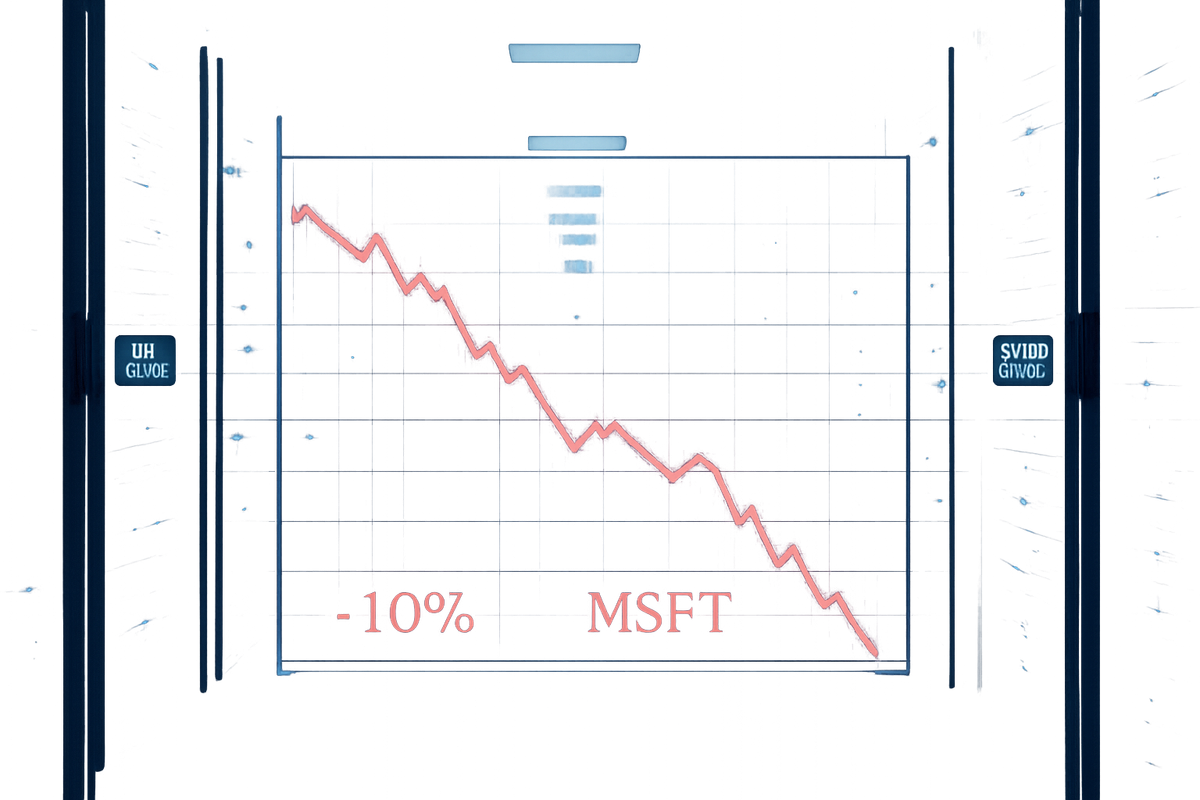
In a jarring reminder that even the world’s most valuable companies are not immune to the gravity of market expectations, Microsoft Corp. (NASDAQ: MSFT) saw its shares plunge nearly 10% following its Q2 FY2026 earnings report on January 28, 2026. Despite beating top and bottom-line estimates with total revenue of $81.3 billion, the tech giant triggered a massive sell-off as investors fixated on a subtle deceleration in its core Azure cloud business and a record-shattering $37.5 billion quarterly bill for artificial intelligence infrastructure.
The immediate implications are clear: Wall Street’s honeymoon phase with generative AI has officially ended. The $357 billion single-day wipeout—the second-largest value loss in U.S. history—signals a fundamental shift in investor sentiment. Market participants are no longer rewarding the "potential" of AI; they are now demanding "AI receipts," specifically in the form of accelerating margins and a clear timeline for a return on the hundreds of billions of dollars being poured into data centers and silicon.
The 39% Paradox: When a Beat is Not a Win
On paper, Microsoft’s second-quarter results for the fiscal year 2026 were robust. The company reported a non-GAAP earnings per share (EPS) of $4.14, handily beating the consensus estimate of $3.92. Revenue grew 17% year-over-year, bolstered by strong performance in its productivity software and a $7.6 billion accounting gain from its stake in OpenAI. However, the narrative shifted instantly during the earnings call when CFO Amy Hood revealed that Azure’s revenue growth had slowed to 39%, down from 40% in the previous quarter.
While a 39% growth rate remains the envy of the enterprise software world, it fell short of the "whisper numbers" held by institutional investors who expected the AI revolution to drive accelerating, rather than decelerating, growth. The timeline of the sell-off was swift; shares fell 4% in after-hours trading on January 28 and spiraled further on January 29 as analysts digested the sheer scale of the company’s capital expenditure (CapEx). Microsoft spent $37.5 billion in a single three-month period—a 66% increase year-over-year—meaning the company is now spending more on hardware and data centers in one quarter than it used to spend in an entire year just four years ago.
The market reaction was compounded by management's admission that they are essentially "sold out" of AI capacity. CEO Satya Nadella confirmed that demand continues to outstrip supply, creating a bottleneck that prevents Microsoft from fully monetizing the interest in its Copilot and Azure AI services. This capacity constraint, coupled with a decline in cloud gross margins from 72% to 67% over the last year, has led to a growing "AI ROI Gap"—a disconnect between the massive capital outlays and the pace of incremental revenue.
The Fallout: Winners, Losers, and the Chipmaker’s Dilemma
The primary beneficiary of Microsoft’s spending spree remains NVIDIA (NASDAQ: NVDA), which continues to supply the lion's share of GPUs for Azure's infrastructure. However, even NVIDIA’s stock felt the collateral damage of the report. Investors fear that if Microsoft—NVIDIA’s largest customer—cannot find a path to high-margin profitability for these chips, a massive "order air pocket" could occur by late 2026 as cloud providers eventually pull back on spending.
In the cloud wars, the results painted a complex picture for competitors. Amazon.com Inc. (NASDAQ: AMZN), whose AWS wing recently reported a 20% growth rate, now finds itself under immense pressure to accelerate its own AI offerings or risk losing further market share to a slightly stumbling Microsoft. Conversely, Alphabet Inc. (NASDAQ: GOOGL) saw its Google Cloud growth hold steady at 34%, with some analysts suggesting its custom TPU (Tensor Processing Unit) infrastructure might offer a more cost-effective path to AI profitability than Microsoft’s heavy reliance on external vendors.
Meta Platforms Inc. (NASDAQ: META) emerged as a surprise "relative winner" in the sector's sentiment shift. On the same day Microsoft fell, Meta’s shares rose as it demonstrated that its AI spending was directly fueling record advertising revenue—a tangible "receipt" that Microsoft’s enterprise-focused Copilot has yet to deliver at a similar scale. For now, the "losers" are the tier-two cloud providers and software-as-a-service (SaaS) companies that lack the capital to compete with the "Big Three" but are still expected by the market to deliver AI-driven miracles.
A Reset of the AI Narrative
The Microsoft earnings report fits into a broader industry trend of "infrastructure fatigue." Since the launch of ChatGPT in late 2022, the technology sector has been characterized by a "build it and they will come" mentality. However, the January 2026 results suggest that the "build" phase is becoming prohibitively expensive even for a company with $50 billion in quarterly operating cash flow. This event mirrors historical precedents such as the build-out of fiber-optic networks in the late 1990s, where the infrastructure preceded the profitable applications by several years, leading to a period of intense market volatility.
There are also growing regulatory and concentration risks that the market is beginning to price in. Microsoft disclosed that roughly 45% of its cloud backlog is now tied to a single entity: OpenAI. This creates a "single point of failure" risk that has made institutional investors uneasy. Should the relationship with OpenAI sour or if the startup's growth trajectory falters, Microsoft’s massive infrastructure investment could become a multi-billion-dollar albatross.
Furthermore, the bottleneck isn't just silicon; it's physical. The surge in CapEx reflects the skyrocketing costs of power, cooling, and grid access. This is creating a ripple effect where companies that provide the "picks and shovels" of the physical grid—such as power management and specialized cooling firms—are beginning to outshine the software companies they serve.
Looking Ahead: The Efficiency Mandate
In the short term, Microsoft is expected to maintain its aggressive spending posture. CFO Amy Hood indicated that CapEx will likely increase again in the second half of 2026 as the company races to bring more data centers online to resolve its capacity constraints. However, the strategic pivot required is clear: Microsoft must transition from "buying growth" to "optimizing growth." The market will be watching closely for the performance of the Maia 200 chip, Microsoft’s in-house silicon designed to reduce its dependence on expensive third-party hardware.
If Microsoft can successfully migrate its internal workloads and those of OpenAI to its custom silicon, it could see a significant margin recovery in 2027. Conversely, if enterprise adoption of Microsoft 365 Copilot remains linear rather than exponential, the company may be forced to announce a strategic slowdown in infrastructure spending—a move that would send shockwaves through the entire semiconductor industry.
The Bottom Line for Investors
The takeaway from Microsoft’s Q2 FY2026 report is that the threshold for success has been raised. In the "new normal" of 2026, beating earnings and growing at 39% is no longer a guaranteed catalyst for stock appreciation if it comes at the cost of historic margin compression and open-ended capital requirements. The "AI ROI Gap" is now the primary metric by which Big Tech will be judged.
Moving forward, the market will be hyper-focused on the efficiency of AI spend. Investors should watch for any signs of a "demand plateau" in enterprise AI and keep a close eye on Microsoft’s ability to diversify its AI customer base away from OpenAI. While Microsoft remains a dominant force in the global economy, the January 30 market reality shows that even the king of the cloud must eventually prove that its multi-billion-dollar bets are paying more than just dividends in hype.
This content is intended for informational purposes only and is not financial advice.