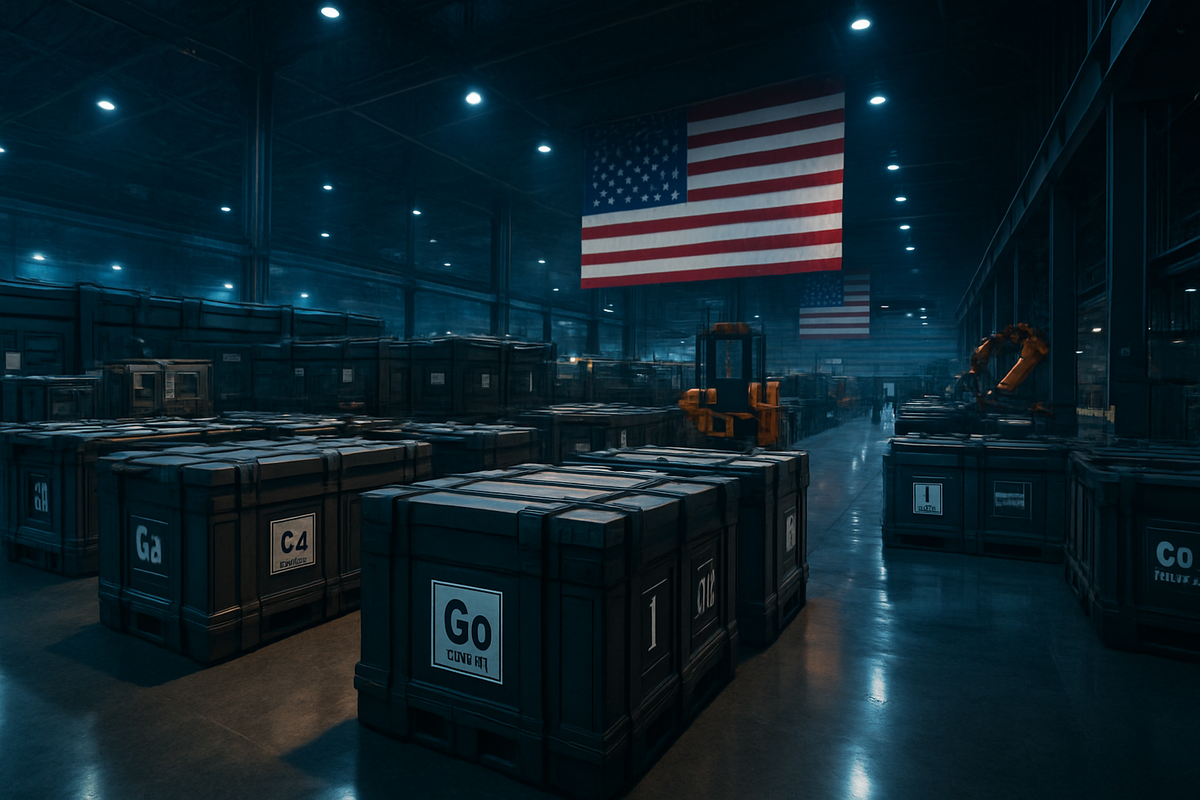
The announcement, delivered from the East Room alongside the CEOs of the nation's largest industrial titans, marks a fundamental shift in U.S. economic policy. By treating critical minerals with the same strategic gravity as crude oil, the administration intends to provide a "sovereign shock absorber" for domestic manufacturers. For the first time, a centralized federal reserve will provide a guaranteed supply of the raw materials necessary for everything from electric vehicle batteries to advanced semiconductor chips and stealth fighter jets.
The Birth of the 'Mineral SPR': A $12 Billion Fortress
The full operationalization of Project Vault follows exactly one year of intense legislative and executive maneuvering. While the foundation was laid in early February 2025 through a series of executive orders directing the Department of Commerce to investigate national security risks under Section 232, the project gained its multi-billion dollar "teeth" through the "One Big Beautiful Bill Act" (OBBBA) signed in July 2025. Today’s launch finalized a record-breaking $10 billion credit facility from the Export-Import Bank of the United States (EXIM), supplemented by approximately $2 billion in private capital from participating corporations and commodity trading houses.
Managed by a consortium of professional traders including Hartree Partners and Traxys North America, Project Vault functions as a public-private partnership. Unlike the traditional National Defense Stockpile, which is sequestered for military use, The Vault is explicitly designed to support the civilian industrial economy. Participating companies pay "carrying costs" and reservation fees to the government in exchange for guaranteed access to these materials during times of market shortage or geopolitical conflict. This mechanism effectively removes the burden of maintaining massive, expensive inventories from corporate balance sheets while ensuring the nation’s assembly lines never go dark.
The timeline leading to today’s launch was accelerated by Beijing’s own aggressive trade posture. Throughout 2024 and 2025, China imposed increasingly stringent export restrictions on gallium, germanium, and antimony—metals where they control over 80% of global processing. These moves were widely seen as a response to U.S. semiconductor bans, but they inadvertently catalyzed a unified American response. By early 2026, the "upstream squeeze" from China had become the primary catalyst for the largest mobilization of industrial policy in modern U.S. history.
The Corporate Winners: Securing the Future of High-Tech Manufacturing
The primary winners of Project Vault are the heavy hitters of American industry who have long been vulnerable to Chinese mineral "blackmail." General Motors Company (NYSE: GM) and Stellantis N.V. (NYSE: STLA) are among the most prominent beneficiaries, as the stockpile will provide a stable floor for cobalt and lithium supplies. For GM, which has invested billions in its Ultium battery platform, the Vault acts as a hedge against the volatile pricing that has historically plagued the EV sector. Similarly, The Boeing Company (NYSE: BA) gains a strategic safety net for titanium and gallium, both of which are essential for next-generation aerospace components and defense electronics.
Technology giants are also entering the fold. Alphabet Inc. (NASDAQ: GOOGL), the parent company of Google, has joined the initiative to secure high-purity gallium and germanium for its custom AI chips and server hardware. By participating in the Vault, Google can bypass Chinese-linked exchanges, ensuring that its massive data center expansions are not derailed by geopolitical trade wars. Other major industrial players like GE Vernova Inc. (NYSE: GEV) are expected to utilize the reserve to stabilize the supply chain for high-end magnets used in wind turbines and power grid infrastructure.
On the extraction side, domestic and "friendly" mining companies are seeing a massive sentiment shift. MP Materials Corp. (NYSE: MP), the largest rare earth producer in the Western Hemisphere, and Albemarle Corporation (NYSE: ALB), a leader in lithium production, are set to benefit from the government’s commitment to purchase bulk quantities at stable price floors. Meanwhile, junior miners like TMC The Metals Company Inc. (NASDAQ: TMC) and Perpetua Resources Corp. (NASDAQ: PPTA) have seen their stocks rally as the market anticipates they will provide the "non-Chinese" feedstock required to fill the Vault’s coffers. Conversely, Chinese giants like CMOC Group Limited (HKG: 3993) face a "geopolitical wall," as their dominance in cobalt and molybdenum is directly challenged by this state-backed diversification.
A New Era of Resource Nationalism and Decoupling
Project Vault represents more than just a storage facility; it is a signal of a broader trend toward "resource nationalism" and structural decoupling. For decades, the global market operated on a "just-in-time" delivery model that favored the lowest-cost producer, which was almost invariably China. The launch of the Vault signals the end of that era. Industry analysts suggest this event fits into a wider trend where supply chain resilience is now prioritized over raw cost efficiency.
The regulatory implications are profound. By utilizing the EXIM Bank as a primary funding vehicle, the Trump administration has essentially weaponized trade finance to compete with China’s "Belt and Road" mineral acquisitions. This move follows historical precedents like the creation of the Strategic Petroleum Reserve in 1975, but with a 21st-century twist: it integrates private sector capital to ensure market liquidity. The ripple effects are already being felt among U.S. allies; Australia and Canada have signaled they may launch "Vault-compatible" programs to create a unified Western mineral bloc.
This policy shift also serves as a warning to global competitors. By creating a $12 billion "buffer," the U.S. is effectively neutralizing China's ability to use "Announcement 18" or other export controls as a diplomatic weapon. If Beijing cuts off supply, the Vault opens its doors, preventing the sudden price spikes that would otherwise cause economic contagion. This "Strategic Mineral Deterrence" is expected to become a cornerstone of U.S. foreign policy moving forward.
The Road Ahead: Operational Challenges and Market Shifts
In the short term, the market should expect a period of "aggressive procurement." Commodity traders managed by the government will be entering the market to buy up 2026 and 2027 production. This could lead to a temporary floor in mineral prices, providing a boost to Western miners but potentially increasing costs for manufacturers who are not part of the Project Vault consortium. Strategic pivots will be required for smaller tech firms and mid-cap manufacturers who may find themselves squeezed between the massive purchasing power of the Vault and the restricted supply from China.
Long-term, the success of Project Vault depends on the speed at which domestic processing can be built. While the Vault can store raw materials, the U.S. still lacks sufficient capacity to refine many of these minerals into useable high-purity forms. Market watchers should look for a second wave of federal subsidies or "Project Vault Phase II" announcements focused specifically on mid-stream refining and chemical processing facilities located on U.S. soil or in "Sovereign Sanctuaries" like Greenland and Australia.
Scenario planning for the next 24 months suggests that China may attempt to "flood" the market with cheap minerals in an effort to make the Vault's $12 billion investment look overpriced and unnecessary. However, the Trump administration has already anticipated this move by including "anti-dumping" triggers in the OBBBA Act, which would automatically increase tariffs on Chinese minerals if prices fall below a certain threshold. The result is a high-stakes game of chicken between the world’s two largest economies over the fundamental building blocks of the future.
Conclusion: A Turning Point for Global Trade
The launch of Project Vault on February 2, 2026, will likely be remembered as the moment the U.S. government took definitive control of its industrial destiny. By bridging the gap between national security and corporate procurement, the administration has created a framework that could serve as a template for other critical sectors, such as semiconductors and pharmaceutical ingredients. The key takeaway for the market is clear: the era of uninhibited globalization is being replaced by a managed, fortified trade system where domestic supply is the ultimate currency.
Moving forward, investors should keep a close eye on the "Sovereign Sanctuary" rotation—the movement of capital out of Chinese-linked assets and into North American, Australian, and Nordic mining and processing companies. The market's stability will now be anchored by the $12 billion stockpile, which acts as both a shield against trade wars and a catalyst for a new domestic mining boom. As the first truckloads of gallium and cobalt begin their journey to secret storage locations across the American heartland, the message to Beijing and the world is unmistakable: America’s high-tech future is no longer for sale.
This content is intended for informational purposes only and is not financial advice.