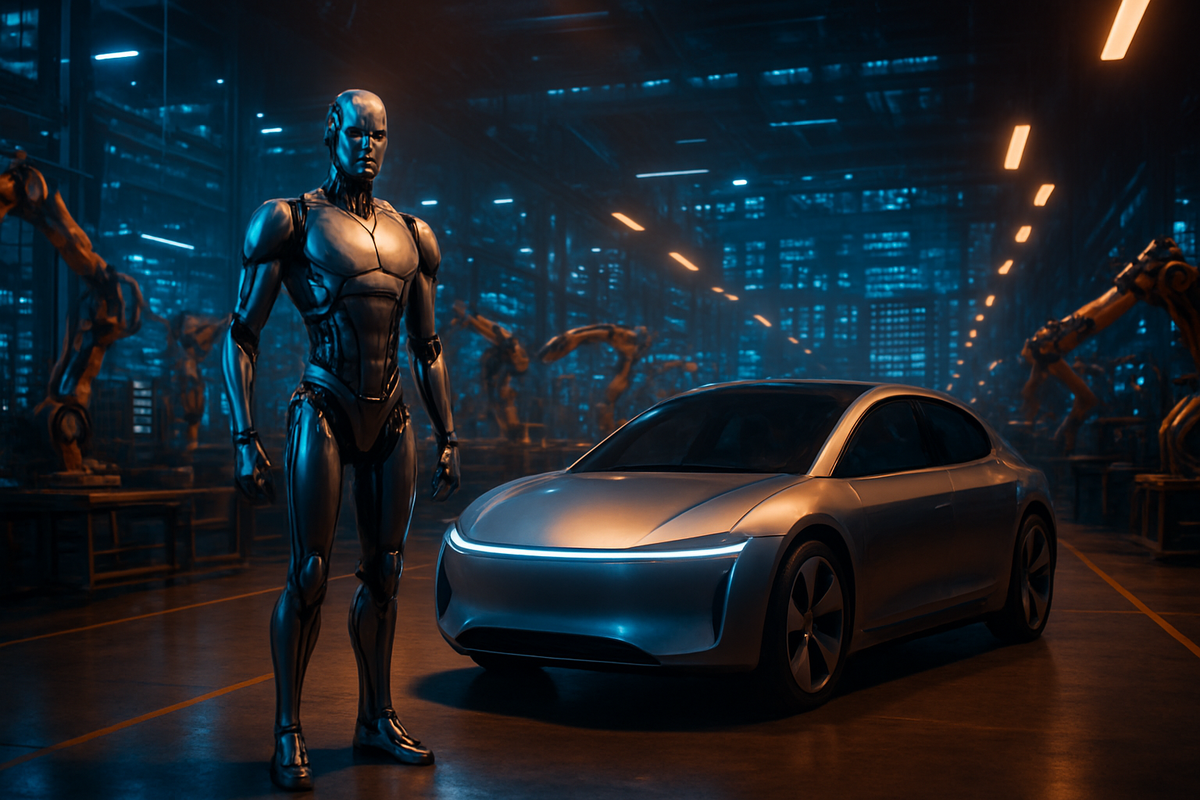
As of early February 2026, the identity of Tesla, Inc. (NASDAQ: TSLA) has undergone its most radical transformation since the launch of the Model S. Following a fiscal year 2025 that saw the company’s first-ever annual decline in both revenue and profit, CEO Elon Musk has doubled down on a future far removed from traditional car manufacturing. The company officially announced a staggering $20 billion capital expenditure plan for 2026—more than double its 2025 outlay—earmarked almost exclusively for artificial intelligence, humanoid robots, and autonomous transit.
This strategic "all-in" maneuver marks a definitive end to Tesla’s era as a high-growth electric vehicle (EV) volume leader and the beginning of its life as a "Physical AI" powerhouse. While financial skeptics point to a 46% drop in net income and thinning operating margins as signs of a fading titan, the equity markets have responded with surprising resilience. Investors appear to have traded near-term earnings stability for a seat at the table of what Musk describes as an "infinite-upside" robotics future, sending the stock higher even as the core automotive business "tears off the Band-Aid" of its former legacy.
The Financial Downturn and the $20 Billion Pivot
The transition was precipitated by a bruising 2025. Tesla reported total annual revenue of $94.8 billion, a 3% decline from 2024, while net income plummeted 46% to $3.8 billion. Operating margins, once the envy of the industry at nearly 17%, withered to a mere 4.6%. The final blow to the "legacy" Tesla came during the Q4 2025 earnings call on January 28, 2026, where the company confirmed it would discontinue its flagship luxury sedans, the Model S and Model X. The space at the Fremont factory will instead be retooled for the mass production of the Optimus humanoid robot and the Cybercab.
To fund this vision, Tesla is scaling its capital expenditure to over $20 billion for the 2026 fiscal year. This war chest is dedicated to six new or retooled production lines and a massive expansion of its "Cortex" AI training cluster at Giga Texas, which now houses approximately 85,000 NVIDIA Corporation (NASDAQ: NVDA) H100 and B200 GPUs. Musk also revealed a $2 billion investment into his AI startup, xAI, to bridge the gap between digital intelligence and physical robotic hardware. The timeline is aggressive: Tesla aims for a production capacity of one million Optimus units annually by the end of the decade, with the first fleet of unsupervised Robotaxis expected to begin geofenced trials in Texas and California by mid-2026.
Winners and Losers in the Robotics Ecosystem
The ripples of Tesla’s pivot are being felt across the global supply chain, creating a new class of industrial victors. Taiwan Semiconductor Manufacturing Co. (NYSE: TSM) has solidified its role as a critical partner, manufacturing Tesla’s proprietary AI5 chips and the Dojo supercomputer’s "System-on-Wafer" architecture. Similarly, Samsung Electronics (KRX: 005930) has emerged as a secondary winner, securing a $16.5 billion contract to provide specialized memory and additional chip fabrication. In the infrastructure sector, Vertiv Holdings Co (NYSE: VRT) and Eaton Corporation plc (NYSE: ETN) have seen a surge in demand as Tesla’s massive data centers require advanced liquid cooling and power distribution systems.
Conversely, the shift has left traditional stakeholders in a precarious position. Tesla’s pivot toward Lithium Iron Phosphate (LFP) batteries for its energy storage and utilitarian vehicles has forced long-time partner Panasonic Holdings Corp (OTC: PCRFY) to pivot its own Kansas-based production toward grid-scale storage rather than luxury EV cells. The most immediate "losers," however, may be the ride-sharing giants Uber Technologies, Inc. (NYSE: UBER) and Lyft, Inc. (NASDAQ: LYFT), whose business models face an existential threat from the Cybercab’s projected $0.80 per-mile operating cost. Furthermore, legacy automakers like Ford Motor Company (NYSE: F) and General Motors Company (NYSE: GM) find themselves trailing in the "compute race," lacking the integrated AI infrastructure to compete with Tesla’s hardware-software synergy.
A Global Shift Toward Physical AI
Tesla’s transformation is a microcosm of a broader industry trend toward "Physical AI"—the integration of large-scale neural networks with mobile, physical forms. This move places Tesla in direct competition not with other car companies, but with robotics pioneers like Boston Dynamics and Figure AI. While Tesla leads in manufacturing scale and data collection, competitors like Waymo, owned by Alphabet Inc. (NASDAQ: GOOGL), still maintain a lead in autonomous safety metrics. However, Tesla’s strategy focuses on the "cost-to-market" advantage, betting that its massive fleet and lower-cost sensor suite will eventually overwhelm more expensive lidar-based systems.
This pivot is not without historical precedent, drawing comparisons to Apple Inc. (NASDAQ: AAPL) and its shift from hardware sales to a high-margin services ecosystem. Much like Apple used the iPhone to lock users into the App Store, Tesla is using its vehicle fleet to build a moat of FSD and robotics subscriptions. However, regulatory headwinds remain the primary bottleneck. The European Union’s AI Act, set to become fully applicable in August 2026, classifies humanoid robots as "High-Risk AI," mandating strict transparency and human oversight. In the US, the NHTSA and state regulators are still grappling with liability frameworks for unsupervised autonomous vehicles, a debate that could delay Tesla's robotaxi rollout by years.
The Road Ahead: Scenarios and Strategic Pivots
In the short term, Tesla faces a "valley of death" where it must sustain massive capital outflows while its core automotive revenue continues to stagnate. The success of this pivot hinges on two factors: the rapid maturation of the 4680 battery cell’s "dry electrode" manufacturing—which Tesla successfully scaled in late 2025—and the market’s willingness to treat Tesla as a tech stock rather than a car company. If Tesla can prove the utility of Optimus in its own factories by 2027, the internal cost savings alone could justify a significant portion of the $20 billion investment.
Long-term possibilities include a complete exit from the private vehicle ownership market in favor of "Transit-as-a-Service." This would involve Tesla operating its own autonomous fleets rather than selling cars to individuals, a move that would fundamentally alter global urban planning. However, the company must execute this transition without losing its remaining automotive market share to aggressive Chinese competitors like BYD Company Limited (OTC: BYDDY), which are currently filling the volume vacuum left by Tesla’s move up the technological value chain.
Conclusion and Investor Takeaways
Tesla’s $20 billion commitment to AI and robotics represents one of the boldest corporate pivots in modern history. By sacrificing short-term profitability and its flagship luxury car lines, the company is attempting to front-run the next industrial revolution. For investors, the key takeaway is that Tesla is no longer an automotive play; it is a high-risk, high-reward bet on the automation of physical labor and transport.
Moving forward, the market will be watching for specific milestones: the first successful geofenced robotaxi trials in Texas, the integration of Optimus into Giga Nevada production lines, and the company's ability to navigate the EU’s looming AI regulations. While the financial decline of 2025 was a sobering moment for the "EV-only" thesis, the current enthusiasm suggests that as long as Elon Musk can sell the future, the market is willing to fund the present—no matter how expensive that present becomes.
This content is intended for informational purposes only and is not financial advice