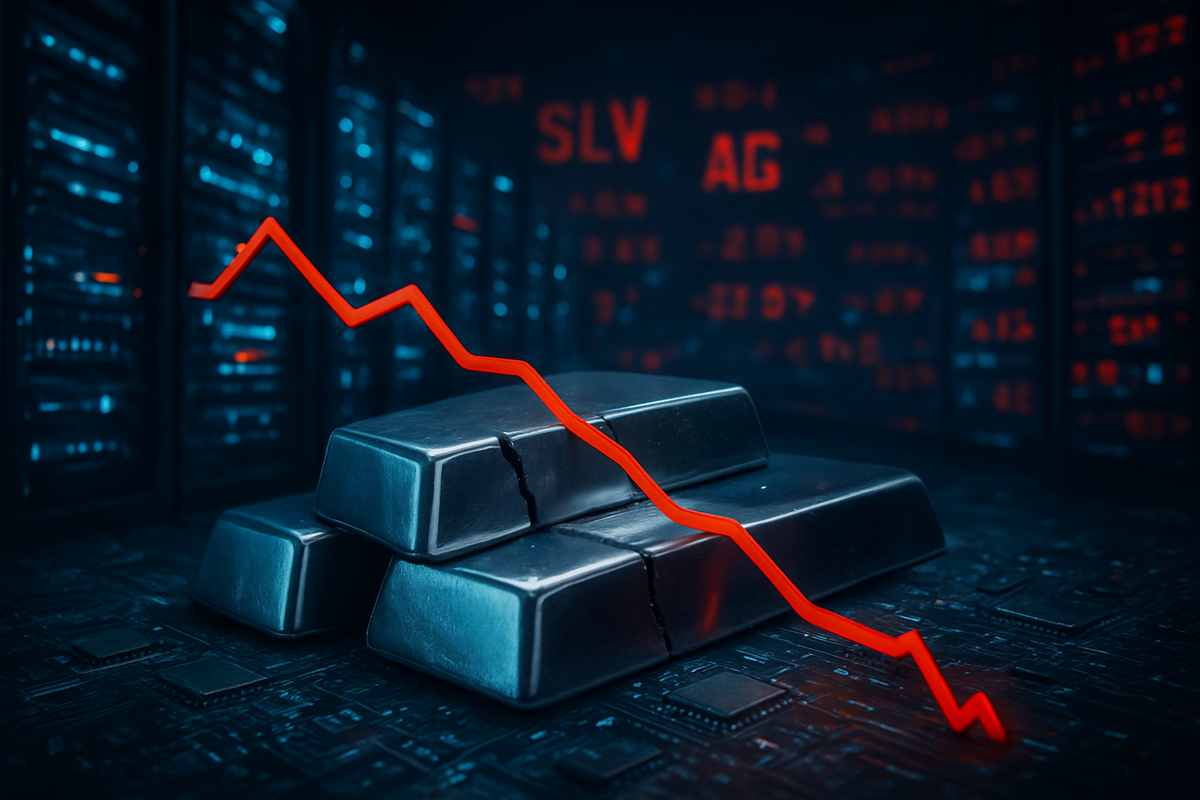
The global financial markets were rocked this past week as the "silver supercycle" came to a screeching halt, leaving investors to pick through the wreckage of one of the most aggressive commodity corrections in recent history. After a relentless climb that saw silver shatter records to trade well above $95/oz, the metal suffered a staggering 27% collapse on January 30, 2026, settling near the $84/oz mark. The swift reversal has sent shockwaves through the tech and energy sectors, which had increasingly come to view silver not just as a precious metal, but as a critical infrastructure component for the artificial intelligence revolution.
The fallout was most visible in the exchange-traded fund (ETF) market, where the iShares Silver Trust (NYSE Arca: SLV) recorded its most disastrous session since its inception. The fund plummeted 28% in a single day, a move that wiped out billions in market capitalization and triggered a cascade of margin calls across retail and institutional portfolios alike. As the dust settles on this "Black Friday" for precious metals, the market is now forced to reconcile a genuine industrial supply crunch with the undeniable reality of a speculative bubble that simply grew too large, too fast.
The AI Fever and the Road to $95
The ascent of silver in late 2025 and the first weeks of 2026 was fueled by a narrative that analysts dubbed the "AI Industrial Squeeze." Unlike previous silver rallies, which were often driven by inflation hedging or currency devaluations, the 2026 surge was rooted in the metal's unique physical properties. As data center construction exploded to accommodate massive new Large Language Models (LLMs), silver’s peerless electrical and thermal conductivity made it indispensable. Silver-sintered pastes became the industry standard for thermal management in the latest generation of AI chips, and silver-plated high-density connectors were required for the massive throughput demands of GPU clusters.
By mid-January, a "speculative frenzy" had taken hold. Retail traders, galvanized by social media momentum and reports of a fifth consecutive year of global supply deficits, began piling into call options. The scarcity narrative was further amplified when major exporters, including China, implemented new licensing regimes for silver shipments to prioritize their own domestic "green tech" and AI industries. This "perfect storm" of fundamental demand and geopolitical tension pushed silver past the $90 threshold for the first time in history, reaching an intraday peak that touched triple digits before the momentum finally snapped on January 30.
The trigger for the collapse was a classic "liquidity event." Following the nomination of a hawkish new Federal Reserve Chair, Kevin Warsh, market expectations for interest rate cuts were abruptly recalibrated. As the U.S. Dollar surged and Treasury yields spiked, the heavily leveraged "long silver" trade became a liability. What began as a moderate pullback quickly turned into a violent liquidation as automated stop-loss orders were triggered and hedge funds rushed to exit their crowded positions.
Winners and Losers in the Aftermath
The carnage was felt most acutely by the pure-play silver miners and investment vehicles. The iShares Silver Trust (NYSE Arca: SLV) became the epicenter of the volatility, experiencing record-breaking volume as investors liquidated positions. Other major losers included high-beta miners like First Majestic Silver Corp. (NYSE: AG) and Coeur Mining, Inc. (NYSE: CDE), both of which saw their stock prices slashed by more than 20% in the immediate wake of the silver price drop. These companies, which had ramped up production guidance based on $100 silver, now face the prospect of tightening margins and re-evaluating capital expenditure for the coming fiscal year.
Conversely, some industrial "winners" are emerging from the rubble. Large-scale consumers of silver, particularly in the solar and semiconductor sectors, may find relief in the lower input costs. Companies like First Solar, Inc. (NASDAQ: FSLR) and major AI hardware manufacturers like Nvidia (NASDAQ: NVDA) could see a marginal easing of supply chain cost pressures if silver stabilizes at more sustainable levels. However, the relief may be short-lived; if the price collapse leads to a slowdown in new mining projects, the underlying structural deficit could worsen, setting the stage for another supply crunch in late 2026 or 2027.
Streaming and royalty companies, such as Wheaton Precious Metals Corp. (NYSE: WPM), have also shown a degree of relative resilience compared to the direct miners. Because their business models are based on fixed-cost silver deliveries, they are often better insulated from the immediate shocks of a spot-market collapse, though they were by no means immune to the broader sector sell-off.
A New Paradigm for Commodity Volatility
The silver crash of 2026 will likely be remembered alongside the 1980 Hunt Brothers cornering attempt and the 2011 "QE bubble" as a cautionary tale of market excess. However, this event is distinct because of its intersection with the "AI race." It highlights a growing trend where traditional commodities are becoming high-beta proxies for technology sentiment. As the world transitions to an electrified and AI-driven economy, the demand for metals like silver, copper, and lithium is becoming increasingly decoupled from traditional macroeconomic cycles and more tied to the CapEx cycles of Silicon Valley.
This event also exposes the fragility of the "paper silver" market—the ETFs and futures contracts that trade many times the volume of the actual physical metal. The 28% drop in SLV suggests that when speculation reaches a fever pitch, the financialized version of the commodity can disconnect from the physical reality, leading to extreme price gapping. Regulatory bodies, including the Commodity Futures Trading Commission (CFTC), are already under pressure to investigate the role of high-frequency trading and margin requirements in the January 30 crash, potentially leading to stricter oversight of commodity ETFs.
What Lies Ahead: Stabilization or Further Slide?
In the short term, the market is looking for a floor. The $84/oz level represents a significant retracement, but it remains nearly double the historical averages seen in the early 2020s. Technicians are watching the $75 to $80 range closely, as this was the consolidation zone before the final parabolic move higher. If silver can hold these levels, it may signal that the "AI narrative" remains intact, albeit at a more realistic valuation.
Strategically, mining companies will likely pivot toward "cost-plus" contracts with their industrial partners to avoid the extreme volatility of the spot market. We may see more direct investment from tech giants into mining projects—a "vertical integration" strategy designed to secure physical supply without being held hostage by speculative swings on the COMEX. The coming months will be a period of "price discovery," where the market must determine the actual value of silver in an AI-dominated world, stripped of the speculative froth.
The Bottom Line
The rise and fall of silver in early 2026 serves as a stark reminder that even the most robust fundamental stories can be derailed by speculative excess. While the "AI race" is a very real driver of silver consumption, the 27% collapse to $84/oz on January 30 proved that the market had priced in years of growth in a matter of weeks. The massive liquidation in the iShares Silver Trust (NYSE Arca: SLV) marks a turning point in how investors view the intersection of precious metals and high technology.
Moving forward, investors should watch for signs of physical supply stabilization and the potential for a "buy the dip" entry from industrial consumers. The era of silver as a sleepy "monetary" metal is over; it is now a front-line technology commodity. However, as the events of late January have shown, being on the front line comes with a level of volatility that only the most disciplined investors can survive.
This content is intended for informational purposes only and is not financial advice