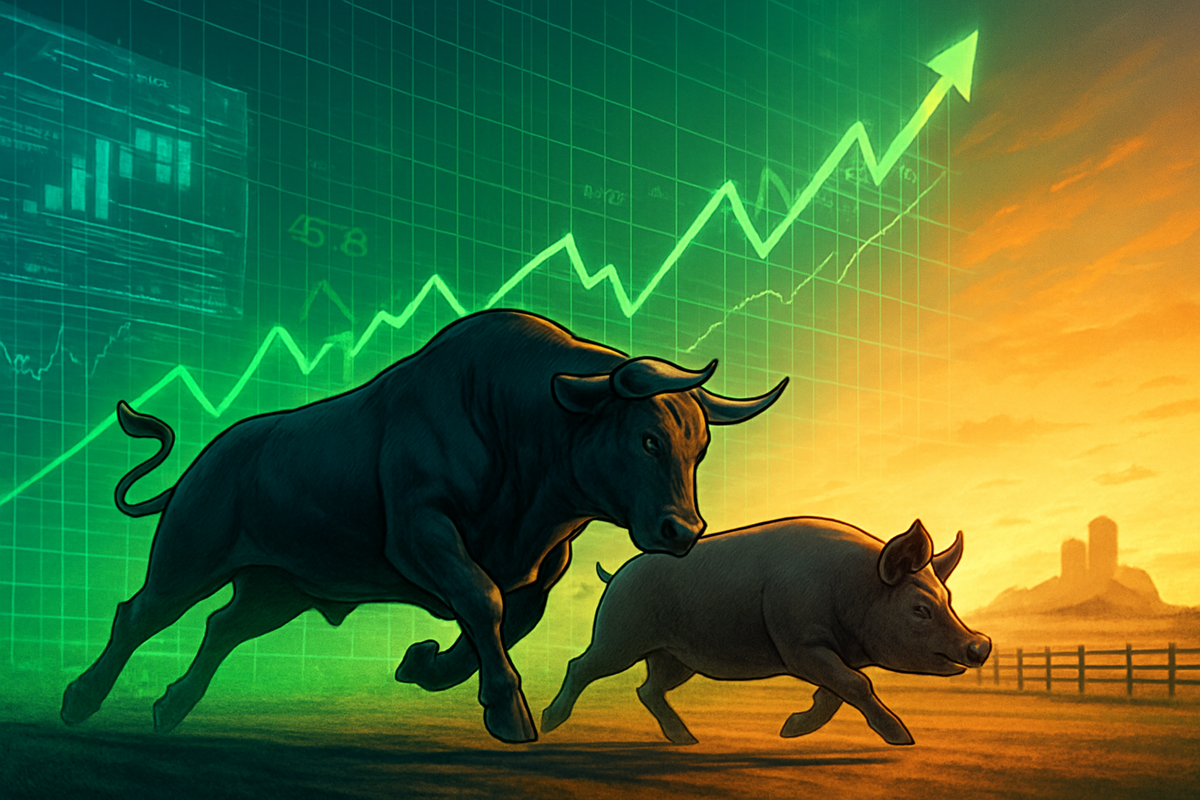
As of February 5, 2026, the U.S. livestock market is witnessing an extraordinary surge in momentum, with both cattle and hog futures barreling toward contract highs. Driven by a combination of generational supply shortages in the beef sector and a massive influx of speculative capital, the protein complex has become the focal point of the commodities world. Producers are seeing some of the highest nominal prices in history, yet the "headline-driven" nature of the current market has introduced a level of volatility that makes risk management more critical than ever before.
The immediate implications are stark: while ranchers and hog farmers are eyeing record-breaking revenues, the processing industry—dominated by global giants—is facing a severe margin squeeze. For the American consumer, the rally in futures suggests that the "cheap protein" era remains a distant memory, as retail prices for beef and pork are expected to climb further in response to these wholesale benchmarks.
The Perfect Storm: Smallest Herds and Speculative Bets
The current rally is anchored by a fundamental supply crisis that has been years in the making. According to the USDA’s January 2026 Cattle Inventory Report, the U.S. beef cattle herd has shrunk to 86.2 million head—its smallest size since 1951. This seven-year liquidation phase, spurred by past droughts and rising input costs, has finally hit a breaking point where market-ready supplies cannot meet even moderate demand. Consequently, April 2026 Live Cattle futures recently breached $207/cwt, while Feeder Cattle contracts have surged over 4% in just the last month, trading near $3.62/lb in regional hubs.
The hog market, while seeing a slight 1% increase in total inventory to 75.5 million head, has not been immune to the bullish fervor. April 2026 Lean Hog futures led the entire protein sector in early 2026, posting an 11.8% gain in January alone to reach contract highs near 97 cents per pound. This rally has been fueled by a weakening U.S. dollar and robust export demand from Mexico and China, which has more than offset the modest increase in domestic supply.
Adding fuel to the fire is a massive wave of speculative money. Hedge funds and Commodity Trading Advisors (CTAs) have rotated heavily into "hard assets" as a hedge against volatility in the tech and metals sectors. As of late January, the combined net-long position held by managed money in the livestock complex was valued at a staggering $17.4 billion. This speculative flow has created a "momentum trade" where systematic buying triggers further price spikes, often decoupled from the day-to-day physical trade.
The industry reaction has been one of cautious elation for producers and deep concern for processors. Market analysts warn that the current environment is "headline-driven," meaning a single report on export cancellations or a shift in fund sentiment could lead to a rapid and painful correction, despite the underlying tight supply.
The Processor's Squeeze: Winners and Losers
The surge in livestock prices has created a polarized landscape for public companies. For meatpackers, the "spread"—the difference between what they pay for a live animal and what they receive for boxed meat—has collapsed. Tyson Foods (NYSE: TSN) recently reported a $143 million adjusted operating loss in its beef segment for the first quarter of 2026. The company has had to take drastic measures, including the permanent closure of its Lexington, Nebraska processing plant, to manage excess capacity in a market where there simply aren't enough cattle to keep the hooks moving.
JBS S.A. (OTC: JBSAY) is similarly feeling the heat in its North American operations, where beef margins have turned negative or "razor-thin." However, JBS is leveraging its global diversification to weather the storm. With cattle cycles in Brazil and Australia currently in a more favorable expansion phase, the company’s international profits are effectively subsidizing its U.S. losses. This global footprint provides a safety net that pure-play U.S. processors lack.
On the other hand, branded food companies like Hormel Foods (NYSE: HRL) are finding more stable footing. While high pork and beef input costs remain a headwind, Hormel’s focus on "value-added" and branded products allows for better price transmission to consumers. The company forecasted 2026 earnings per share in the range of $1.43 to $1.51, banking on strong turkey demand and aggressive cost-cutting measures to offset the earnings pressure from the volatile hog market.
A Historic Shift in Agricultural Investment
The current market fits into a broader industry trend where livestock is no longer seen just as a food commodity but as a high-stakes financial asset. The $17.4 billion in speculative capital represents a significant shift from historical norms, where livestock was often overlooked by major Wall Street funds. This "financialization" of the meat industry means that prices are increasingly influenced by macroeconomic factors—such as Federal Reserve interest rate decisions and global currency fluctuations—rather than just the number of cattle in a feedlot in Kansas.
Comparing today’s market to the 1950s—the last time the herd was this small—reveals a major difference: the speed of information and capital. In 1951, supply shocks took months to reflect in the broader economy. In 2026, high-frequency trading and 24-hour news cycles mean that a "tight" supply report is priced into the futures market within seconds, often leading to "overbought" conditions that can be dangerous for unhedged producers.
Furthermore, regulatory scrutiny is beginning to mount. As retail meat prices stay elevated, there are renewed calls from policymakers to investigate the concentration of the meatpacking industry and the role of speculative investment in driving up food inflation. The ripple effects are being felt by retail partners and restaurant chains, who are being forced to choose between shrinking their margins or passing record-high costs onto a weary public.
The Road to 2028: What Comes Next?
In the short term, the market remains in a "price rationing" phase. Analysts do not expect a meaningful recovery in cattle supply until at least 2028, as it takes years to rebuild a breeding herd from record lows. This suggests that while volatility will remain high, the "floor" for prices has likely shifted permanently higher. Producers who can navigate the current environment may see several more years of high prices, provided they can manage their own rising costs for labor and land.
A strategic pivot toward more sophisticated risk management is already underway. Small-to-mid-sized producers are increasingly turning to Livestock Risk Protection (LRP), a USDA-subsidized insurance tool that allows them to lock in a price floor without the risk of margin calls that come with traditional futures trading. In a "headline-driven" market, these tools are no longer optional; they are essential for survival.
Potential scenarios for the remainder of 2026 include a "blow-off top" where speculative buying pushes prices to unsustainable levels, followed by a sharp correction as consumer demand finally buckles under the weight of $15-per-pound ground beef. Investors and producers alike must watch for signs of "demand destruction"—where consumers shift heavily toward poultry or plant-based alternatives—as the primary threat to the current rally.
Summary and Outlook for Investors
The livestock market of early 2026 is a study in extremes. With the cattle herd at a 75-year low and speculative interest at record highs, the momentum is undeniably bullish, but the risks are equally historic. The key takeaways for the market moving forward are the persistent supply-demand imbalance and the precarious position of major processors who are caught in the middle.
Moving forward, the market is expected to remain highly sensitive to USDA inventory updates and fund positioning reports. Investors should keep a close eye on the quarterly earnings of Tyson Foods (NYSE: TSN) and JBS S.A. (OTC: JBSAY) for signs of a turnaround in processing margins, as well as export data to see if international buyers remain willing to pay "American prices" for protein.
Ultimately, the current momentum highlights a new era of livestock trading—one where biological cycles and financial speculation are inextricably linked. For those in the trade, the message is clear: enjoy the record highs, but keep your risk management tools within reach, as the only constant in a headline-driven market is change.
This content is intended for informational purposes only and is not financial advice.