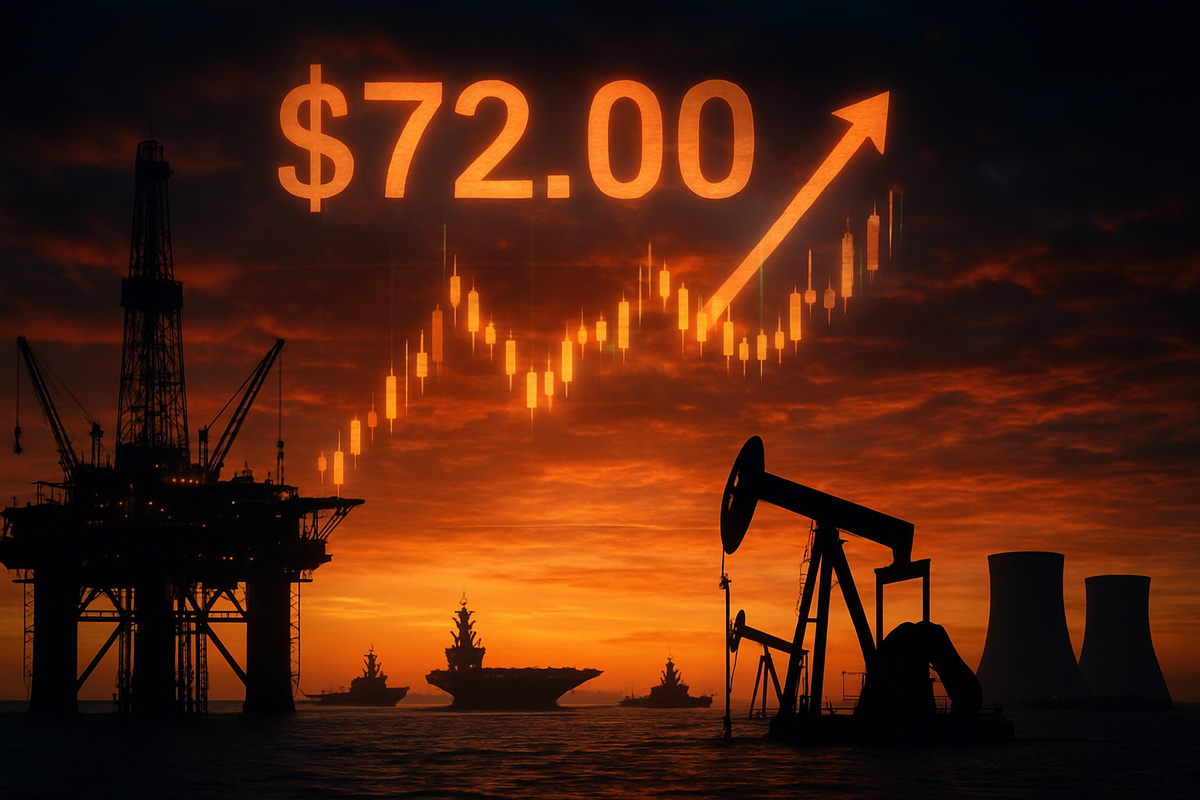
February 5, 2026 — Global energy markets are on edge this week as Brent crude oil prices breached the critical $72 per barrel threshold, marking a six-month high. The rally, which has seen prices climb nearly 12% since the start of the year, is being fueled by a rapidly expanding geopolitical risk premium. As of today, February 5, 2026, the primary catalyst for market volatility remains the escalating military and diplomatic friction between the United States and Iran, specifically centering on Tehran’s renewed nuclear enrichment activities and a major naval buildup in the Arabian Sea.
The surge to $72 represents a significant psychological and technical breakout for a market that spent much of late 2025 mired in concerns over a potential supply glut. However, the immediate threat of a direct kinetic conflict in the Middle East has superseded fundamental data. While prices have seen a slight technical retreat to the $65–$68 range this morning in anticipation of high-stakes diplomatic talks scheduled for tomorrow in Istanbul, the underlying tension continues to underpin global energy supply forecasts and has injected a level of volatility not seen in the energy sector for over a year.
The Path to $72: A Timeline of Escalation
The current crisis traces its roots to late 2025, following a series of events that have systematically dismantled the regional status quo. On December 28, 2025, a massive wave of domestic uprisings began across Iran, triggered by the total collapse of the Iranian rial and runaway inflation exceeding 42%. In response, the Iranian government initiated a brutal crackdown, which the Trump administration condemned while signaling that "help is on its way" to the protesters. This rhetoric from Washington was interpreted by Tehran as a clear threat to regime survival, leading to a pivot toward nuclear leverage.
Tensions reached a boiling point in mid-January 2026 when the U.S. Navy deployed a massive naval flotilla, led by the USS Abraham Lincoln (CVN-72) carrier strike group, to the Arabian Sea. The situation turned physical in early February when U.S. forces shot down an Iranian Shahed-139 drone that had aggressively approached the carrier group. Simultaneously, satellite imagery has confirmed that Iran is fast-tracking repairs to its nuclear facilities at Esfahan and Natanz, following localized airstrikes in 2025. The International Atomic Energy Agency (IAEA) reported in November 2025 that it has "lost continuity of knowledge" regarding Iran’s centrifuge production, raising fears that Tehran may be approaching a "breakout" capability for weapons-grade uranium.
Initial market reactions have been swift and binary. The "geopolitical risk premium" is estimated by analysts to be adding roughly $7 to $8 to every barrel of oil. Traders are currently pricing in the possibility of a "worst-case scenario" involving a blockade of the Strait of Hormuz—a narrow waterway through which approximately 20% of the world's oil supply passes daily.
Corporate Divergence: Winners and Losers in the $70+ Era
The spike to $72 oil has created a distinct landscape of corporate winners and losers. Major energy producers have seen a massive resurgence in market sentiment. ExxonMobil (NYSE: XOM) has emerged as a primary beneficiary, with its stock price rallying nearly 4% this month. The company’s heavy investments in low-cost production regions like the Permian Basin and Guyana are allowing it to generate record free cash flow at these price levels. Similarly, Chevron (NYSE: CVX) has seen its stock surge over 12% year-to-date, leveraging its expanded portfolio following recent acquisitions and a strategic ramp-up in South American production to capitalize on the higher price floor. Occidental Petroleum (NYSE: OXY) has also witnessed a 10.5% rally as higher revenues help the company accelerate its debt reduction plans.
Conversely, the airline industry is facing a severe margin squeeze. Fuel typically accounts for 20% to 30% of a carrier's operating costs, and the sudden price hike has forced airlines to react. Delta Air Lines (NYSE: DAL) has remained somewhat resilient, aided by its ownership of the Trainer refinery, which provides a unique internal hedge against rising jet fuel costs. However, United Airlines (NASDAQ: UAL) has warned that if oil reaches the $80 range, its 2026 profitability targets could be in jeopardy. American Airlines (NASDAQ: AAL) has faced the most volatility, compounded by "Winter Storm Fern," which forced thousands of cancellations earlier this year. To combat the rising fuel bill, American and other carriers have begun implementing aggressive "fuel surcharges," with some international routes seeing price hikes of over 15% in the last month alone.
Broader Significance: Energy Security Returns to Center Stage
This event fits into a broader industry trend where "Energy Security" is once again taking precedence over "Energy Transition." The move to $72 oil has forced many governments to reconsider the speed of their shift away from fossil fuels, as high energy prices threaten to reignite global inflation. The current situation serves as a stark reminder of the "physical economy's" enduring power; while technology and services have dominated market narratives for years, the stability of the global economy remains tethered to the flow of crude.
The geopolitical risk also impacts the strategy of the OPEC+ alliance. Led by Saudi Arabia and Russia, the group recently met on February 1, 2026, and decided to extend their current production "freeze" through March. This move was a strategic masterstroke, allowing the U.S.-Iran tension to maintain high prices without the alliance having to implement deeper, more painful production cuts. However, the alliance is also holding approximately 2.5 million barrels per day in "spare capacity," specifically in Saudi Arabia, which acts as a safety net should Iranian supplies be suddenly knocked offline. This positioning allows OPEC+ to act as the "lender of last resort" to the energy market, further cementing their influence over global policy.
The Road Ahead: Istanbul and the "Danger Zone"
The immediate focus for the market is the "Istanbul Channel"—the diplomatic talks scheduled for February 6, 2026. If these talks show signs of progress, such as a "freeze-for-freeze" agreement where Iran halts enrichment in exchange for targeted sanctions relief, we could see oil prices quickly retreat toward the $60 mark. However, a breakdown in negotiations could lead to a rapid escalation. Analysts at several major banks have warned that a direct military exchange could send Brent crude toward $90 or $100 per barrel overnight.
In the long term, this period of high volatility may lead to a strategic pivot among global consumers. We are already seeing "surcharge proliferation" across the transport and logistics sectors, which will likely cool consumer demand if sustained. For energy companies, the current windfall provides the capital necessary to either reinvest in oil and gas to ensure supply security or to accelerate their own green energy transitions as a hedge against future geopolitical instability.
Summary and Outlook for Investors
The crude oil market’s ascent to $72 per barrel is more than just a pricing trend; it is a reflection of a world in geopolitical flux. The standoff between the U.S. and Iran has reintroduced a level of risk that had been largely dormant throughout early 2025. While market fundamentals—including a projected global supply surplus later in 2026—suggest that oil prices should be lower, the reality of potential war has created a "new normal" for energy pricing.
As we move forward, investors should keep a close watch on the outcomes of the Istanbul summit and the continued deployment status of the USS Abraham Lincoln. The resilience of the "Physical Economy" stalwarts like XOM and CVX suggests that the market is currently favoring tangible assets over speculative growth. For the average consumer and traveler, the coming months will likely be characterized by higher costs at the pump and in the air, as the world waits to see if diplomacy can defuse the powder keg in the Middle East.
This content is intended for informational purposes only and is not financial advice