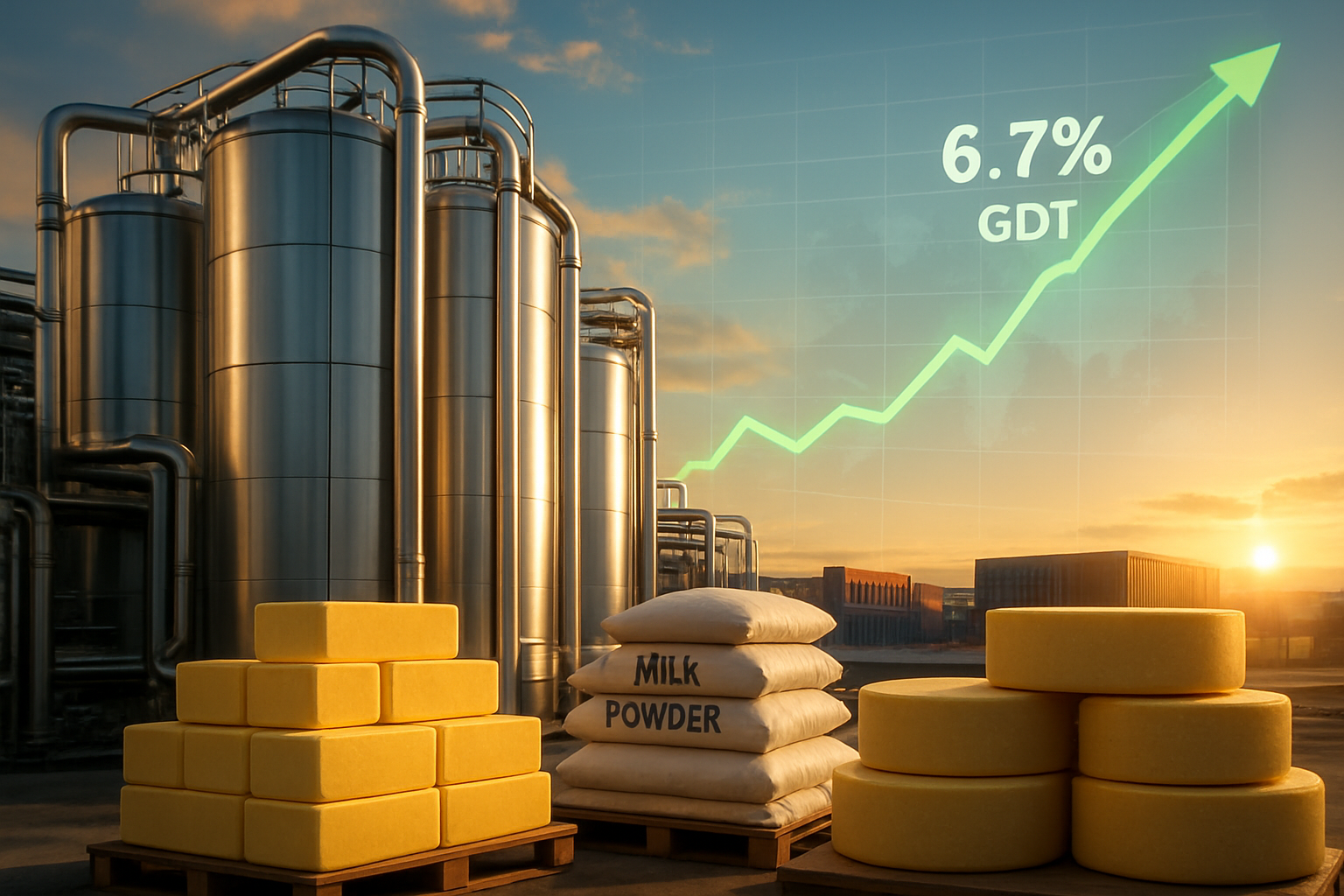
The global dairy industry is experiencing its most significant bullish shock in years, punctuated by a massive 6.7% leap in the Global Dairy Trade (GDT) price index during the February 3, 2026, auction. This surge has sent shockwaves through milk futures markets, signaling a "genuine reset" for a sector that struggled with oversupply throughout much of late 2025. While the rally is broad-based, it is creating a stark divide between different segments of the dairy complex, particularly as powder and fat prices outpace a lagging cheese market.
The immediate implications of this rally are being felt across global commodity desks. With Skim Milk Powder (SMP) and butter leading the charge, international buyers are scrambling to secure supplies ahead of seasonal demand peaks. This "February Jump" has not only bolstered the bottom lines of major exporters but has also introduced a complex divergence in U.S. domestic milk futures, where Class IV contracts (butter and powder) are significantly outperforming Class III (cheese) contracts. This discrepancy is highlighting structural shifts in dairy production and processing capacity that could define the agricultural landscape for the remainder of 2026.
A "Powder and Fat" Power Play
The GDT Event 397, held on February 3, 2026, marked the third consecutive gain for the year, following a robust 6.3% rise in early January. The 6.7% jump in the trade-weighted average was driven primarily by an explosive 10.6% surge in Skim Milk Powder prices, which reached $2,874 per metric ton. Butter followed suit with an 8.8% increase to $5,773 per metric ton, while Whole Milk Powder (WMP)—the benchmark for New Zealand’s massive export market—rose a healthy 5.3% to $3,614 per metric ton.
The timeline leading up to this moment suggests a classic demand-pull scenario. After nearly a year of "wait-and-see" behavior, Chinese buyers returned to the market in force, absorbing roughly 35% of the total volume offered at the auction. This was compounded by "seasonal panic buying" from the Middle East and North Africa, particularly Algeria, as distributors sought to stock up ahead of the Ramadan and Easter holidays. The total volume traded was slightly lower than historical averages at 24,034 metric tons, which further tightened the price discovery process.
Initial market reactions have been overwhelmingly positive for international dairy cooperatives. In New Zealand, the farmgate milk price forecast is already being revised upward toward the NZ$9.30/kgMS mark, a level that would provide significant relief to producers facing high input costs. However, the reaction in the United States has been more nuanced, as domestic traders grapple with a surplus of cheese that is currently acting as an anchor on certain segments of the futures market.
Winners and Losers in a Two-Speed Market
The primary beneficiary of this rally is the Fonterra Co-operative Group (NZX: FCG), the world's largest dairy exporter. As the dominant player in the GDT auctions, Fonterra stands to capture the immediate upside of the powder and fat price surge. The cooperative's ability to pivot its production streams toward SMP and WMP allows it to capitalize on the returning Chinese demand, likely leading to higher dividends for its shareholders and better payouts for its member farmers.
Conversely, major cheese processors such as Saputo Inc. (TSX: SAP) and Kraft Heinz (NASDAQ: KHC) face a more challenging environment. While lower cheese prices might seem beneficial for their input costs, the extreme divergence in milk classes is creating market volatility. Saputo, in particular, which has a significant footprint in both Canada and the U.S., must navigate a domestic U.S. market where Class III milk futures—driven by cheese—are languishing around $15.33 per hundredweight (cwt). This is a sharp contrast to Class IV futures, which have climbed toward $17.10/cwt on the back of the global butter and powder rally.
Multinational consumer goods companies like Danone (EPA: BN) and Nestlé (SIX: NESN) may also find themselves squeezed. As major buyers of dairy ingredients, the nearly 9% rise in butter prices and 10% rise in SMP will likely lead to increased COGS (cost of goods sold) for their dairy and nutrition divisions. While these companies have historically possessed strong pricing power, the speed of the 2026 rally may test their ability to pass these costs on to consumers who are already weary of food inflation.
The Class Divergence: A New Agricultural Signal
The current rally is exposing a deep structural divergence within the agriculture sector. The gap between Class IV and Class III milk is the widest it has been in several years, signaling that the "bullishness" is currently concentrated in fats and powders. This is largely due to an "abundance of cheese" in the U.S. market, resulting from massive processing plant investments made during 2024 and 2025. These new facilities have flooded the market with cheese blocks and barrels, keeping spot cheese prices as low as $1.41 per pound even as other dairy commodities skyrocket.
Furthermore, a shift in U.S. dairy cattle genetics has led to a "butterfat surge." Modern herds are producing milk with significantly higher fat content than previous generations. While this is a boon for butter production, the lack of a corresponding increase in milk protein has created a "protein-to-fat imbalance" for cheesemakers. This imbalance is essentially forcing a surplus of fat into the Class IV market, which, paradoxically, is being met by strong global demand, while the excess cheese production capacity continues to weigh down Class III values.
Historical precedents, such as the 2014 dairy boom, suggest that such extreme divergences are rarely sustainable. Eventually, the market typically corrects through either a collapse in the premium class or a recovery in the laggard. However, with U.S. milk production running nearly 5% higher than previous year levels and a national herd of 9.57 million head, the supply-side pressure on cheese remains formidable, suggesting that 2026 may be the year of the "split dairy economy."
What Comes Next: A Seasonal Spike or a Structural Shift?
Looking ahead, the critical test for the dairy market will be the April 2026 GDT auctions. Market analysts are currently debating whether the 6.7% jump is a "seasonal head-fake" driven by pre-holiday buying or the beginning of a long-term upward trend. If prices hold steady after the Ramadan and Easter procurement windows close, it will confirm that global demand is structurally robust enough to absorb the current high levels of production.
For producers and processors, the short-term strategy will likely involve a "dash for components." Farmers are expected to focus on maximizing fat and protein tests to take advantage of the component-heavy milk checks favored by the current market. Long-term, the industry may need to pause its expansion of cheese processing capacity in favor of modernizing drying facilities for powders, as the global market clearly demonstrates a higher appetite for storable, exportable dairy ingredients over fresh cheese.
Market opportunities may also emerge in the mozzarella sector, which saw a 10.6% price spike in the latest auction. This suggests that while cheddar and bulk cheese are struggling, high-value specialty cheeses remain in high demand globally. Investors and companies that can successfully pivot their product mix toward these high-growth areas will be best positioned to weather the volatility of the coming months.
Summary and Market Outlook
The 6.7% surge in the GDT index is a watershed moment for the 2026 dairy market, marking the end of the 2025 doldrums and the start of a aggressive price recovery. The rally, however, is not a "rising tide that lifts all boats." The stark divergence between Class IV strength and Class III weakness highlights a fragmented industry where global demand for powders and fats is currently at odds with a domestic U.S. oversupply of cheese.
Moving forward, the market appears to be entering a period of high volatility. While the return of Chinese demand provides a solid floor for prices, the underlying supply of milk remains high, particularly in the United States and New Zealand. Investors should closely watch for any signs of "demand destruction" if prices for butter and powder continue their double-digit climbs, as well as the monthly production reports from major dairy basins.
For now, the momentum belongs to the exporters and the powder-focused cooperatives. As the 2026 agricultural cycle progresses, the ability of the market to reconcile the "cheese glut" with the "powder panic" will determine whether this rally has the legs to sustain itself through the second half of the year.
This content is intended for informational purposes only and is not financial advice