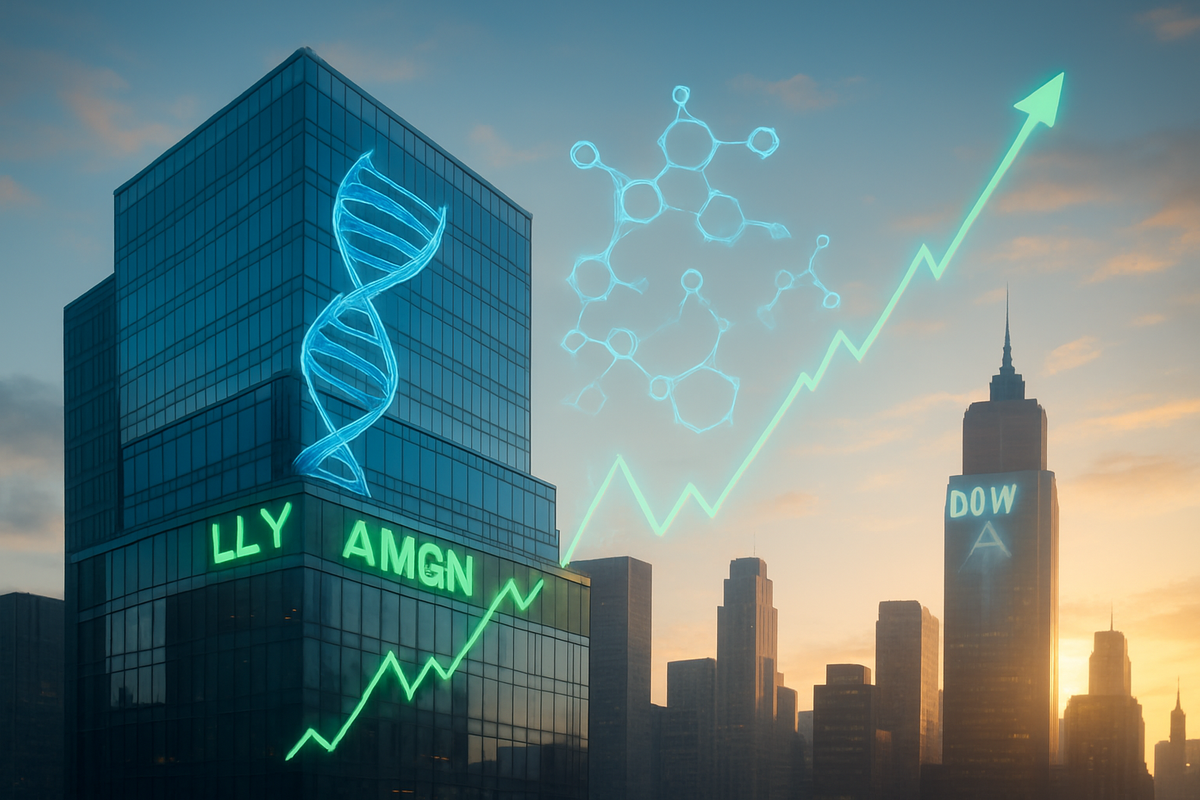
As the first week of February 2026 unfolds, a dramatic shift in investor sentiment has split the U.S. stock market. While technology and artificial intelligence stocks have faced a sharp pullback, the healthcare sector has emerged as the market's primary engine of growth. The Dow Jones Industrial Average surged toward the 50,000 mark this week, fueled by "blowout" fourth-quarter earnings from pharmaceutical giants Eli Lilly and Company (NYSE: LLY) and Amgen Inc. (NASDAQ: AMGN). The primary catalyst? An insatiable global appetite for GLP-1 medications that has transformed these traditional defensive plays into high-octane growth engines.
The divergence in the market is striking. On February 4, 2026, the Dow climbed roughly 600 points to hit a record high near 49,600, even as the tech-heavy Nasdaq Composite plunged 1.4%. This "defensive rotation" reflects a growing preference for companies with massive, tangible cash flows—like those producing weight-loss and diabetes treatments—over speculative AI valuations. With Eli Lilly surpassing a $1 trillion market capitalization and Amgen delivering its strongest earnings beat in years, the healthcare sector is now being viewed by many as the "new tech" in an increasingly volatile economic landscape.
Blowout Results: The Numbers Behind the Surge
The catalyst for this week’s market move was the simultaneous release of Q4 2025 earnings by Lilly and Amgen. On February 4, Eli Lilly reported a staggering 43% year-over-year increase in revenue, reaching $19.3 billion. The company’s performance was anchored by its blockbuster GLP-1 franchise; Mounjaro, its diabetes treatment, saw worldwide revenue climb 110% to $7.41 billion, while its obesity-focused counterpart, Zepbound, generated $4.26 billion—a 122% increase compared to the previous year. Adjusted earnings per share (EPS) came in at $7.54, shattering the consensus estimate of $6.91 and providing a clear signal that the company’s manufacturing scale-up is finally meeting the global surge in demand.
Amgen similarly impressed Wall Street, leading the Dow as its top-performing component during the rotation. The company reported revenue of $9.9 billion and an adjusted EPS of $5.29, far exceeding the $4.73 forecast by analysts. While Amgen’s established products like Repatha (up 44%) and TEZSPIRE (up 60%) showed robust growth, investor attention was firmly fixed on the progress of MariTide, Amgen’s injectable obesity drug currently in late-stage trials. Amgen’s shares closed up over 8% following the report, providing the single largest point-lift to the price-weighted Dow index in months.
The timeline for this rotation was accelerated by a series of macroeconomic factors. Leading up to the earnings reports, the broader market was on edge due to weaker-than-expected labor data—with only 22,000 jobs added in January 2026—and a partial government shutdown that began in early February. These uncertainties, coupled with soft guidance from tech leaders like Advanced Micro Devices, Inc. (NASDAQ: AMD), created a vacuum that the pharmaceutical sector’s strong fundamentals were perfectly positioned to fill.
Winners and Losers in the Great Sector Shift
The primary winners of this rotation are undoubtedly the major pharmaceutical firms that have successfully tapped into the metabolic health market. Eli Lilly and Company (NYSE: LLY) has cemented its position as a global leader, with its market cap crossing the $1 trillion threshold once again. Amgen Inc. (NASDAQ: AMGN) has also seen a significant re-rating of its stock, as investors begin to price in its potential to compete in the weight-loss space. Beyond these two, the broader pharmaceutical and healthcare sector has benefited from a "halo effect," with other dividend-paying Dow components like Walmart Inc. (NYSE: WMT) and The Coca-Cola Company (NYSE: KO) also hitting multi-month highs as investors seek stability.
Conversely, the technology sector has faced the brunt of the capital exit. Companies heavily reliant on the "AI hype cycle" saw significant selling pressure. High-profile semiconductor firms and software providers have been punished for guidance that failed to meet the lofty expectations set in 2025. Furthermore, reports that AI developers like Anthropic are disrupting established enterprise software models have caused jitters among growth investors. This shift highlights a transition from speculative AI bets to "hard assets" and essential healthcare products that generate immediate, high-margin revenue.
The GLP-1 Revolution and Market Significance
This event signifies a fundamental change in how the market categorizes large-cap pharmaceutical companies. Historically, these stocks were viewed as slow-growing, dividend-focused defensive plays. However, the GLP-1 revolution has introduced a "tech-like" growth trajectory to the sector. Lilly’s 2026 revenue guidance of $80 billion to $83 billion represents a massive leap forward, proving that the scale of the obesity and diabetes market is larger than many analysts initially predicted. This has forced institutional investors to rebalance their portfolios, treating healthcare as a core growth driver rather than a secondary safe haven.
The ripple effects are being felt across the industry. Competitors are rushing to bring their own metabolic treatments to market, but the manufacturing moats built by Lilly and Novo Nordisk (NYSE: NVO) are proving difficult to bridge. Additionally, the success of these drugs is beginning to influence regulatory and policy discussions. As the clinical benefits of GLP-1s extend to heart failure, kidney disease, and even sleep apnea, insurance coverage is expanding, further cementing the long-term revenue potential for these companies. The historical precedent for this shift can be compared to the rise of big tech in the 2010s, where a handful of companies dominated an entire decade of market returns.
What Lies Ahead: Oral Pills and Pipeline Battles
The immediate future will focus on the next evolution of GLP-1 therapy: oral administration. Eli Lilly has already announced plans to launch orforglipron, its oral GLP-1 pill, later in 2026. This move could potentially lower costs and increase patient adherence, further expanding the addressable market. Investors will also be watching the progress of Amgen’s MariTide, as any positive clinical data could position the company as a formidable third player in a market currently dominated by a duopoly.
However, challenges remain. The healthcare sector must navigate ongoing drug price negotiations and potential patent challenges as governments look to manage the rising cost of these blockbuster treatments. Furthermore, as the tech sector finds a new floor, the "defensive rotation" may lose steam, leading to a more balanced market environment. Strategic pivots toward combination therapies—targeting not just weight loss but overall metabolic health—will likely be the next frontier for these companies as they look to maintain their competitive edge through 2027 and beyond.
Summary and Investor Takeaways
The strong Q4 2025 performance of Eli Lilly and Amgen has redefined the start of 2026 for the financial markets. By delivering massive earnings beats and robust guidance, these companies have validated the healthcare sector as a primary source of stability and growth. The surge in GLP-1 sales from products like Mounjaro and Zepbound has not only propelled the Dow to new heights but has also provided a necessary refuge for capital fleeing a volatile tech sector.
Moving forward, investors should closely monitor manufacturing capacity and the development of oral medications. While the "defensive rotation" has been the story of early 2026, the long-term viability of these gains will depend on the pharmaceutical industry’s ability to keep pace with demand while navigating a complex regulatory landscape. For now, the "metabolic gold rush" shows no signs of slowing down, and the healthcare giants of the Dow remain the stocks to watch as the market navigates a year of significant economic transition.
This content is intended for informational purposes only and is not financial advice