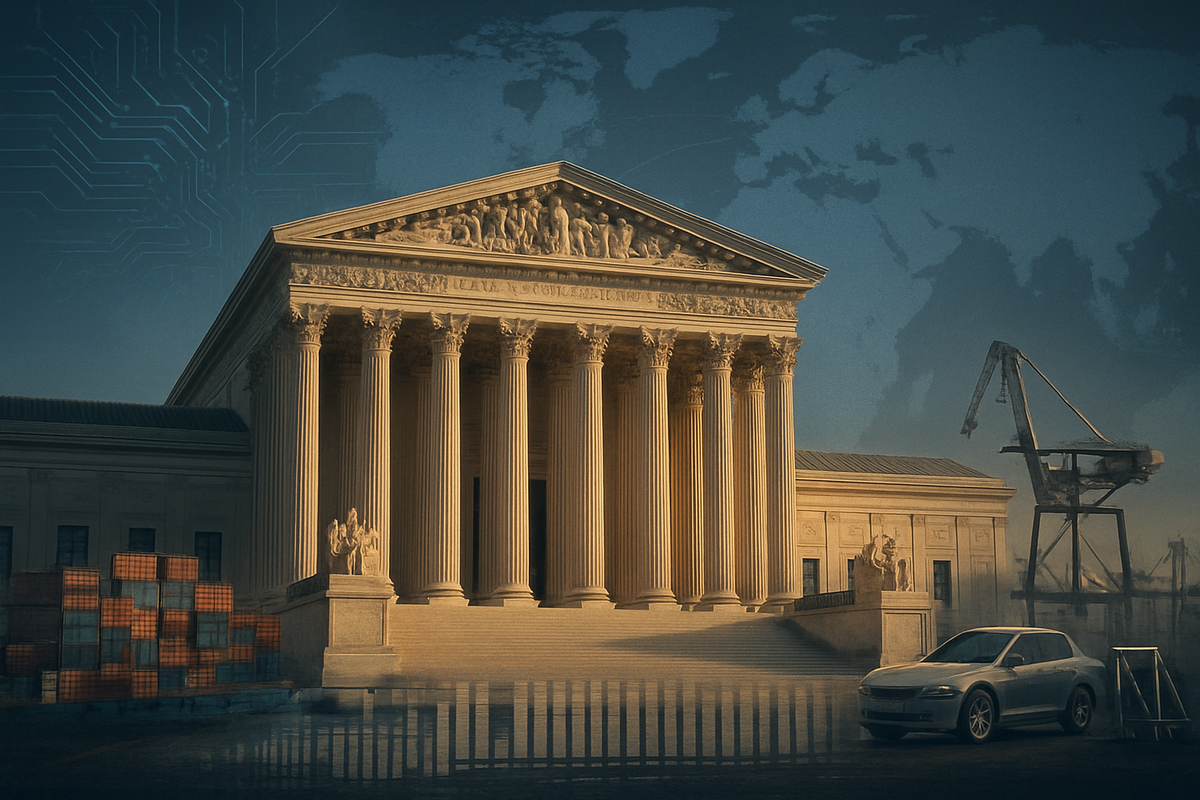
As the calendar turns to early February 2026, the global financial community is fixated on 1 First Street NE, Washington, D.C. The Supreme Court of the United States is expected to issue a final ruling in Learning Resources, Inc. v. Trump, a consolidated case that challenges the legality of unilateral presidential tariffs imposed under the International Emergency Economic Powers Act (IEEPA). With tens of billions of dollars in duty refunds hanging in the balance and the future of American trade policy at a crossroads, sectors ranging from consumer electronics to heavy manufacturing are preparing for what could be the most significant market-moving judicial decision of the decade.
The outcome of this case will determine whether the executive branch has the constitutional authority to bypass Congress and impose "reciprocal" or "universal" tariffs based on broad declarations of national emergency. For companies like Apple Inc. (NASDAQ: AAPL) and Walmart Inc. (NYSE: WMT), which have spent the last several years navigating a high-tariff environment, the ruling represents more than just a legal formality; it is a fundamental shift that could either restore billions to their balance sheets or solidify a new era of permanent trade protectionism.
The Legal Siege: IEEPA and the Battle Over the Purse Strings
The road to the Supreme Court began in earnest in late 2024, following a series of aggressive executive actions that utilized the IEEPA of 1977 to levy tariffs on a wide array of imported goods. While the IEEPA allows the President to "regulate" or "prohibit" transactions during an emergency, the lead plaintiff, Learning Resources, Inc., argued that the statute does not explicitly grant the power to "tax" or "impose duties"—a power historically reserved for Congress under the Taxing and Spending Clause.
Oral arguments, heard on November 5, 2025, revealed a court deeply skeptical of the executive's expansive interpretation of trade statutes. The plaintiffs argued that the administration’s use of tariffs to combat trade deficits and social issues (such as the fentanyl crisis) lacked a "rational connection" to the economic measures imposed. Lower courts, including the U.S. Court of International Trade, had already ruled the tariffs illegal in 2025, prompting the current administration to appeal to the highest court. The market's anxiety is fueled by the fear that a ruling against the government could trigger a chaotic "substitution mechanism," where the executive branch simply re-labels the same tariffs under different authorities like Section 232 (National Security) or Section 301 (Unfair Trade Practices).
Winners and Losers: A $133 Billion Pendulum
The stakes for specific public companies are immense. Walmart Inc. (NYSE: WMT) and other major retailers have been "front-loading" inventory for months to mitigate the impact of the 10% "universal" tariff currently in place. If the Supreme Court rules the tariffs unconstitutional, Walmart could be among the first to benefit from a massive pool of approximately $133.5 billion in duty refunds currently held in escrow by U.S. Customs and Border Protection. Analysts suggest that a favorable ruling could provide an immediate one-time earnings-per-share (EPS) boost for the retail giant, which has filed thousands of protective cases to preserve its right to these refunds.
In the tech sector, Apple Inc. (NASDAQ: AAPL) remains highly exposed due to its continued reliance on Chinese manufacturing for the iPhone and Mac lines. Current cumulative tariffs on products from China have reached as high as 65%, with analysts estimating a 9% hit to Apple’s gross margins. While a SCOTUS victory for importers would provide relief, the threat of a "substitution strategy" remains. Meanwhile, Nvidia Corporation (NASDAQ: NVDA) is navigating a more complex landscape; while tariffs on advanced semiconductors under Section 232 remain in place, a broader ruling against executive overreach could limit the administration's ability to impose new "revenue-sharing" licenses on AI chip exports.
On the other side of the coin, domestic manufacturers like United States Steel Corporation (NYSE: X) and some segments of Tesla, Inc. (NASDAQ: TSLA) have occasionally benefited from the protectionist umbrella. However, even Tesla has warned in its recent January 2026 earnings call that the rising cost of "compute and flash products" due to retaliatory tariffs is beginning to weigh on its AI-driven robotics and "RoboTaxi" initiatives.
The "Major Questions" and the Future of Trade Policy
The wider significance of this case lies in the application of the "Major Questions Doctrine"—a legal principle that says if an agency (or the President) wants to decide an issue of vast economic or political significance, it must have clear permission from Congress. If the Court rules that the President cannot unilaterally impose tariffs via IEEPA, it would effectively strip the executive branch of its most potent trade weapon. This would force a return to the pre-2016 status quo where trade policy was largely dictated by long-term treaties and congressional legislation.
This shift would likely create a "regulatory vacuum" in the short term. Competitors in the European Union and Southeast Asia are watching the case closely, as a rollback of U.S. tariffs could lead to a massive reshuffling of global supply chains. However, if the Court affirms the executive's power, it would establish a precedent for "permanent emergency" trade management, where the President could theoretically adjust the cost of any imported good at a moment's notice, adding a permanent layer of volatility to international commerce.
Strategic Pivots: Navigating the Post-Ruling Landscape
Regardless of the verdict, the corporate world has already begun its strategic pivot. Many firms are moving away from "Just-in-Time" manufacturing toward a "Just-in-Case" model, maintaining higher inventory levels to buffer against sudden policy shifts. If the tariffs are struck down, we expect to see a surge in "near-shoring" to countries with established free-trade agreements, as companies look to lock in long-term stability rather than gambling on the whims of executive orders.
In the event of a government loss, investors should watch for an immediate flurry of activity from the Department of Commerce. The "Substitution Mechanism" is already in the works, with the administration having prepared Section 232 national security proclamations for advanced logic chips and medium-duty vehicles as a "Plan B." This would mean that while the legal basis for the tariffs changes, the economic reality for companies like General Motors Company (NYSE: GM) and Ford Motor Company (NYSE: F) might remain largely unchanged, potentially leading to a "sell the news" event for stocks that rally on an initial headline of a SCOTUS tariff strike-down.
The Final Verdict: What Investors Must Watch
As we wait for the Supreme Court to release its opinion, the market remains in a state of "contained volatility." The key takeaways for the coming months will be the specifics of the Court’s language—whether they issue a narrow ruling on IEEPA or a broad rebuke of the nondelegation of taxing powers.
Investors should keep a close eye on the "Duty Refund Escrow" accounts and any guidance from the Treasury Department on the timeline for disbursements. Furthermore, the expiration of temporary trade deals with China in late 2026 adds another layer of urgency to this ruling. Ultimately, the Learning Resources case is not just about the price of toys or iPhones; it is a defining moment for the balance of power in Washington and the predictability of the American market moving forward.
This content is intended for informational purposes only and is not financial advice.