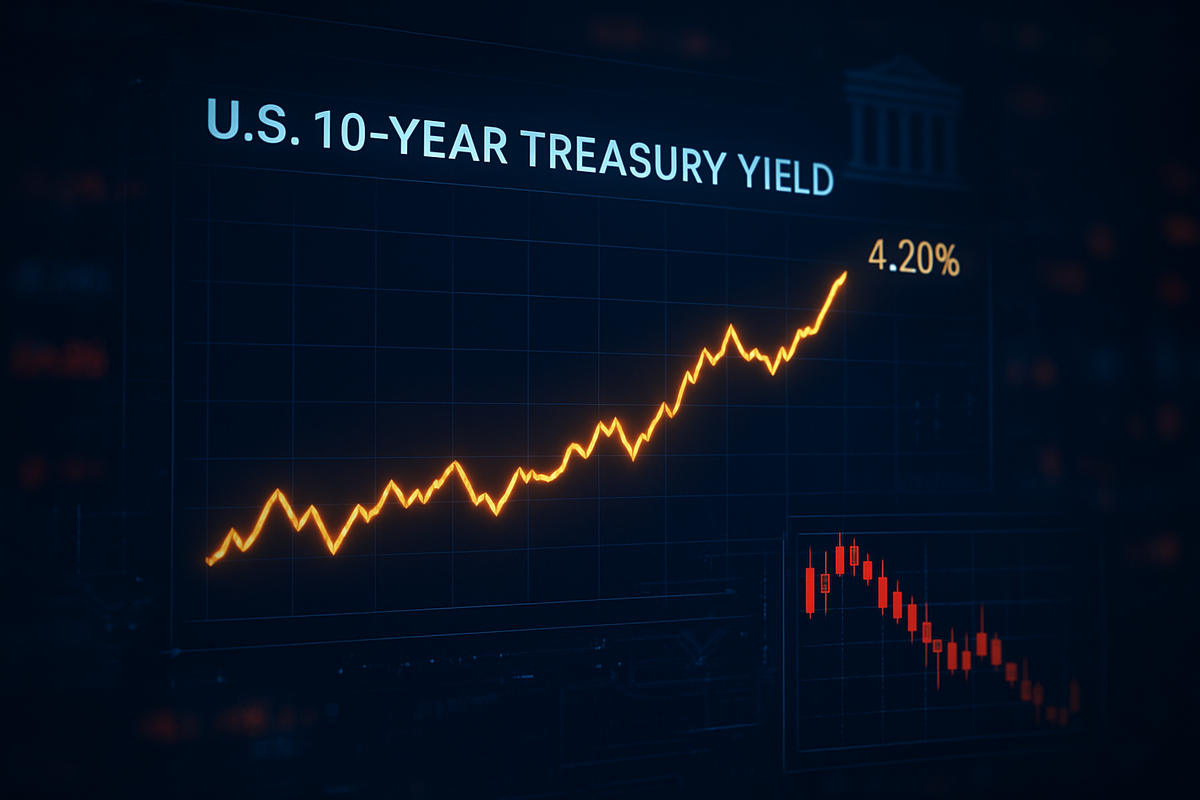
The era of easy-money optimism faced a stark reality check this week as the benchmark U.S. 10-year Treasury yield surged past the critical 4.20% technical resistance level, reaching heights not seen since the volatility of late 2024. This breakout, which saw yields climb as high as 4.29% by early February 2026, has sent shockwaves through the equity markets, forcing a painful repricing of growth assets and casting a long shadow over the Federal Reserve’s anticipated easing cycle.
The move comes on the heels of the January 2026 Federal Open Market Committee (FOMC) meeting, where policymakers opted for a "hawkish hold," maintaining the federal funds rate at 3.50% to 3.75%. This decision, combined with the nomination of Kevin Warsh to succeed Jerome Powell as Fed Chair later this year, has effectively reset market expectations. Investors who were betting on a swift return to low rates are now grappling with a "higher-for-longer" reality that is particularly punishing for companies with long-duration cash flows and those yet to turn a profit.
A Technical Breakout Driven by Economic Resilience and Policy Pivots
The breach of the 4.20% level was not a sudden fluke but the culmination of several weeks of building pressure. In late January, the U.S. Treasury market began pricing in a more robust economic outlook than previously forecast. Data released in the final week of the month showed Q4 2025 GDP growth at a surprising 4.4%, while unemployment remained anchored at a healthy 4.4%. These figures stripped away the "recession hedge" that had kept yields suppressed throughout much of 2025.
The catalyst that ultimately tipped the scales was the January 27-28 FOMC meeting. While the Fed kept rates steady, the tone was far more cautious than the market expected. Chair Jerome Powell highlighted that while inflation has moderated to 2.7%, it remains stubbornly above the 2.0% target. The meeting was also notable for its internal division, with two governors—Stephen Miran and Christopher Waller—dissenting in favor of a cut. However, the majority’s "wait and see" approach, coupled with the White House’s nomination of Kevin Warsh, signaled a transition toward a more hawkish leadership. Warsh is widely viewed by the bond market as a policy hawk who may prioritize price stability over liquidity, prompting a rapid sell-off in long-dated Treasuries.
Growth Stocks Under the Microscope as Valuations Compress
The sudden spike in the "risk-free" rate has hit the technology sector with surgical precision. Non-profitable tech stocks and high-growth innovators, often grouped within the ARK Innovation ETF (NYSEARCA:ARKK), have seen their valuations compressed as the discount rate used to value future earnings rises. ARKK, which has struggled to reclaim its post-pandemic glory, found itself back in a defensive crouch as investors rotated out of "moonshot" bets and into cash-flow-positive value plays.
Even the titans of the industry have not been immune to the yield surge. Alphabet Inc. (NASDAQ: GOOGL) and Microsoft Corp. (NASDAQ: MSFT) have faced renewed scrutiny over their massive capital expenditures. With Alphabet projecting an AI-related spend of up to $185 billion for 2026, the rising cost of capital makes these astronomical investments harder for the street to digest. If the 10-year yield remains above 4.20%, the hurdle rate for these projects increases, potentially leading to a re-evaluation of the AI "arms race" that has fueled the Nasdaq's gains over the past year. Conversely, large-cap financial institutions and traditional "value" sectors are seeing some relief as higher rates improve net interest margins, provided the economy avoids a hard landing.
Broader Implications: The $1.8 Trillion Debt Wall and Trade Tensions
This yield breakout is occurring at a sensitive time for the broader corporate landscape. U.S. companies are facing a looming $1.8 trillion "debt wall"—a massive amount of corporate bonds set to mature in 2026. For years, these firms enjoyed ultra-low interest rates; now, they face the prospect of refinancing that debt at yields that are double or triple their previous levels. A 10-year Treasury yield consistently above 4.20% significantly raises the floor for corporate borrowing costs, which could lead to a wave of credit downgrades or a slowdown in business investment.
Furthermore, the rise in yields is intersecting with a shift in trade policy. Fears of "cost-push" inflation are being stoked by potential 10% to 25% tariffs on goods from Europe and Canada. If these tariffs are enacted, they could serve as a secondary inflationary impulse, forcing the Fed to keep rates elevated even if the labor market begins to cool. This "inflationary tail" is exactly what the bond market is currently pricing in, as the 10-year yield acts as a barometer for long-term inflation expectations. The historical comparison to the "taper tantrum" of years past is becoming more relevant, as the market realizes that the path back to 2% inflation may be more arduous than anticipated.
The Path Forward: Watching the Data and the Fed Transition
In the short term, all eyes remain on the February inflation prints and the labor market's resilience. If job growth remains robust while inflation stays sticky, the 10-year yield could easily test the 4.50% mark, further punishing growth stocks and highly leveraged companies. Investors should watch for any signs of a strategic pivot from the "Magnificent Seven" companies, as they may be forced to prioritize stock buybacks or dividends over speculative AI R&D to maintain investor interest in a high-yield environment.
Longer term, the transition of leadership at the Federal Reserve will be the dominant narrative. As Kevin Warsh prepares for his potential confirmation, his public statements will be scrutinized for clues on how he intends to manage the balance sheet and the "dot plot." The market is currently in a "price discovery" phase, attempting to find the new neutral rate in an economy that refuses to slow down despite the most aggressive tightening cycle in decades.
Summary and Investor Takeaways
The technical breakout of the 10-year Treasury yield above 4.20% marks a significant turning point for the 2026 market. It signals that the "Goldilocks" scenario of falling inflation and imminent rate cuts may have been premature. For investors, the takeaway is clear: the cost of capital is staying higher for longer, and the "growth at any price" model is being replaced by a focus on profitability and balance sheet strength.
Moving forward, the primary risks to monitor are the refinancing pressures on mid-cap companies and the potential for a "policy error" if the Fed remains too restrictive for too long. However, if the economy can continue to support 4%+ GDP growth alongside these rates, the market may eventually find a new equilibrium. For now, caution is the watchword as the bond market asserts its dominance over equity valuations.
This content is intended for informational purposes only and is not financial advice.